





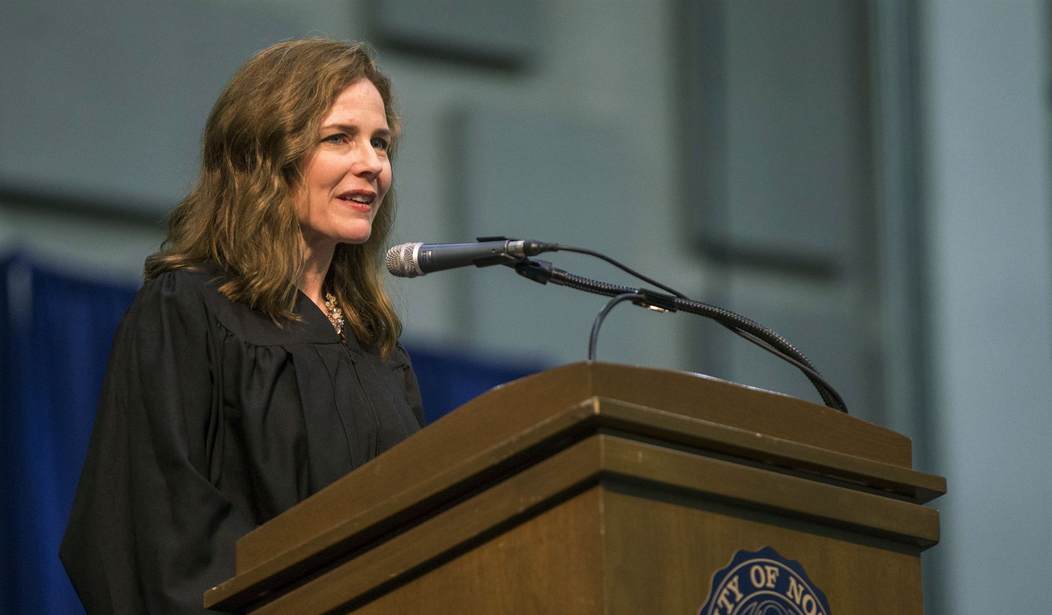
Back in February of 2016, Amy Coney Barrett did an interview with CBS about filling Supreme Court vacancies. The interview was done shortly after Justice Antonin Scalia passed away and Democrats were pushing for Judge Merrick Garland to be confirmed.
Democrats sliced the clip to make it sound as though Barrett was against filling a vacancy during a presidential election year:
Here is Judge Amy Coney Barrett explaining why it’s wrong to fill a SCOTUS vacancy during a presidential election year. pic.twitter.com/a5H09OmgsX
— Gavin Newsom (@GavinNewsom) September 26, 2020
Even the Washington Post concluded that what she was saying was taken out of context. Barrett was explaining that filling Scalia's seat should wait until after the election because there was a divided government (President Obama in the White House and Republicans controlled the Senate). In other words, Republicans wouldn't agree to Garland's confirmation because it was someone Obama put forth.
The argument Barrett made was simple: replacing Scalia, the Court's staunch conservative, with a progressive justice isn't a unilateral move. It changes the court's makeup. And that's what people took issue with.
From WaPo (emphasis mine):
But the full context of Barrett’s remarks make clear she was saying no such thing. In fact, she was explicitly making a point about how rare such a scenario would be in divided government — a situation we don’t have today, with a president and Senate controlled by the same party.
Coney noted that the only recent example of a Senate controlled by the opposite party confirming a president’s nominee in a presidential election year was Anthony M. Kennedy — a Ronald Reagan appointee whom the Democratic-controlled Senate confirmed in early 1988. That vacancy was different from what was happening in 2016, she noted, because it actually came about in 1987, and the Democratic Senate was replacing a moderate Republican appointee (Lewis F. Powell Jr.) with a moderate Republican appointee.
“We’re talking about Justice Scalia, the staunchest conservative on the court, and we’re talking about him being replaced by someone who could dramatically flip the balance of power in the court,” Barrett said. “It’s not a lateral move.”
That’s not taking a position on what’s appropriate; it’s merely summarizing what happened. But beyond that, she was explicitly talking about divided government, which doesn’t apply in 2020.
“The question is what does this precedent establish, and I don’t think it establishes a rule for either side in the debate,” Barrett said. “If you look back at, say, the six [justices] that were confirmed in the 20th century in a presidential election year, all but one of those was confirmed … in a period of united government, where the president and the Senate were the same political party.”
Barrett noted that setup meant that it “shouldn’t be a surprise” that those justices were confirmed, but then raised Kennedy as the exception.
Barrett added, crucially: “The president has the power to nominate, and I don’t think either one of them can claim that there’s a rule governing one way or another.”
That would seem the most operative quote today.
Below is the full interview:


Join the Conversation
VIP members get the ability to comment on articles.