





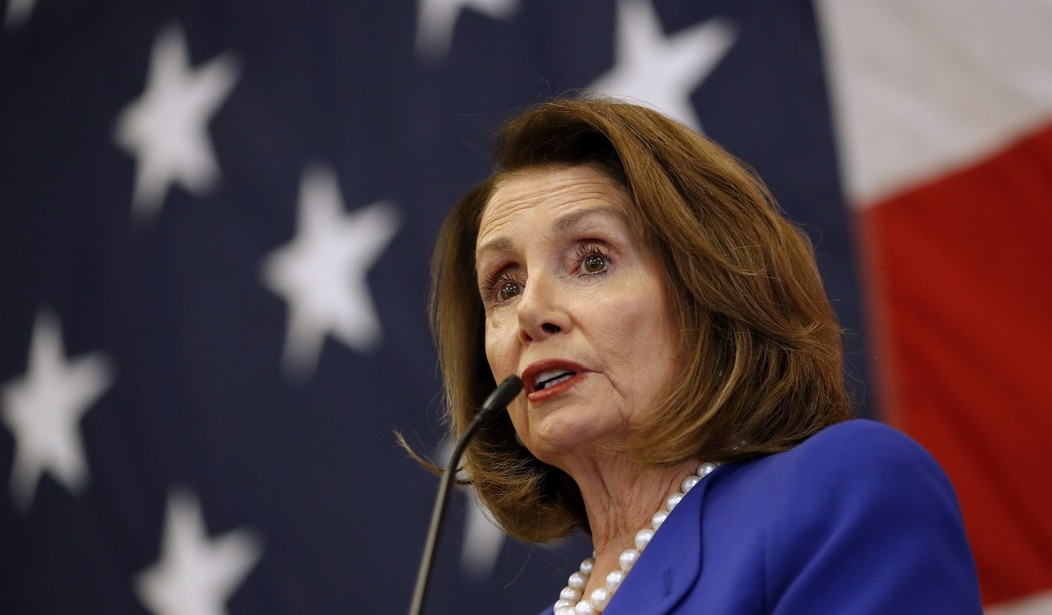
House Minority Leader Nancy Pelosi (D-CA) attempted to downplay the phenomenal unemployment rate under the Trump administration, 3.8 percent, the lowest rate since April 2000. At her weekly press conference Thursday, Pelosi claimed that wages have been stagnant and that Democrats can offer an even better deal than these record numbers.
She told reporters that "the unemployment rate is down, but the dependence on subsidies, food insecurity, housing subsidies, and the rest, has not gone down because of the wage stagnation."
“This isn’t just about the unemployment rate, it’s about wages rising in our country so that consumer confidence is restored,” she said. “Because our economy will never fully reach its possibilities unless we increase the consumer confidence and that can only be increased by a better deal, better jobs, better wages, better future."
She claimed that "unless we have an increase, a very significant increase in wages, bigger paychecks, we are going to increase the frustration of America’s families because they’ll be saying: Hip, hip hooray, unemployment is down! What does that mean to me in my life? I need a bigger paycheck.”
Pelosi concluded that it’s not just about increasing jobs but about “justice.”
“When we’re talking about this, it’s not to increase more jobs so that we can subsidize more low-paying jobs by public investment and housing support and food support and the list goes on,” she said, “but to have living wages for people, justice, economic justice, social justice. Justice, it’s a very important value that America has.”
Wages are not stagnant, growing 2.7 percent in May compared with last year. However, wage growth has been slow especially given the low unemployment rate.
The Washington Post noted Tuesday that “wage growth is still hovering around 2.6 to 2.8 percent, which is barely above inflation.”
Recommended
However, they add that “there’s optimism that Americans will finally get wage growth over 3 percent later this year. There are many signs that companies can’t find enough workers and are finally willing to pay more to get (and keep) employees.”
Pelosi’s claims about wage stagnation stand in stark contrast to comments from Ivanka Trump and House Speaker Paul Ryan, who both touted recent wage growth earlier this week.
“Unemployment is at 3.8 percent,” Ryan told reporters Wednesday, “3.8 percent rate is the lowest unemployment rate in half a century. Wages are growing too. The wage growth is truly impressive.”
Ivanka Trump tweeted Wednesday that wages are “rising.”
For the FIRST time since record-keeping began, the U.S. has MORE job openings than unemployed workers. Wages are rising and people are being drawn back in to the workforce from the sidelines. ????
— Ivanka Trump (@IvankaTrump) June 6, 2018
CNN Money noted that “wage growth has picked up in recent months,” but that “economists have been puzzled for a long time about why pay isn't climbing faster.”
“In a job market this tight, employers are typically forced to pay much more to attract workers,” they explained. “In 2000, the last time unemployment was this low, wages grew at a pace of about 4%.”
They offered some possible explanations for the slow wage growth.
“Productivity and inflation are lower than in previous periods of growth, and economists believe that has kept a lid on wages,” they noted. “The erosion of workers' bargaining power has also played a role. Another explanation: Employers are turning to new workers — such as younger people and those just re-entering the job market — to fill positions vacated by better-paid veteran workers who are either retiring or taking new positions elsewhere.”
CNN Money concluded that “economists are confident that wages will keep climbing as competition for workers grows.”
This is not the first time Pelosi has claimed that wages were stagnant under President Trump. In December, Politifact rated her claim that “Republicans have still failed to deliver on their promise of higher wages for working families,” as “mostly false.”
“The two best statistics for judging this assertion both show wage growth,” the fact checker concluded. “One of them, however, shows growth that’s barely above inflation, meaning that Americans wouldn’t necessarily keep any more of their income in their pocket.”








Join the conversation as a VIP Member