
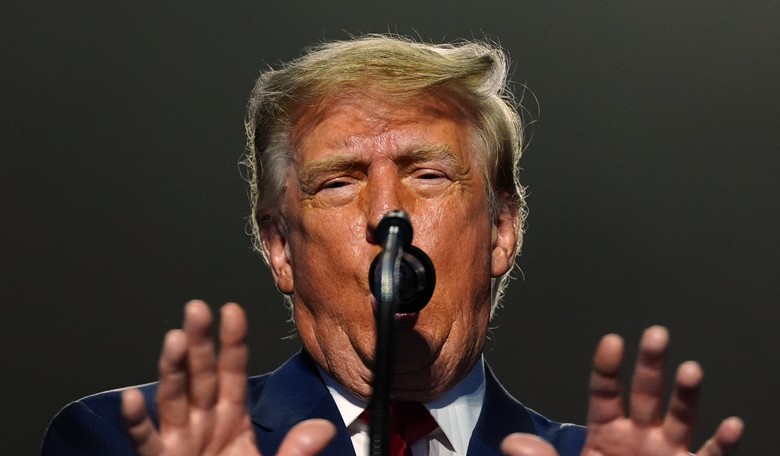
Just hours after Jensen Huang was reinstated as CEO of NVIDIA on Monday, President Trump said that the investigation into Huang's potential criminal liability over export controls has cleared the CEO himself of any wrongdoing.
Speaking on CNBC's "Squawk Box," Trump explained that Huang has remained within the confines of U.S. export control laws, and can sell older, less advanced chips abroad, but not the more advanced Blackwell chips. He seemed to say that if Huang sold chips legally, and the buyer then sold them to someone else, that does not make Huang guilty of anything. He went on to add that the greater national security threat would be losing Huang as head of NVIDIA.
President Trump says the Attorney General's investigation found Jensen Huang "himself was exonerated" on the Nvidia export controls issue, explaining that if Huang "sells them to somebody else and they go out and sell, that's a problem that they may have into the future." CNBC: “What did the Attorney General tell you, sir, about the potential criminal liability and overhang for Jensen Huang and the export controls issue?” President Trump: “Well, they did a study. They did a pretty good investigation, and they felt that he himself was exonerated. I don't know what word you want to use. He's in the business of selling chips. Now, he sells chips that are older, you know, the 200, I guess, he was allowed to do. The 200s and older, you know, it's sort of semi-obsolete, not even a big market for it. But the Blackwell and the various other things, he wouldn't be allowed to do. But he is in the business of selling chips, and if he sells them to somebody else and they go out and sell, that's a problem that they may have into the future. Who knows?”
— RedWave Press (@RedWavePress) November 23, 2026
"What did the Attorney General tell you, sir, about the potential criminal liability and overhang for Jensen Wang and the export controls issue?" CNBC asked.
"Well, they did a study. They did a pretty good investigation, and they felt that he himself was exonerated," President Trump said. "I don't know what word you want to use. He's in the business of selling chips. Now, he sells chips that are older, you know, the 200, I guess, he was allowed to do. The 200s and older, you know, it's sort of semi-obsolete. Not even a big market for it. But the Blackwell and the various other things, he wouldn't be allowed to do. But he is in the business of selling chips, and if he sells them to somebody else and they go out and sell, that's a problem that they may have into the future."
When asked whether the newly reinstated CEO poses a risk to national security, the president replied that "the bigger threat would be losing the brainpower of somebody like Jensen."
President Trump SHUTS DOWN CNBC over Jensen Huang national security concerns, saying “the bigger threat would be losing the brainpower of somebody like Jensen.” CNBC: “And are you confident that [Jensen Huang] doesn't represent the national security threat? We saw this reporting in the New York Times that Jensen Huang’s paramour, I guess you'd call her, Alice Huang, was in contact with an MSS officer at the time she was having the affair with Jensen. So does that not raise national security threat questions in your mind?” President Trump: “Well, who isn't in contact? I just left China. I had a great summit… and it was at the top of the line. Nobody's ever seen anything like it. The president respects our country greatly. Again, he didn't respect it two years ago, I can tell you that. Then he met me at the plane, which is something they've never done, which was a sign. And we're doing very well, and our country is doing very well. And as far as a threat is concerned, I think probably China speaks to everybody. They speak to me, they speak to everybody. That doesn't make them bad. But I can tell you, the bigger threat would be losing the brainpower of somebody like Jensen. That would be a threat. To me, that would be a far bigger threat than anything we're talking about.”
— RedWave Press (@RedWavePress) November 23, 2026
While some have been quick to argue that Huang is a national security risk, two points are worth considering.
First, all we know for certain is that Huang was a target of Chinese Communist Party intelligence operations. There is currently no evidence that he leaked any secrets or gave suspected Chinese companies preferential treatment as a result of his affair. That is for an ongoing and thorough DOJ investigation to discover.
Second, when it comes to selling chips to likely CCP shell companies in Singapore and elsewhere in Asia, Huang has a single job: to sell chips. Protecting national security is the government's job, and handing it to a private citizen would let him decide what counts as a threat. So if you're worried about national security, ask why the Commerce Secretary decided to delay blacklisting Megaspeed, the company where the alleged Chinese spy was working. Huang is certainly easier to blame, but we cannot pretend that he is solely responsible.
This comes as President Trump cast doubt last week on whether Alyssa Huang was a Chinese spy at all.
🚨 JUST NOW: President Trump reveals he NEVER got confirmation in his reports that Alice Huang — Jensen Huang's affair — was a "Chinese spy" "I get reports on a daily basis it was a woman, it was a pretty woman, and any pretty woman that comes from China, they considered her to be a spy!" The spy claim first came from a New York Times report citing anonymous people briefed on U.S. intelligence Nvidia's own board said it had NO REASON to believe company secrets or national security were compromised Elon AND Trump now believe Nvidia made a poor move in ousting Jensen.
— Eric Daugherty (@EricLDaugh) November 19, 2026
Jensen Huang is expected to testify before Congress in the first week of December.