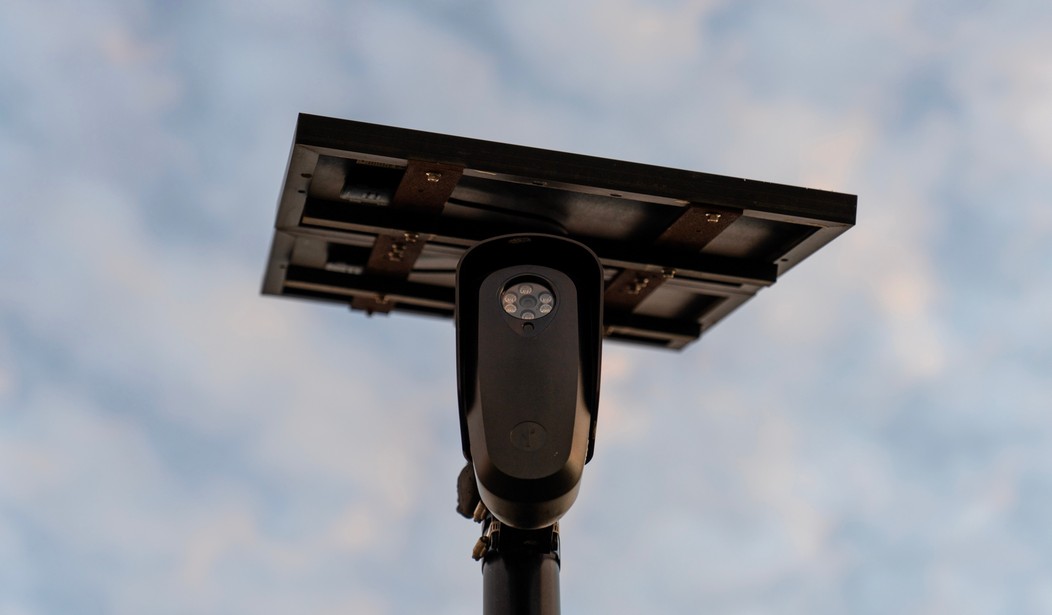

Flock cameras, alongside the construction of new AI data centers, are quickly becoming issues set to blindside both Democrats and Republicans. While the research on data centers falls decisively on the side of construction and expansion, Flock cameras are far less simple, and far more divisive.
Conservatives, in particular, have raised concerns about the creation of a 1984-esque, Big Brother surveillance state and the potential for violation of Americans’ right to privacy. This article will seek to steel man the case for automated license-plate readers, despite those concerns.
First and foremost, it is important to explain what Flock cameras do, and, more importantly, what they do not do. Of the more than 120,000 cameras deployed across the country, operating in over 5,000 U.S. communities and used by more than 4,800 law-enforcement agencies, the devices photograph passing vehicles and store that information in a database.
The key distinction is that Flock cameras track license plates and vehicles, not the identities of the people behind the wheel. They capture a vehicle’s license plate, make, model, color, and any distinguishing features, including bumper stickers, custom colors, or visible damage. Flock then temporarily stores the collected information on behalf of its customers, typically for 30 days, though retention periods can vary.
Flock cameras have already produced tangible public-safety benefits despite widespread opposition. According to Flock, its surveillance network helped solve more than 700,000 crimes across the United States in 2023, roughly 10 percent of all reported crimes nationwide. In more recent figures, the company says its cameras have supported the resolution of nearly one million cases and helped locate more than 10,000 missing people.
Of course, Flock’s own claims should not be accepted without question, but most research on the technology is often clouded by the intense political bias surrounding it. Still, one American political scientist has credited Flock with contributing to the steep decline in crime since 2020, particularly when it comes to auto theft, a crime Flock cameras are uniquely positioned to deter and solve. Vehicle theft reportedly fell by 50 percent between 2023 and 2026, after the system began achieving widespread deployment in 2022.
The key concern, however, centralizes on one issue: privacy.
Rafael A. Mangual, a senior fellow and head of research for policing and public safety at the Manhattan Institute, argues that the privacy case against Flock cameras is ultimately unconvincing. Americans have no constitutional right not to be photographed in a public place. Flock cameras, therefore, do not violate constitutional rights merely by recording what is already visible in plain view, something police officers have always been permitted to observe without a warrant.
Mangual further argues that if automatic license-plate readers were truly as corrosive to liberty as critics claim, the harm would have become apparent during the nearly two decades such systems have been in use. The New York Police Department, for example, has used automatic license plate reader technology since 2006. Yet no major constitutional dispute has emerged from New York City. Instead cases have centered on gun rights, voting rules, and labor law, not the roughly 250 license-plate readers that were deployed throughout the city. If there was any convincing constitutional case against them, why have none been brought against the cameras over the last 20 years?
Another reason to view Flock cameras in a more favorable light is that Flock is a private company, not a government agency, and is therefore subject to the naturally constraining framework of a free market.
That makes Flock subject to competition from companies that may offer stronger privacy protections. Cities can also negotiate contracts that limit how the technology is used, how long data is retained, and which agencies can access it. Unlike a surveillance system built and operated entirely by government, Flock must even earn and retain public support if it wants to remain in business. As jurisdictions around the country consider blocking or restricting the cameras, the company has an incentive to respond to public concerns and the demands of local governments. But that only works if citizens remain engaged, paying close attention to the contracts, safeguards, and decisions being made by their local officials.
Abuses have occurred. Some police officers have reportedly used Flock cameras to stalk women. But that is not a feature of the technology itself; it is misconduct by individual officers abusing access to the system.
The appropriate response is to build meaningful accountability mechanisms within law-enforcement agencies. Requiring officers to document and log the reason for every Flock-system search, for example, would create an audit trail and make improper use easier to detect and punish. Those safeguards must ultimately be enforced by the agencies that grant officers access, not by Flock itself.
By no means does the case for Flock cameras settle the debate.
A quote from Benjamin Franklin seems especially relevant, that “Those who would give up essential Liberty, to purchase a little temporary Safety, deserve neither Liberty nor Safety.”
The real question, however, is what liberty is actually being surrendered, and whether the benefits Flock cameras provide can fairly be dismissed as merely “a little temporary safety.”
Editor's Note: Do you enjoy Townhall's conservative reporting that takes on the radical Left and woke media? Support our work so that we can continue to bring you the truth.
Join Townhall VIP and use promo code FIGHT to receive 60% off your membership.