







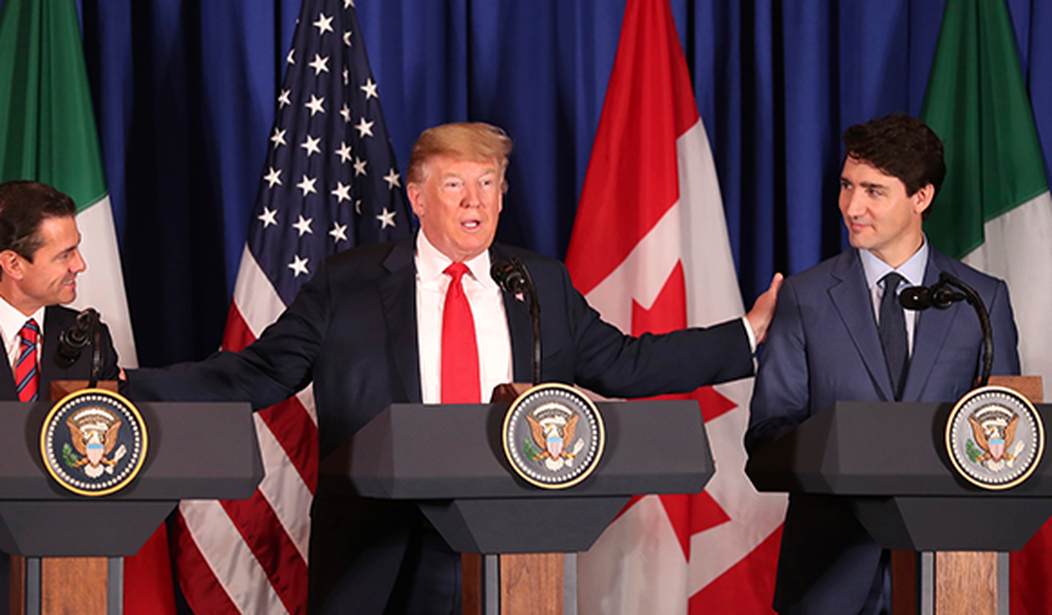
After spending months complaining about the disparity between the United States and other nations' duties, along with the unfair treatment of U.S. exporters, President Trump is once again threatening to pull the plug on one of the best tariff-equalizing deals ever made: the North American Free Trade Agreement. As always, his allies argue that this is a brilliant negotiating strategy to force the Democrats to adopt his new NAFTA. I don't know if that strategy will succeed, but it's incredibly inconsistent with his stated goal of wanting lower and reciprocal tariffs on U.S. exports.
A quick reminder of how we got here: From day one in the White House, the president has declared his intention to pull out of NAFTA. He has claimed many times that the 1994 deal was the worst deal ever agreed to by the United States. He used this threat of withdrawal to extract a new deal with Canada and Mexico called the United States-Mexico-Canada Agreement (USMCA), a deal he modestly labeled "the most important trade deal we've ever made by far."
This statement, however, should be taken with a grain of salt. In fact, while the USMCA includes some needed modernization to the 25-year-old NAFTA and delivers a sliver of trade liberalization in a few areas, on net it's more protectionist than NAFTA, due to punishing new "rules of origin" and high minimum-wage requirements. But no matter how imperfect the agreement is, it may ease the fear of a NAFTA withdrawal -- for now, at least.
With the Democrats regaining a majority in the House, the future of the USMCA is somewhat in limbo. As a result, the president is in full attack mode. He announced last weekend, "I will be formally terminating NAFTA shortly. ... And so Congress will have a choice of the USMBCA or pre-NAFTA, which worked very well."
I fail to see what leverage the president believes he has against the Democrats. For one thing, they have always largely opposed free trade in general. I doubt that moving away from trade liberalization will be a big problem for them. Besides, since Trump's election, the Democrats' strategy has consisted of opposing him at every turn. With this ultimatum, Trump is giving them a golden opportunity to do just that. The cherry on top is that he will likely be blamed for the economic downfall that would inevitably follow the end of NAFTA.
I also fail to see how the president sees a return to the pre-NAFTA world as advancing his goal of reciprocity in trade duties. Under NAFTA, all U.S. exports going to Mexico are duty-free, as are non-agricultural U.S. exports to Canada. Even in spite of the Canadians' high dairy duty, 97 percent of U.S. agricultural exports go to our neighbor to the north duty-free. In exchange, Mexico and Canada export their goods to us free of tariffs.
A withdrawal would shatter this balance. Not only will tariffs go up, hurting consumers and exporters in all three countries, but the tariffs would be highest on U.S. exports to Canada and Mexico. As my colleague Dan Griswold explained to me, "Without NAFTA, U.S. duties on imports would jump from virtually zero to an average of 2.3 percent on non-farm products and 3.8 percent on farm products. The corresponding average duties in Canada would jump to 2.3 and 12.4 percent, and in Mexico to 3.5 and 20.1 percent."
In other words, by his own standard, President Trump would make trade even more "unfair" to American exporters than it was when he came into office. But it gets worse. As it happens, Mexico is the king of free trade agreements. The country has some 40 agreements with other nations. Unlike Americans, exporters in these favored nations will face low duties when exporting to Mexico.
The bottom line is that if President Trump believes unfair trade is defined by other countries imposing higher tariffs on U.S. exporters than the U.S. imposes on them, he needs the current NAFTA in place in case the Democrats reject the USMCA. If he withdraws and the Democrats pull out of the USMCA, he will have done more to bring about unfair trade to U.S. exporters than anyone before him.

Join the Conversation
VIP members get the ability to comment on articles.