







It may be a prudent policy to always be polite to the police, but does that mean Americans must give up the right to be rude?
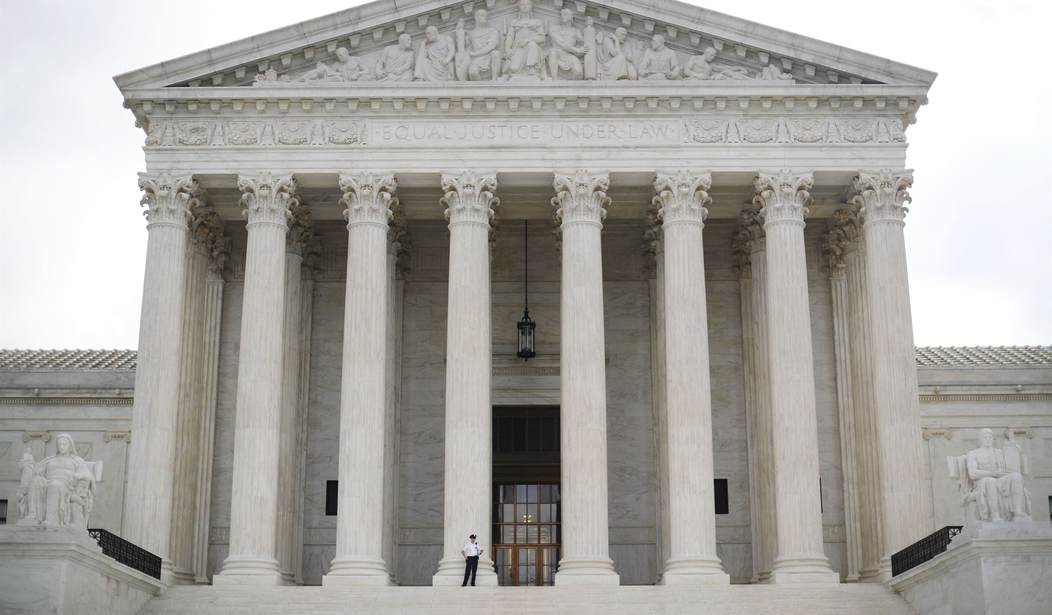
A question similar to this -- transcending it, in fact -- is now before the Supreme Court of the United States.
It started at an Alaskan event called "Arctic Man," where an individual engaged in two contentious conversations with two policemen. The second conversation ended with the policemen arresting the person, who, according to a petition filed in the Supreme Court by the attorney general of Alaska, "was charged with disorderly conduct and resisting arrest."
At issue now is not that state's laws forbidding disorderly conduct and resisting arrest but a federal law that permits individuals to bring suit against government officials who use government power to deprive them of a constitutional right.
As quoted in the Alaska attorney general petition, 42 U.S.C. 1983 says: "Any person who, under color of any statute, ordinance, regulation, custom, or usage, of any State or Territory or the District of Columbia, subjects, or causes to be subjected, any citizen of the United States or other person within the jurisdiction thereof to the deprivation of any rights, privileges, or immunities secured by the Constitution and laws, shall be liable to the party injured in an action at law, suit in equity, or other proper proceeding for redress."
No criminal case was brought against the man arrested at Arctic Man. "The prosecution later dismissed the case for budgetary reasons," said the attorney general petition.
But the person arrested did not dismiss the case. He brought a suit against the arresting officers in federal court alleging, among other things, that he is the victim of a "retaliatory arrest" because of his conversations with them.
The district court ruled that if there was probable cause against the individual, he could not bring suit for a retaliatory arrest.
"The court ruled," said the attorney general petition, "that the existence of probable cause also barred respondent's First Amendment retaliatory-arrest claim, noting that this Court 'has never recognized a First Amendment right to be free from a retaliatory arrest that is supported by probable cause.'"
The man appealed to the U.S. Court of Appeals for the 9th Circuit, which disagreed with the district court on this point. It held, according to the attorney general, "that the existence of probable cause for an arrest does not bar a plaintiff's claim that the arrest was retaliatory in violation of the First Amendment."
The police officers appealed to the Supreme Court.
"To maintain a damages claim for retaliatory arrest in violation of the First Amendment, a plaintiff must plead and prove the absence of probable cause for the arrest," the attorney general of Alaska argued to the Supreme Court on their behalf.
In other words, unless an American can prove that there was no probable cause for the police to arrest him for any crime whatsoever, the police can arrest him in retaliation for exercising his right to free speech.
The Rutherford Institute submitted a brief to the court rejecting the rule that Alaska wants.
"A probable-cause shield that makes it easier for police officers to arrest speakers in retaliation for speech that offends or upsets an officer would not only squash expressive disorder at the cost of individual freedom, but also silence debate on controversial issues of public concern," Rutherford said.
"That approach," it said, "would result in less protection for precisely the type of speech that needs protection most."
"Many Americans, though they may not know or intend it, break the law daily by committing crimes that go largely unrecognized, such as jaywalking, exceeding the speed limit, or failing to signal before making a turn," said Rutherford.
"Although these types of crimes may not often result in arrest, the fact remains that an officer possesses the authority to arrest someone whenever probable cause exists to believe that person committed any crime," said Rutherford. "That means that in almost any circumstance in which a person might publicly exercise First Amendment rights -- and potentially experience retaliation for that speech in the form of an arrest -- the arresting officer could likely identify some violation of the law, however trivial, and claim probable cause existed to justify the arrest."
"And," Rutherford concluded, "even if the arrest were motivated by the officer's animus toward the speaker and would not otherwise have occurred, the existence of probable cause would defeat the First Amendment claim outright under petitioners' proposed test."
Fifty years ago, who would have imagined that an American president (former President Obama) would stand behind a regulation requiring Catholic nuns to provide insurance for abortifacients -- or else pay ruinous fines? Who would have imagined that a president would take those nuns all the way to the Supreme Court, seeking the power to restrict their free exercise of religion by forcing them to act against the right to life?
Who doubts now that future American politicians could be just as aggressive in restricting freedom of speech?
Terence P. Jeffrey is the editor in chief of CNSnews.com.


Join the Conversation
VIP members get the ability to comment on articles.