







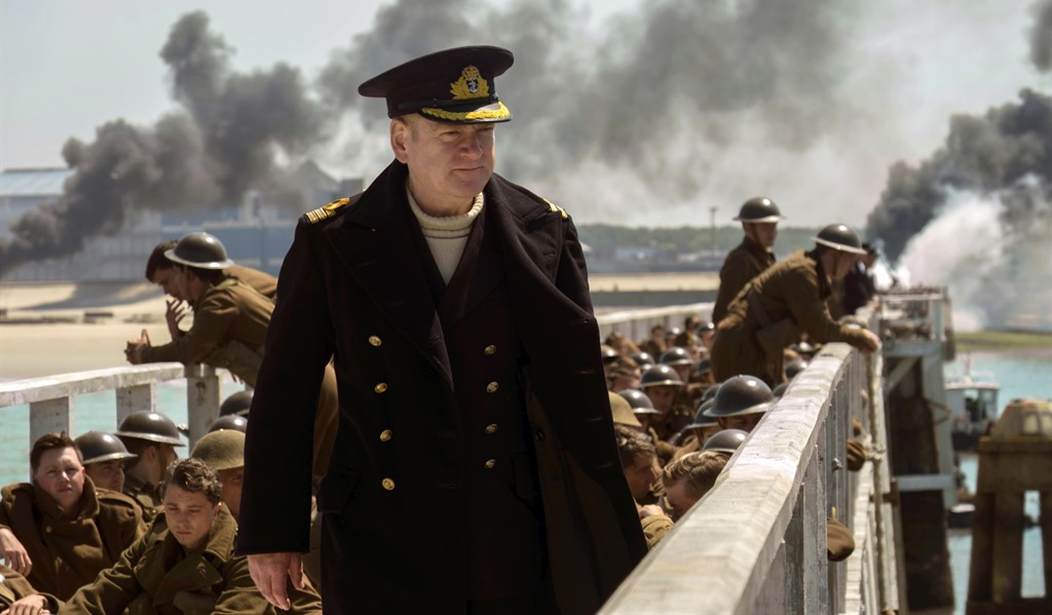
"Dunkirk" is the hit of summer, particularly with the millennials who may even absorb a modicum of history with the spectacle. The film is set in 1940, but it says something to the cultural sensibility of our time, depicting courage, imagination and grit against all odds in the British (and French) strategic retreat from Europe in the early days of World War II.
This version skimps on history and has a mesmerizing musical score that thumps so hard it's sometimes difficult to care whether it has anything to say. Because it's about men, and only men, feminists nit-pick it to death. Women only get to put the kettle on after the boys have had fun fleeing death on the beach. Dunkirk was no bikini beach party, and the ladies didn't miss anything.
But the retreat was one of the great triumphs of the war, and that comes across almost in spite of itself. In May 1940, the British and the French thought they would turn back the German blitzkrieg racing across Western Europe and were finally bottled up on the beaches of France. Dunkirk was months before Pearl Harbor and Hitler's declaration of war on the United States. It saved more than 338,000 British and French troops.
The evacuation of the beaches demonstrated individual bravery of soldiers and civilians alike. The English call the strategy of rescue "muddling through," and nobody does it better. Some historians think that if Dunkirk had been a catastrophe, then-Prime Minister Winston Churchill would have been toppled and replaced by a government seeking a passive peace with Germany, and German might be the language of Parliament today.
Critics love the movie, and Forbes Magazine reported on Aug. 29 that it has already earned $413 million globally and about $173 million in the United States. It's likely to receive multiple Academy Award nominations even though its stars, Kenneth Branagh and Mark Rylance, weren't given much to say. One critic calls it "classic silent cinema." Christopher Nolan directed 6,000 extras as if they were ants on a flattened anthill, fodder for war.
At times the movie seems almost a video game, with iconic Spitfires and Messerschmitts dueling for control over the beaches. And the famous flotilla of more than 800 "little ships" -- yachts, fishing trawlers, cockle carriers and paddle steamers -- is reduced to one gentleman and his pleasure craft. But he offers a persuasive reason for his participation. "Men my age dictate this war," he says. "Why should we not fight it?"
Pretentious themes of earth, air, fire and water with little human interest and the soldiers as helpless pawns reduce "Dunkirk" to the cliche "war is hell." But even in this telling, an audience experiences an extraordinary story of heroism in defeat, demonstrating how intelligent military strategy in the midst of chaos can inspire men running away to fight another day.
As Richard Brody writes in The New Yorker, the film may be the first virtual reality movie, where young audiences must fill in the blanks of the characters' inner lives with their own. There are no clues as to what the men on the beach feel. In this interpretation, the director is so in awe of the "the greatest generation" that he wants viewers to walk in their boots. But it's difficult to imagine the millennials in line to see this movie filling them.
It's hard to fathom why this "Dunkirk," with so little depth except of the water, is so popular. This is the second movie telling of the story -- a British-made version was released in 1958. Perhaps the current version, which breaks up history into fragments and does away with the historical narrative rooted in a real fight of good against evil, is more suited to their sensibilities. The enemy is never named. There's no Hitler, no Nazis (not even Robert E. Lee.)
In a visual age, pictures have primacy over words, and this "Dunkirk" testifies to history reduced to spectacle without specifics. Pity and fear are depersonalized, and it's all but impossible to feel that "there but for the grace of God go I." But words have more power than flashy visuals. Churchill is not in this film. The director did not want the story to get "bogged down" by the new prime minister.
For those curious enough to consult history, it was immediately after Dunkirk when Churchill gave the speech that ignited the spirit that preserved the British nation. "We shall defend our island, whatever the cost may be," he said the morning after with infectious defiance. "We shall fight on the beaches. We shall fight on the landing grounds. We shall fight in the fields and in the streets. We shall fight in the hills. We shall never surrender."


Join the Conversation
VIP members get the ability to comment on articles.