





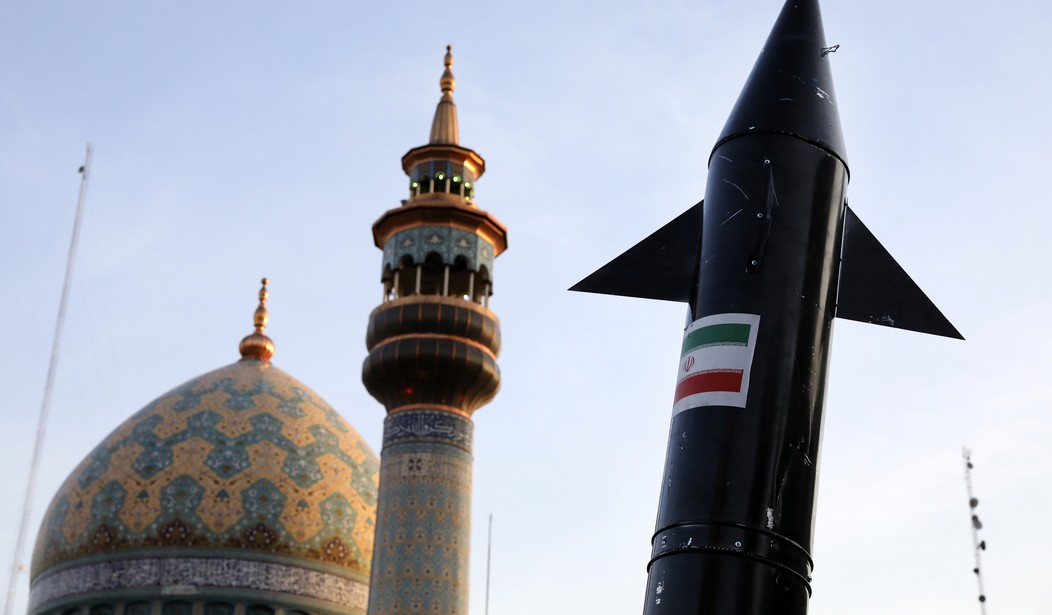
Facing a looming threat of military action by U.S. President Donald Trump and Israel’s Benjamin Netanyahu, Iran’s Islamic Revolutionary Guard Corps (IRGC) has ramped up its sabre rattling by unveiling a fleet of over 1,000 new vertical take-off and landing (VTOL) drones. Listed as a terrorist organization in both America and Canada, the IRGC’s aggressive posturing is being seen by Middle East experts as an attempt to bolster the Islamic Republic’s faltering hegemony in the region. Having witnessed the collapse of their main collaborator, Bashar al-Assad, in Syria, the decapitation of their proxy allies, Hamas and Hezbollah, by Israel, and the pummelling of the Houthis in Yemen by the US and the UK, the Iranian mullahs are now at their weakest point since they seized power in the 1979 revolution. On 26 October last year, an Israeli air strike on Iranian military sites, including air-defence batteries, a kamikaze drone factory, and missile production facilities, crippled the mullahs’ missile production capability and exposed the vulnerability of their air defence systems.
The unveiling of the new VTOL drones, at a military drone base in Zahedan, near the country's southeastern border, has come as a direct rejoinder to the theocratic regime’s unmasked military weakness, while at the same time promoting its growing position as a supplier of drones to the global market. Iranian bravado is hardly likely to have gone down well in the Pentagon or Tel Aviv. Indeed, there is growing consternation at the way Vladimir Putin has shored up the mullahs’ collapsing economy by purchasing thousands of Iranian drones for use in his illegal war in Ukraine. A massive Russian drone and missile strike on Kyiv on the night of Sunday, 25 May, involved 298 drones and 69 missiles, leaving many civilians dead and injured. The drones were primarily of Iranian origin.
Meanwhile, talks aimed at dismantling the Iranian regime’s nuclear programme, including ending all uranium enrichment, ending further weaponization and missile development, and severing links with Hamas, Hezbollah, the Houthis, and the Iraqi Shia militias, are grinding on. President Trump has made it clear that failure to comply will lead to military action against Iran’s nuclear sites, probably including U.S. air support for Israeli bombing strikes. To underline the seriousness of his threats, Trump has deployed six B-2 bunker-busting stealth bombers to Diego Garcia in the Indian Ocean. In panic, the mullahs are trying to string out diplomatic negotiations with the U.S., while simultaneously stage-managing meetings with the EU.
Iran’s state-controlled Press TV highlighted the three new drone designs, boasting they were based on captured U.S. drones—most notably the RQ-7 that crashed in 2005 and the RQ-170 it seized in 2011—as templates for developing its own unmanned aerial systems. Brigadier General Nozar Nemati, Deputy Commander of the Iranian Army's Ground Forces, stated: "It is because of these investments, planning, and persistence in research, as well as progress and development in such efficient and empowering fields that the Army's Ground Force is now recognized as a leading and pioneering force in employment and utilization of the capacity and power of new defense and military achievements."
The three types of drones, Homa, Dideban, and Shahin-1, were each shown to have different military capabilities. The Homa VTOL supports electronic warfare and reconnaissance, Dideban enables precision targeting, and Shahin-1 is built for pinpoint attacks on enemy positions. Their vertical take-off and landing capabilities offer key advantages, eliminating the need for runways, rocket boosters, launching tubes, ramps, platform vehicles, and other equipment, making them suitable for various applications and environments. The Homa VTOL drone, named after a mythical Persian bird, has a wingspan of 6 yards, an empty weight of 265 lbs, a payload capacity of up to 88 lbs, and a maximum take-off weight of 573 lbs. It can reach speeds up to 125 mph, operate within a radius of 60 miles, fly at altitudes up to 12,000 ft, and sustain flight for 10 to 12 hours.
The mullahs had previously announced they were developing a range of new drone bases to counter threats to the country's sovereignty. They also unveiled their first drone carrier warship in February this year. The IRGC’s naval force is the primary user of VTOL drones, as, apart from large aircraft carriers, most vessels lack the space for conventional drone take-off and landing. Generally, VTOL drones tend to be heavier, as smaller military drones (typically under 22 lbs) can be launched manually.VTOL drones excel in environments with limited space or where traditional take-off and landing are impractical, such as urban areas, mountainous terrain, or maritime settings. Hybrid VTOL designs, which combine vertical take-off with fixed-wing flight, achieve longer flight times than multirotors, making them ideal for reconnaissance, surveillance, mapping, and delivery over extended areas. No doubt, the broadcasting of their new drone fleet was designed to warn the U.S. and Israel that Iran has boosted the protection of its military assets from potential airstrikes and surveillance, while at the same time offering a leap in warfare resources, posing a greater threat to its enemies. U.S. Commander-in-Chief Donald Trump is unlikely to have been impressed.
Facing a crumbling economy, soaring inflation, a collapsing currency, and widespread unrest, the theocratic regime is on its last legs. The unveiling of 1,000 new combat drones, accompanied by bellicose threats from the terrorist IRGC, will have reinforced U.S. and Israeli determination to hold the mullahs to account. There has been an exponential rise across Iran of resistance units of the main democratic opposition movement. The movement has garnered a massive international following of Western politicians, diplomats, academics, and decision-makers. They are recognized as a government-in-waiting, ready to step in when the theocratic regime is overthrown. They argue that Western governments have kicked the can down the road for far too long. Appeasement has failed, and it is time for a new policy on Iran. Western leaders must now open to direct negotiations with the main democratic opposition movement to plan for a new democratic Iranian republic.



Join the Conversation
VIP members get the ability to comment on articles.