







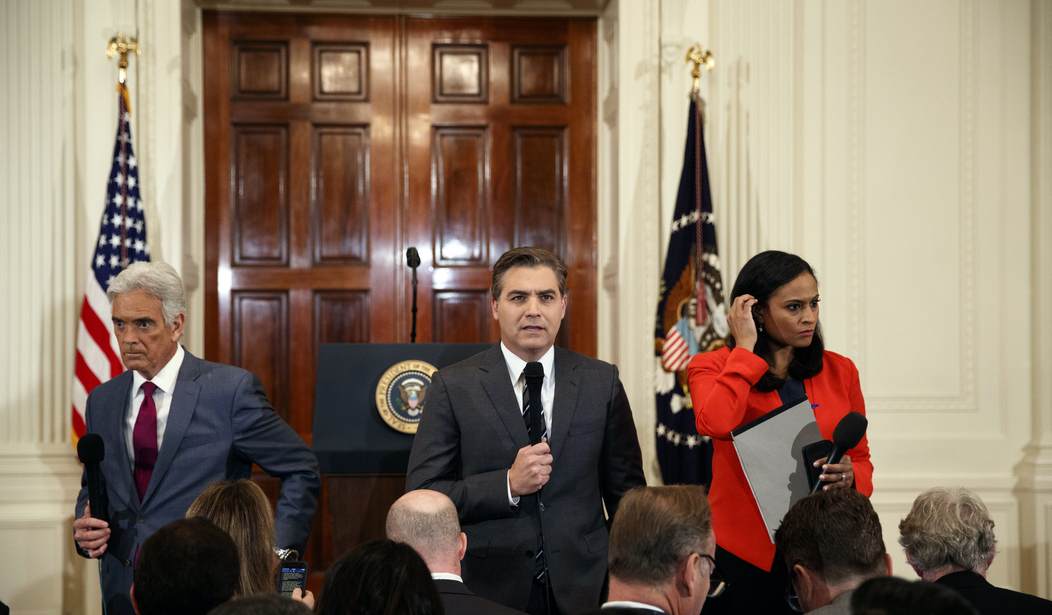
A new favorite phrase of the leftist media—which is to say, the media—is “without evidence,” as in “(insert name of conservative here) stated, without evidence….” In most cases, the media is either lying or ignorant of basic rhetorical terms.
Specifically, they fail to grasp the difference between two words that, although often used interchangeably, do not mean the same thing: “evidence” and “proof.” What they’re really saying is, “without proof,” which may be true but is a far cry from “without evidence.” Evidence is simply information that suggests something might be true. Enough such information could constitute “proof” in the broadest sense of that term.
In classical rhetoric, however, “proof” is the product of deductive reasoning, based on a premise that is universally accepted as true. In a court of law, for example, this might take the form of DNA testing, since it is generally acknowledged that no two people have the exact same DNA (except, perhaps, identical twins). The problem is that, outside the realms of science and mathematics, actual proof of anything is pretty scarce. It’s somewhat rare even in science, as we see when scientific “facts”—such as “Pluto is a planet”—are disproved after more information becomes available.
That’s why most arguments are inductive rather than deductive. Inductive reasoning is about probability, not proof, relying on numerous pieces of evidence. The more evidence, the more likely the proposition is to be true—or at least persuasive. For example, “smoking cigarettes causes lung cancer” is an inductive argument. There’s no absolute, incontrovertible proof of that, in the mathematical sense. There’s just a lot of evidence. A whole lot of evidence. I’m certainly convinced. But even the most persuasive inductive argument is not, technically, proof.
That’s true in our legal system, as well, although there we tend to use the word “proof” very loosely. Even in a criminal case, the “burden of proof” is “beyond a reasonable doubt”—which is not the same as beyond any doubt at all. Sometimes attorneys can absolutely prove their case—as when DNA or fingerprints are present—but often they rely on inductive arguments using “circumstantial evidence.” Yet circumstantial evidence is, in fact, a form of evidence. In civil cases, the “burden of proof” is even lower: a “preponderance of the evidence,” meaning something is more likely to be true than not. Obviously, such arguments are purely inductive—but that doesn’t mean they can’t be persuasive, and it certainly doesn’t mean they can’t carry the day.
Exhibit A in the evidence versus proof dichotomy is, of course, President Trump himself. Remember when he claimed, “without evidence,” that the intelligence community and the Obama administration were spying on his campaign? It turns out that not only was there plenty of evidence—there was proof, in the form of documents and admissions. Similarly, the president was accused of lying—of lacking “evidence”—when he insisted, last spring, that we would have a vaccine for COVID-19 by the end of the year. I’ll be happy to excuse you if you need to stop reading for a moment and go get vaccinated.
Now Trump is claiming, “without evidence,” that the election was stolen. But in fact, there are reams of evidence: eyewitness accounts, forensics, photographs and videos of suspicious behavior, extreme statistical anomalies. Taken together, it might (or might not) be enough to persuade a court, if any court would actually hear it. Unfortunately, corrupt leftist judges have no interest in reversing the outcome, while feckless “conservative” judges are probably afraid of having their homes burned to the ground in another Antifa/BLM peaceful protest.
So next time you hear some talking head claim that the president or another conservative said such-and-such “without evidence” (oddly, they never seem to accuse leftists of this), keep in mind that they are almost certainly wrong, if not outright gaslighting. The individual thus maligned probably does have at least some evidence—although the exact nature of that evidence and whether it will persuade anyone remain to be seen. That the accuser is either unaware of the evidence or intentionally ignoring it does not, in itself, constitute a counter-argument.
Rob Jenkins is a 35-year veteran of higher education as a professor and former administrator. A regular contributor to several national and regional publications, he is also the author of six books, including Think Better, Write Better (2019). The views expressed here are his own. Email Rob at rjenkinsgdp@yahoo.com and follow him on Parler @robjenkins41
Join the Conversation
VIP members get the ability to comment on articles.