





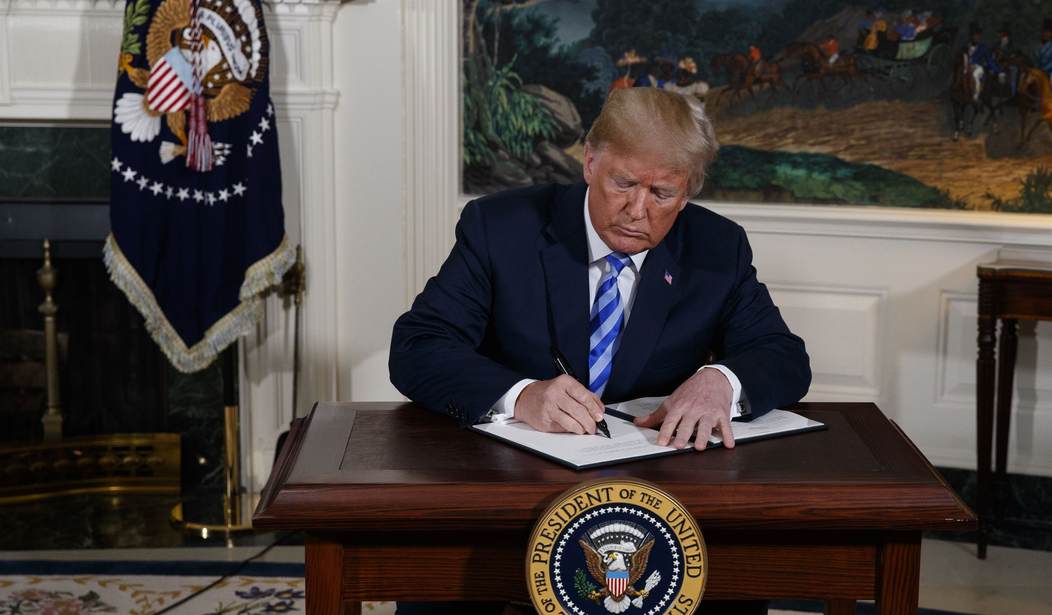
PARIS -- U.S. President Donald Trump had long been expected to renege on the deal that America and five other nations struck with Iran in 2015, and he did so on Tuesday. The immediate impact: U.S. sanctions against Iran are back on. However, it's the long-term impact that could make this one of the worst moves ever made by an American president.
Whether Trump is aware of it or not, withdrawing from the Iran nuclear deal could reorient many of the pieces on the global chessboard -- and not in America's favor.
First, the withdrawal conveys the message that America's promises are worthless, even when they're in writing. Trump has been hoping to negotiate a detente with North Korea, which by most estimates now has a nuclear bomb. Now, North Korea is witnessing a broken U.S. promise and can easily place itself in Iran's shoes. Why would North Korean President Kim Jong Un give up his nuclear weaponry after seeing America back out of the Iran deal?
Last year, Trump boasted about his volte-face on America's recent detente with Cuba. He placed restrictions on travel to Cuba and blocked U.S. companies from doing business with any companies associated with the Cuban military (which is difficult to avoid since the military touches every sector in the country). If the U.S. business community can't rely on Trump to provide a stable environment for international business development, how can Kim trust him?
Turkey and the Philippines seem to believe that the sword of Damocles is hanging over their longstanding defense and security cooperation with the U.S., prompting both countries to look to Russia and China.
Second, Trump's decision is a slap in the face to America's Western allies, many of which are home to multinational companies that have started doing business in Iran since the ratification of the nuclear deal. Trump's reimposition of sanctions against Iran means that these companies have to worry about violating the U.S. Foreign Corrupt Practices Act, risking prosecution and billion-dollar fines. Foreign companies with a presence on Wall Street (or even foreign companies whose emails pass through a U.S. server, or who conduct transactions through a U.S. bank) fall under American jurisdiction.
Allies who believe that they can't rely on America to keep its promises from one administration to the next will be motivated to seek out other options. The main beneficiary of this is Russia, which has long been conveying the message that the U.S. is a less-than-reliable partner. Russia has also been working with China to build an alternative banking architecture. If this new architecture enables European countries to bypass a U.S. system that controls their access to markets, then Trump will have emboldened the competition at America's expense.
Third, the move would slam the door on any opportunity to build the kind of relationships that Western intelligence agencies seeking insight into Iran can only dream about. The five hardest intelligence-collection targets are widely considered to be North Korea, Iran, Russia, China and France. In the first four cases, it's because access is so difficult. (In the case of France, it's because key decisions are very tightly held near the top of the food chain and spy-busting counterintelligence is aggressive.) With Iran and North Korea, America was on the verge of prying open those vaults without firing a shot -- not with boots on the ground but with business shoes. And isn't that the ultimate objective? Aren't spying, aggression and warfare largely about the prospect of economic gain?
Of course, national security is a viable pretext for international conflict, too. And that brings me to my final point.
The U.S. withdrawal from the nuclear deal confirms Iran hard-liners' earlier suspicions that abandonment of nuclear self-defense capabilities would prove to be foolish, because even a signed deal is no guarantee that a friend today won't decide to become your foe tomorrow.
From the outset, Trump has been strangely obsessed with the Iran deal even though it's become clear that he doesn't understand all of its implications. It's the rare issue on which he finds himself in lockstep with the Washington establishment. (And many of those establishment members benefit from the largesse of Iran's regional foes.) That should have been Trump's first warning sign.
Trump has long seemed intent on undoing one of the rare things that Obama actually got right. The decision to ditch the Iran deal could change the world -- and not in a way that benefits America, global security or the free market.
Join the Conversation
VIP members get the ability to comment on articles.