







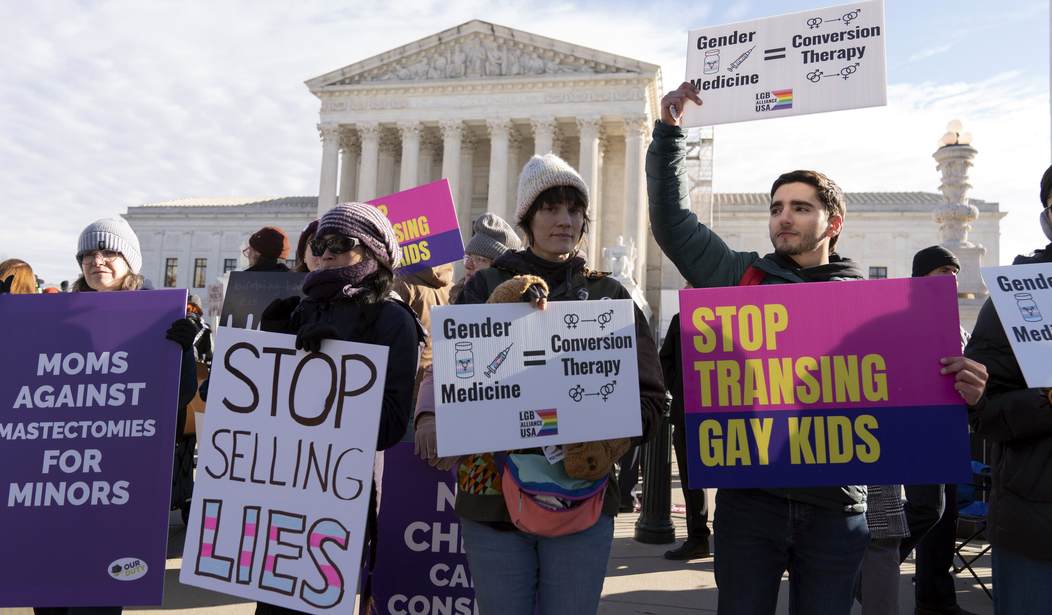
In late January, a New York jury awarded $2 million in a medical malpractice settlement to a detransitioned woman whose doctors performed a double mastectomy on her when she was just 16 years old and identifying as transgender. Within days of the news, the American Society of Plastic Surgeons (ASPS) recommended stopping so-called “gender-affirming” surgeries on minors, and the American Medical Association (AMA) followed suit.
The pediatric gender medical complex, which seemed unshakable not long ago, is now crumbling. If some of the largest medical organizations are folding on surgeries at the sight of a single medical malpractice victory—the first of its kind for a detransitioner—it will, hopefully, be only a matter of time until cross-sex hormones and puberty blockers are treated the same way.
This positive momentum, however, should not stop us from being aware of the absurd nature of it all: the country has made progress on ending the medical mutilation of minors, yes, but only because we somehow got to a place where ending the medical mutilation of minors became a political issue to begin with—where the state, along with every mainstream institution, decided to sanction experimental butchery on spurious grounds in the name of “care.” Countless confused children around the country have become the prey of unscrupulous, ideologically motivated doctors, therapists, and nurses. We can’t treat them as collateral damage to be forgotten as the rest of us begin to move on.
Indeed, we need justice for those the system harmed, and safeguards put in place to prevent such a medical scandal from ever repeating itself again. Stories from detransitioners give us a place to start.
Consider the story of Soren Aldaco, a detransitioner from Texas. Aldaco has called the so-called “gender-affirming care” she received as a child “an elaborate placebo” that came from a medical system that “prioritizes ease and conformity over health.” Aldaco began identifying as transgender at just 11 years old, feeling like she had been “born in the wrong body.” A doctor began affirming her identity when she was just 15 and in a psychiatric hospital, which socialized her as transgender. By 17, she was on hormones, and by 19, she had undergone a double mastectomy—both of which caused severe complications. Within a year, sick of the complications, she stopped testosterone and embraced being the woman she always was.
The medical professionals who harmed her could have helped her get to this place of self-acceptance as a child, but instead, citing supposed “compassion,” pushed and affirmed a delusion that ultimately left her with irreversible medical damage. “At the end of the day,” she told IW Features, “you need to be able to discern between enabling and helping…. Sometimes the compassionate response is one which sets firm boundaries.”
Firm boundaries begin with acknowledging the sheer magnitude of what was done to children, and what it means for the rest of us, too. While advocates of gender ideology will often point out that a relatively small percentage of the population has been directly affected by pediatric gender medicine, the fact remains that all of us—regardless of whether or not we ever identified as transgender, or even know someone who does—depend on the medical system in some way, shape, or form.
And the legitimacy of the entire medical system (including the parts that have nothing to do with gender ideology) has been challenged by the pediatric gender medicine complex having gained so much power in the first place. In order to return to sanity, medical organizations like the AMA and ASPS that have now reversed their positions will have to conduct themselves with humility and lead with humility when interacting with the public. As will organizations that bolstered false claims from gender ideology activists, including universities and the media.
As for the rest of us—those of us who were willing to question pediatric gender medicine before it was “acceptable” in the mainstream—we have a duty, too: to make sure that none of this is memory-holed, and that we acknowledge and learn from our mistakes as a country rather than being doomed to repeat them.
Neeraja Deshpande is a policy analyst at Independent Women.
Editor’s Note: Every single day, here at Townhall, we will stand up and FIGHT, FIGHT, FIGHT against the radical left and deliver the conservative reporting our readers deserve.
Help us continue to tell the truth about the Trump administration and its successes. Join Townhall VIP and use promo code FIGHT to receive 60% off your membership.


Join the Conversation
VIP members get the ability to comment on articles.