







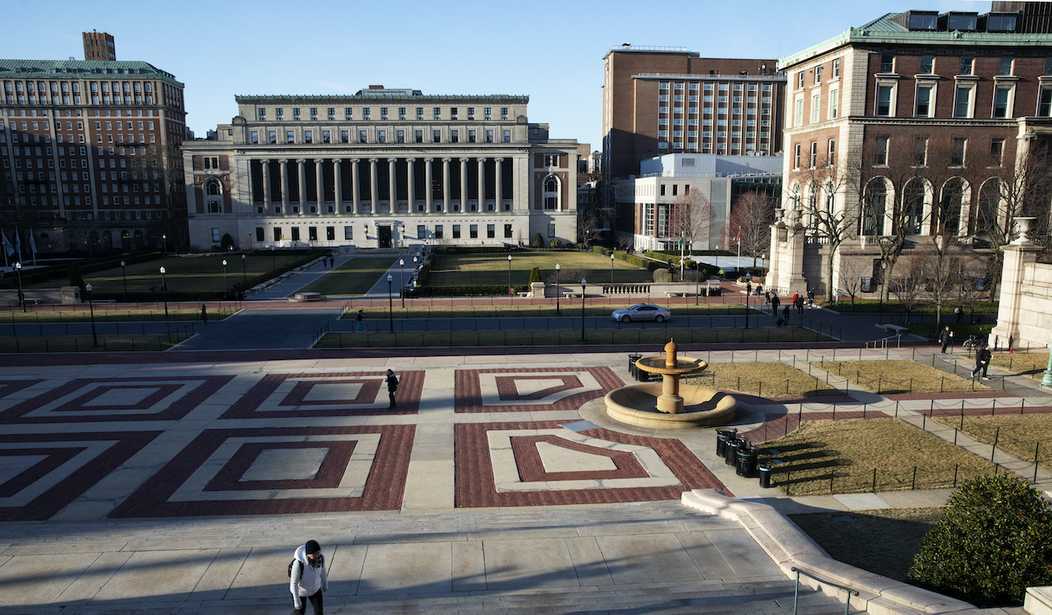
Some of America's most beautiful spaces -- our colleges and university campuses -- are closed and empty these days. Schools have canceled their spring semesters and commencements because of the COVID-19 virus; classrooms, dormitories and athletic facilities have been closed.
Students at many institutions are told that they can continue to access instruction online. But exams and grades have been canceled in many cases, and one suspects that online viewership will be sporadic and concentration intermittent.
But students shouldn't hover around their home mailboxes waiting for an envelope with a tuition rebate check. And students -- and parents -- who expect that their campuses will reopen in fall, next spring or the fall after that may be in for surprise and disappointment.
American higher education has been in serious and increasing trouble in the past two decades. Yes, it's true that American university science and technology departments lead the world, and the (increasingly unscientific) social sciences and (often inhumane) humanities departments can still boast some brilliant scholars.
But at some point, too much of a good thing stops being a good thing. People have observed for years that college graduates make more money over their lifetime than non-college graduates. But it doesn't follow that people not headed to college will make money if they go there.
A dismaying number of American college freshmen never end up graduating, not after four or six or 20 years. An even more dismaying number of non-graduates and graduates end up with daunting amounts of college loan debt, non-dischargeable in bankruptcy, which reduces or prevents significant wealth accumulation. Americans today have more college debt than credit card debt.
And for what? In his new book, "The Breakdown of Higher Education," John M. Ellis, an emeritus professor at the notoriously left-wing University of California, Santa Cruz, cites multiple studies showing that half of graduates make no intellectual gains -- "no statistically significant gains in critical thinking, complex reasoning and writing skills," as one study puts it. As the American Council of Trustees and Alumni surveys have shown, many schools don't teach the basics of American history or government. College degrees are not so much evidence of learning as of plodding persistence.
And a willingness to put up with left-wing agitprop, force-fed by "tenured radicals," in Roger Kimball's phrase, in traditional academic disciplines as well as grievance studies departments. American universities keep grinding out more Ph.D.s (writing theses no one may ever read) than they have tenure-track teaching jobs so that an increasing number accept hourly wages as adjuncts and look forward to increases in the minimum wage.
Meanwhile, administrators now outnumber teachers at American colleges and universities. Many spend their time in meetings and conferences promoting "equity, inclusivity and diversity." Some spend time enforcing speech codes prohibiting free expression that colleges and universities at one time fostered. Others are occupied in regulating adult students' social behavior, conducting kangaroo courts in which those accused of sexual harassment or assault are denied any presumption of innocence, the ability to call witnesses and knowledge of any charges.
The notion that adults, who are eligible to vote and serve in the military, need such guidance is rooted in the Latin phrase "in loco parentis," the notion that students at residential colleges need something like parental supervision -- even if that supervision is irksome and increasingly expensive.
The fact is that the residential college, the model of American higher education since its 17th-century foundations, is the exception rather than the rule in most of the world. University students typically live in parental homes or with roommates in cheap nearby apartments. That's true of most undergraduates in Britain, where Cambridge and Oxford and their beautiful quads were the models for Harvard and William & Mary.
For the 100 or so selective colleges, the residential college model will continue to be profitable. But even Harvard, with its $37 billion endowment, saw fit to lay off hundreds of subcontracted campus dining hall workers.
Dozens, perhaps hundreds, of lesser-known schools, whose graduates never get interviews with Goldman Sachs, may be thrust into bankruptcy if the perceived need for social distancing closes classrooms or reduces enrollments. As Heather Mac Donald writes in City Journal, "Students and their parents may start to ask why they should pay astronomical fees for a campus experience if they can get the same instruction over the web."
And perhaps some college and university administrators will ask whether they can somehow cut back on administrative bloat, especially if the alternative is figuring out some other use for their beautiful but suddenly obsolete campuses.
Michael Barone is a senior political analyst for the Washington Examiner, resident fellow at the American Enterprise Institute and longtime co-author of The Almanac of American Politics.


Join the Conversation
VIP members get the ability to comment on articles.