





Is President Trump fulfilling candidate Trump's promises?
You can make a case that he is, based on some surprising and widely unexpected economic developments. Vice President Mike Pence, writing in The Des Moines Register, put it succinctly: "The evidence is clear: America is back." He adds, "It's no accident."
Pence and other Trump enthusiasts can point to increasing macroeconomic growth. Growth rose 4.1 percent in the second quarter and is up more than 3 percent for the year. Unemployment was down to 3.9 percent in July. The S&P 500 stock index is up 6 percent since the Trump presidency, while the rest of the world's stock markets are down 6 percent. These are numbers any recent administration would boast about.
More notable are positive trends among subgroups that weren't doing so well before Trump took office. Former Obama administration chief economic adviser Jason Furman, writing for Vox, notes that in the past three years "recent wage growth ... at the low end of the wage scale" is stronger than growth among the higher-paid. Similarly, Bloomberg columnist and portfolio manager Conor Sen makes the point that job growth has been greatest among "goods-producing workers and the least-educated workers."
Both Furman and Sen contrast current trends with those in the 1998-2001 period of torrid economic growth, when income gains were concentrated at the top of the economic spectrum and employment gains were concentrated in office jobs and "meds and eds" -- the government-financed or heavily regulated health care and education sectors.
So maybe growing income inequality isn't inevitable after all. And maybe the economic prospects of groups clustered at the low end of the economic scale are not as dire as has long been assumed.
The unemployment rate among young millennials -- those over 25 -- is only 5.1 percent, according to Sen, the lowest since the government began measuring this in 1994. So much for mom's basement sofa. Black unemployment was down to 5.9 percent in May, and Hispanic unemployment was down to 4.6 percent in June, both the lowest number since the early 1970s, when government began tracking them.
Moreover, the labor force is expanding, with 600,000 entrants in June, notes American University economist Evan Kraft, writing in The Hill. Simultaneously, the disability rolls are decreasing. All of which suggests that incentives to work are returning to Appalachia and other previously forlorn areas where so many idle people have been driven to opioid dependency.
Blue-collar employers have been searching hard to fill job vacancies, ditching educational requirements and following the advice of liberal and conservative politicians to take a chance on former felons who have served their time, as the Manhattan Institute's Aaron Renn reports.
Historically, Democratic candidates have promised to create economic opportunities for those starting off with disadvantages, especially racial minorities and those from non-college households. But recent Democratic presidents, like recent Republican presidents, have seen economic growth concentrated among the affluent, highly educated and well-positioned.
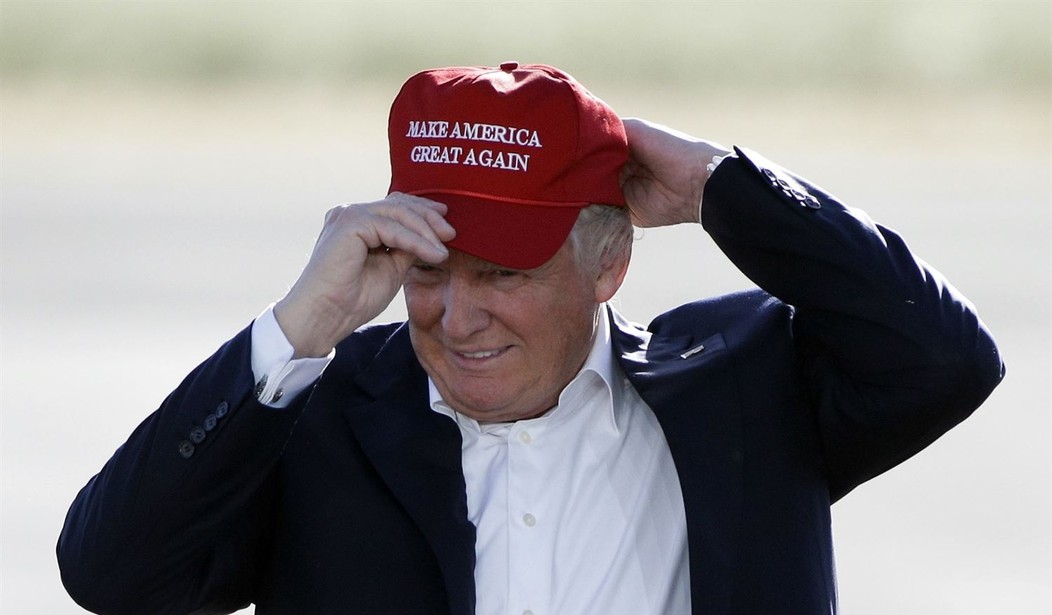
Candidate Trump's call to "Make America Great Again," however unspecific, was taken, and intended to be taken, as a promise to deliver different better results for the downscale. He constantly talked about reopening factories, strengthening manufacturing and encouraging blue-collar job growth.
As an electoral strategy, this seemed to ignore courting minorities and rely on an inevitably shrinking segment of the electorate. But the segment hadn't shrunk enough (and its size was consistently underestimated, as The New York Times' Nate Cohn demonstrated) to prevent Trump from winning 100 Obama electoral votes in Florida, Pennsylvania, Ohio, Michigan, Wisconsin, Iowa and Maine.
Now it looks like Trump is creating the kind of economy he promised, with growth targeted at the downscale (including blacks and Hispanics) rather than the upscale, with lower economic inequality and with growth spreading to regions that have seen little of it for decades. Do you remember any mainstream media or liberal economist who envisioned such results?
Of course you can add caveats. You can say these numbers are just statistical noise, not harbingers or long-term trends. You can argue, as Furman does, that some of these trends started in the late Obama years. You can make the broader point that presidents' policies have only limited economic effects, and that trends like the apparent revival of manufacturing may owe more to exogenous factors rather than to Trump's policies.
So maybe this is not a case of promises kept but just dumb luck. Of course you can say the same thing -- just dumb luck -- about the 100 electoral votes Trump targeted and won. But after a while, you might wonder.

Join the Conversation
VIP members get the ability to comment on articles.