





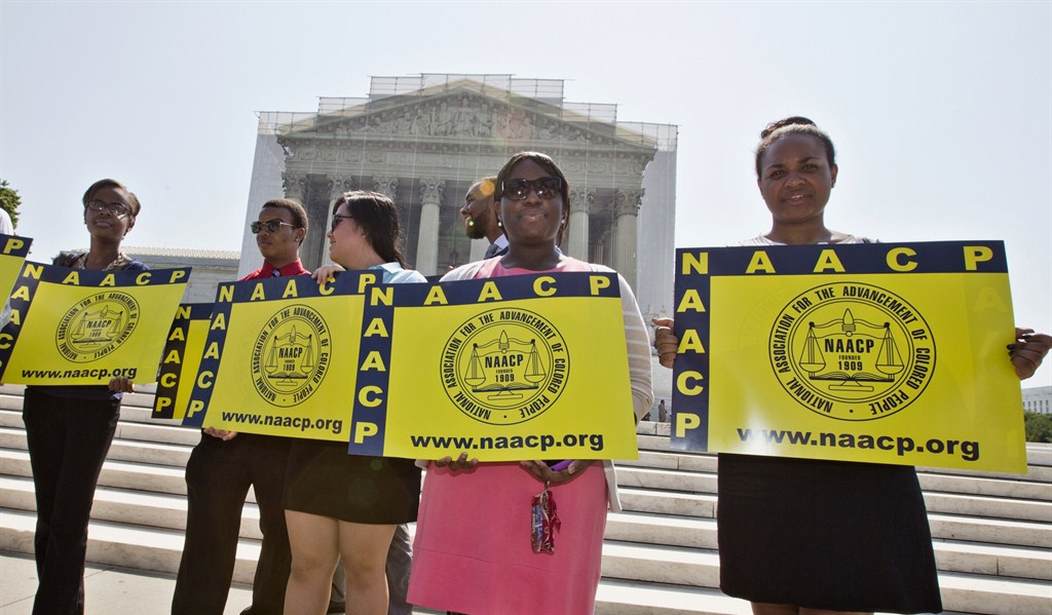
Schuette v. BAMN shouldn't have been a hard case. The Fourteenth Amendment outlaws racial discrimination. Racial quotas and preferences are, by definition, racial discrimination.
Fifty-eight percent of Michigan voters in 2006 voted to prohibit racial quotas and preferences in admission to state colleges and universities.
As Justice Antonin Scalia asked in his concurring opinion in Schuette v. BAMN, announced April 22, "Does the Equal Protection Clause of the Fourteenth Amendment forbid what it expressly requires?"
He went on, "Needless to say (except that this case obliges us to say it), the question answers itself."
So why did this case go all the way to the Supreme Court? Why did the justices feel obliged to write five separate opinions while upholding Michigan 6-2? Why did only one other justice, Clarence Thomas, sign onto Scalia's concurrence?
The short answer is that university, media and corporate elites have an enormous emotional investment in maintaining racial quotas and preferences.
That investment goes back half a century, to the years just after passage of the Civil Rights Act of 1964, which enforces the Fourteenth Amendment's ban on racial discrimination.
The hopes of its advocates were in some ways exceeded. White Southerners, who had reacted violently to black Freedom Riders a few years before, quickly acquiesced in integration of public accommodations.
The Nixon administration acted swiftly and decisively to end racial segregation in Southern schools.
Elite universities across the nation had already been admitting blacks for years. But they found that relatively few blacks had the test scores and high school records normally required for admission.
So they instituted "affirmative action," a euphemism for racial quotas and preferences. In time, Hispanics -- a category invented in 1970 by the Census Bureau -- were added to the list, anomalously, since most were the offspring of immigrants who had never suffered racial segregation in the United States.
Such practices were effectively upheld by the Supreme Court's 1978 Bakke decision, in which Justice Lewis Powell, casting the decisive vote, said that race could be "one factor" in admission decisions, in order to attain racial or ethnic diversity.
At that point, it was still barely arguable that racial quotas were fair compensation for past racial discrimination. That argument was weaker when the Supreme Court faced the issue again in the 2003 Gratz and Grutter cases.
In an opinion by Justice Sandra Day O'Connor, the Court fudged the issue. Explicit racial quotas were forbidden. But a "narrowly tailored use of race in admissions decisions" to insure "a diverse student body" were OK. O'Connor added that she expected they wouldn't be needed in 25 years, i.e., 64 years after the Civil Rights Act of 1964.
Justice Anthony Kennedy's opinion in Schuette, in which two other justices concurred, avoids taking this issue head on. Rather, it concentrates on avoiding two 1969 and 1982 Supreme Court decisions that overturned referenda repealing a fair housing ordinance and a ban on school busing.
Those were the basis for the Sixth Circuit appeals court's 8-7 decision in 2011 overturning the Michigan referendum results and for Justice Sonia Sotomayor's 58-page dissent.
Sotomayor takes for granted that blacks and Hispanics benefit from racial quotas and preferences. Evidently she is not familiar with Richard Sander and Stuart Taylor's 2012 book, "Mismatch: How Affirmative Action Hurts Students It's Intended to Help and Why Universities Won't Admit It."
"Mismatch" shows how blacks and Hispanics admitted with below-average test scores tend to drop out without graduating, shy away from science and engineering courses and are stigmatized as inferior. It argues persuasively that they would do better in schools where most students have similar levels of preparation.
So it's not clear that racial quotas and preferences help blacks. And it is clear, though no justice mentioned this, that quotas exclude many Asians from schools where they would otherwise be admitted. That's why Asian legislators defeated California Democrats' drive for a referendum to repeal that state's ban on racial quotas and preferences.
University administrators don't seem to care. Their sense of moral worth seems tied to how many blacks and Hispanics they admit, regardless of how these students do later. As Sander and Taylor note, California administrators have been stealthily employing racial quotas in defiance of state law.
So racial discrimination is likely to continue, at least till three more justices agree with Scalia that the Fourteenth Amendment means what it says.



Join the Conversation
VIP members get the ability to comment on articles.