





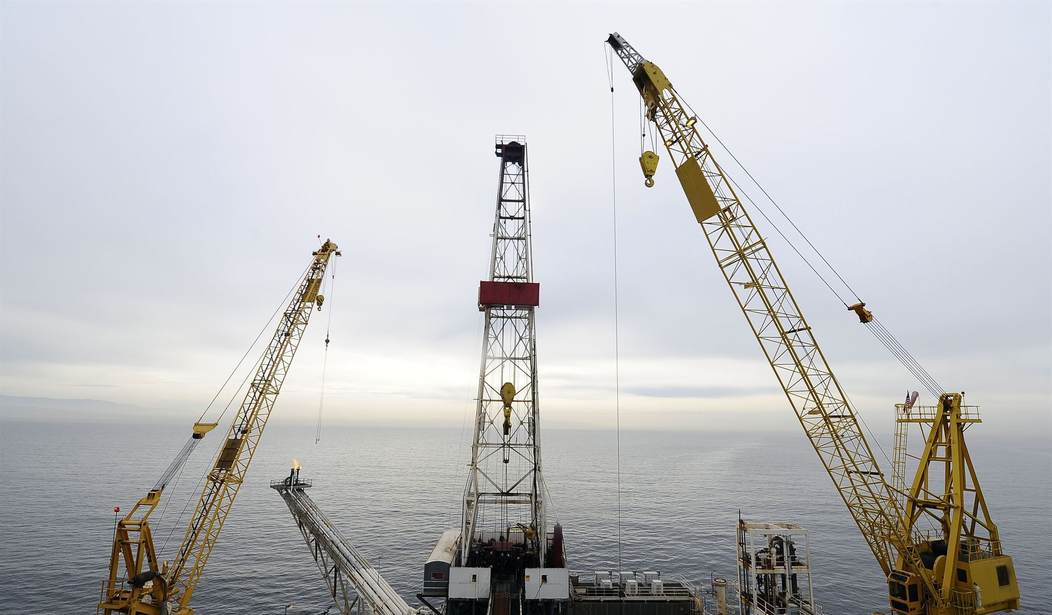
Despite America breaking records in oil production, consumers paid more for gasoline this spring, serving as a reminder that supply isn’t the only factor affecting oil prices. Oil production by OPEC members recently fell to a four-year low. At nearly the same time, oil sanctions were imposed against Venezuela and sanctions against Iranian oil exports were tightened, sending shockwaves rippling through the world market.
The lesson for policymakers to take from recent gas pump price shocks is that, unless the nation is fully able to draw upon all of its energy resources when needed, American consumers will remain at the mercy of geopolitical currents. That means that we must begin the initial stages of exploring untapped areas right now. Energy development is not as simple as flipping a switch. It’s a long process that involves many steps such as seismological surveys, obtaining mineral rights and securing permits before the drilling phase can even begin.
One of the more geologically promising prospects is known as the “1002 Area,” a small plot of land only about the size of a large city airport located on a coastal plain between the Arctic Ocean and the Alaska National Wildlife Refuge (ANWR). Concentrated beneath this modest patch of ground lies an astounding 10.4 billion barrels of oil, according to an estimate by the U.S. Geological Survey. At peak production, the 1002 Area would be capable of producing 1.45 million barrels a day, the U.S. Energy Information Administration calculates. To put that figure in perspective, the United States imported an average of 869,000 barrels per day of crude from Saudi Arabia in 2018.
The capability of untapped resources such as the 1002 Area to help replace oil imported from the world’s more politically volatile areas would convey substantial benefits. The nation would strengthen its national security as well as its energy security while gaining a hedge against oil price spikes that are so often a by-product of turmoil in regional flashpoints. Additional oil sources also mean that American petroleum product exports can continue to bring economic vitality to our economy.
The experience of oil production at nearby Prudhoe Bay on Alaska’s North Slope suggests that natural resources would be developed safely without harm to the environment. Prior to production, which began there in 1977 when construction of the 800-mile Trans-Alaska Pipeline was completed, activists claimed that oil production would wreak environmental havoc. They argued that oil development would decimate the Porcupine caribou herd living within the habitat. But that’s not what happened.
More than 40 years and 12.6 billion barrels of oil later, the Prudhoe Bay oil fields remain the largest in North America and currently boast more than 800 actively producing oil wells. And yet by 2017, the Porcupine caribou herd had grown to record high numbers – roughly twice the size of what they had been in 2001 – prompting a regional biologist to remark, “We might have just recorded the largest number for this herd since modern scientific monitoring started in the 1970s.” The good stewardship and continuous advances applied to safety technology and practices in Prudhoe Bay and the North Slope can be extended to the 1002 Area together with new learnings.
Congress passed a law with bipartisan support in 2017 ending a drilling moratorium and directing the Department of the Interior to establish a program for the leasing, development, production, and transportation of oil and natural gas along the coastal plain of the ANWR where the 1002 Area is located.
Meanwhile, in a “greener than thou” competition among presidential candidates, Sens. Cory Booker (D-N.J.), Elizabeth Warren (D-Mass.), Kamala Harris (D-Calif.) and Bernie Sanders (I-Vt.) joined Sen. Jeff Merkley (D-Ore.) in introducing legislation that would block all drilling near ANWR. The bill would amend the Outer Continental Shelf Lands Act to bar the Department of the Interior from issuing oil and gas leases in the area. This is the same position advocated by the left fringe “Keep It In the Ground” movement, whose adherents not only campaign against the extraction of any fossil fuel but actively oppose any fossil fuel-related project, including pipelines, rail transportation, refineries, energy exploration and so on. Adopting “Keep it in the Ground” policies would cause U.S household energy expenditures to jump by $4,550 on average by 2040, according to a 2017 OnLocation study.
The nation needs more, not fewer, sources of energy to protect the economy and its citizens. Now is not the time for posturing to curry political favor among monied environmental donors. To the extent that America can tap its energy resources when geopolitical events present challenges, we can remain virtually impervious to them. Going forward with developing Alaska’s 1002 Area is a prudent first step.

Join the Conversation
VIP members get the ability to comment on articles.