





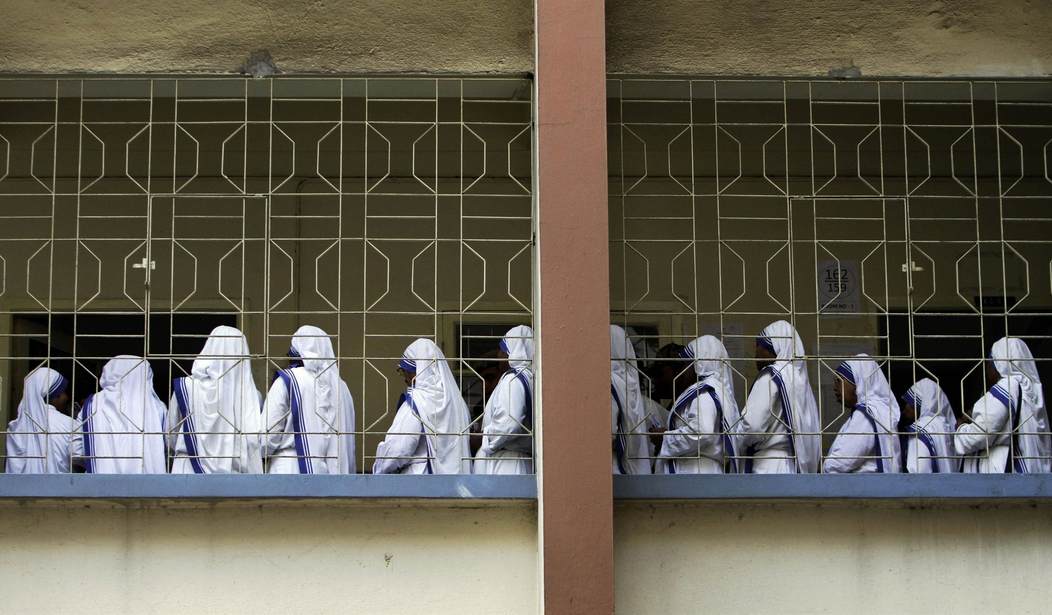
A beaming smile comes from a man on a thin mattress on the floor. He looks malnourished. And I know he's dying because he's at a Missionaries of Charity Home for the Dying. And yet, it's hard not to look at his photo and long for what he has. It may not be much from a conventional perspective, but it's what matters most.
Nirmal Hriday — "Home of the Pure Heart" — was founded by Mother Teresa in 1952. The photo was taken by American photographer Michael Collopy when he visited in 1996, a year before Mother Teresa's death.
"A glowing light in the darkness of the modern world," is how Collopy thought of Mother Teresa. He was in high school when he first became aware of this simple yet powerful woman via Malcom Muggeridge's film "Something Beautiful for God." He became fascinated with the powerful simplicity of the future saint.
As an adult, Collopy gave the world an intimate look at Sister Teresa and her fellow nuns' work in the 1996 book "Works of Love Are Works of Peace: Mother Teresa of Calcutta and the Missionaries of Charity," published by Ignatius Press. It's a beautiful coffee-table book — even my copy with its beat-up paper cover wrap and dog-ears and highlighting — but it is really a prayer book.
"One thing that has made a real impression on me is the interior beauty of the Indian people," Collopy reflects in text that appears under a photo of five women on a street outside Prem Dan — the main "Gift of Love" home the sisters have for the otherwise abandoned in Calcutta. "Even in the worst of material circumstances they are dignified and gracious. They smile easily and genuinely. They are so welcoming," Collopy writes.
Mother Teresa said that "no contemplation is possible without asceticism and self-abnegation."
We could all use a reminder to unplug from both the ruthless material world and our selfish desires. Maybe then, we could start to find inspiration and discernment.
In one of the photos, I notice Mother Teresa's eyes. I remember the single time I saw her — she was a few feet away from me at Mass. I was an undergraduate at the Catholic University of America, and she was in D.C. for the final profession of some of her sisters. I noticed how small and delicate she appeared. In the book, what I notice is her eyes. She clearly sees something we don't. She's looking at the world — at what is in front of her — but she is seeing something more.
Well, she sees everything now. And since we can't interview her from where she is eternally, we'll have to stick with what she left us with: "I never look at the masses as my responsibility," Mother Teresa said. "I look only at the individual. I can love only one person at a time. I can feed only one person at a time."
Just start somewhere. With one person. And see what happens from there.
God gives us the honor of serving Him when we care for another. And we will be on that same road together for the peace that surpasses all understanding.
Note: There is an exhibit based on "Works of Love Are Works of Peace" currently at John Paul II National Shrine in Washington, D.C. through Nov. 11, which includes a first-class relic from Mother Teresa. Collopy will be speaking there on Sept. 26.
Kathryn Jean Lopez is senior fellow at the National Review Institute, editor-at-large of National Review magazine and author of the new book "A Year With the Mystics: Visionary Wisdom for Daily Living." She is also chair of Cardinal Dolan's pro-life commission in New York and is on the board of the University of Mary. She can be contacted at klopez@nationalreview.com.
Editor’s Note: Do you enjoy Townhall’s conservative reporting that takes on the radical Left and woke media? Support our work so that we can continue to bring you the truth.
Join Townhall VIP and use promo code FIGHT to receive 60% off your membership.


Join the Conversation
VIP members get the ability to comment on articles.