





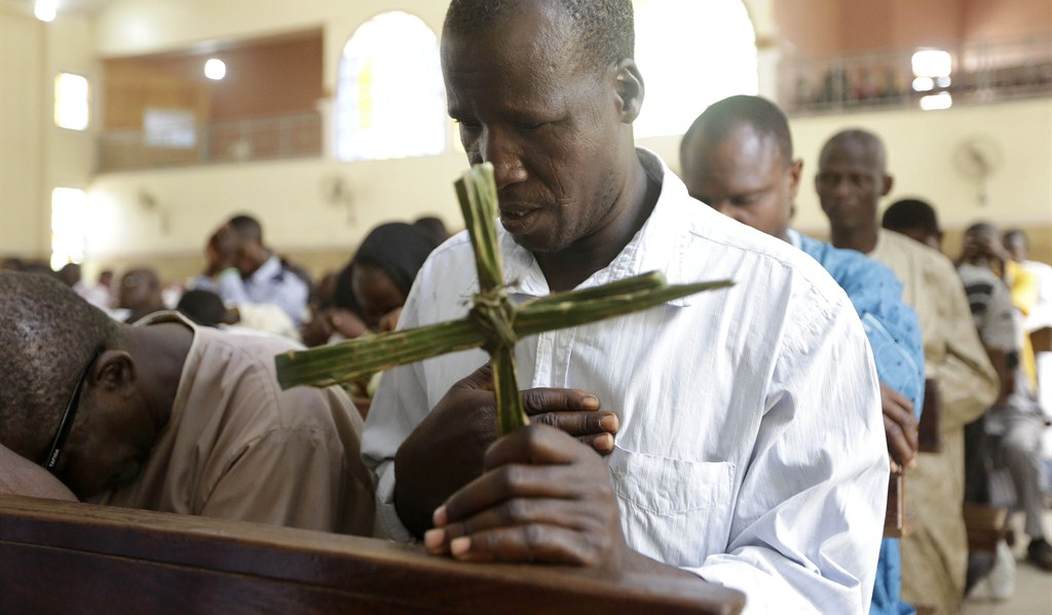
A little girl -- maybe 4 years old -- looks at you with disappointment. In a photo on display in a new exhibit in Manhattan, she appears to be reacting to boys with her who are cutting in line in front of her for food. Also in the gallery is a photo of that same girl exuding joy. It's almost if she's expressing gratitude to the viewer for paying attention, even for a few minutes. She's a displaced person, which is what the July exhibit at the Sheen Center for Thought and Culture is about. She's a Christian in Northern Nigeria, a place where it can be risky for members of her faith.
"Among the Displaced: Photographs of Iraq and Nigeria" is the debut showing of American Stephen M. Rasche's photographs, which he took while working with persecuted Christians in those countries. One of them, taken last year, shows a woman who lost one of her eyes and went blind because of Boko Haram terrorists. She now lives in a housing development for Christians and Muslims established by the Catholic Diocese of Yola. The photo makes clear her pain, but also highlights that the terrorists never robbed her of her dignity.
Another photo from Abuja, Nigeria, shows a man with malaria. His disease has gone untreated, which is not rare for the "tens of thousands" displaced in camps there. Typhus, cholera, typhoid and yellow fever, among other conditions, may also go untreated. The man looks like he knows his suffering could be alleviated.
Rasche began working with the Chaldean Church in Iraq during the ISIS genocide against Christians and other religious minorities. Rather than renounce their faith, Catholics fled their homes in Mosul and went to Erbil, near Kurdistan. Archbishop Bashar Warda and the Archdiocese of Erbil established a Catholic university and a hospital there, to care for these people and give them hope for the future. Rasche became chancellor of the university and a voice for the people whom our country's actions in Iraq helped displace.
In the exhibit, there's a 2016 photo of a priest encountering what ISIS did to his parish church in Karamless, Iraq. He looks astonished, saddened and overwhelmed by the scene. The terrorists had destroyed and desecrated the altar and a stature of the Virgin Mary. In both Iraq and Nigeria, there is debate about what to do with statues that have been desecrated -- also in the exhibit is a beheaded Nigerian statue of Christ the Redeemer with bullet holes throughout. Mary of Karamless was put back together, though with scars visible -- her arms attached by wires. The statue was presented to Pope Francis for a blessing when he bucked COVID-19 and security concerns to be with his persecuted people in that country.
Throughout Scripture, there are commands to care for widows and orphans. One of Rasche's photographs is of an "'orphaned' elderly displaced" woman. This woman was being moved to her third displaced persons camp in six months at the time the photo was taken. She asks Rasche in exasperation: "When will I go home?"
Two photos in the exhibit are of Catholic religious sisters, one at the papal Mass in Erbil in 2021, another in Nigeria in 2022. After I take a first look at the exhibit, Rasche points to the photo of Sister Mary Joseph, a Dominican sister, and declares her a saint. He adds that she will frequently reach out to him to ask how he's doing and if he needs any specific prayers. She, meanwhile, lives in a convent that is routinely surrounded by gunfire, abductions and murders at night. As the description beside the photo explains: "While admitting that she and the others were often terrified at night, 'in the morning, we go out on the street, and return to our work with joy.'"
July begins in the U.S. with celebrations of liberty. For those who don't have the same kinds of religious protections we do, freedom is a choice to live life to the fullest with dignity and joy, even amid existential threats. We may shy away from knowing the plight of the persecuted, for fear of our powerlessness. But in "Among the Displaced," we see people who are not victims, but victors in their perseverance in hope for the truth of what they believe about God and eternity. That's how there are smiles amid the pain.
(Kathryn Jean Lopez is senior fellow at the National Review Institute, editor-at-large of National Review magazine and author of the new book "A Year With the Mystics: Visionary Wisdom for Daily Living." She is also chair of Cardinal Dolan's pro-life commission in New York, and is on the board of the University of Mary. She can be contacted at klopez@nationalreview.com.)


Join the Conversation
VIP members get the ability to comment on articles.