





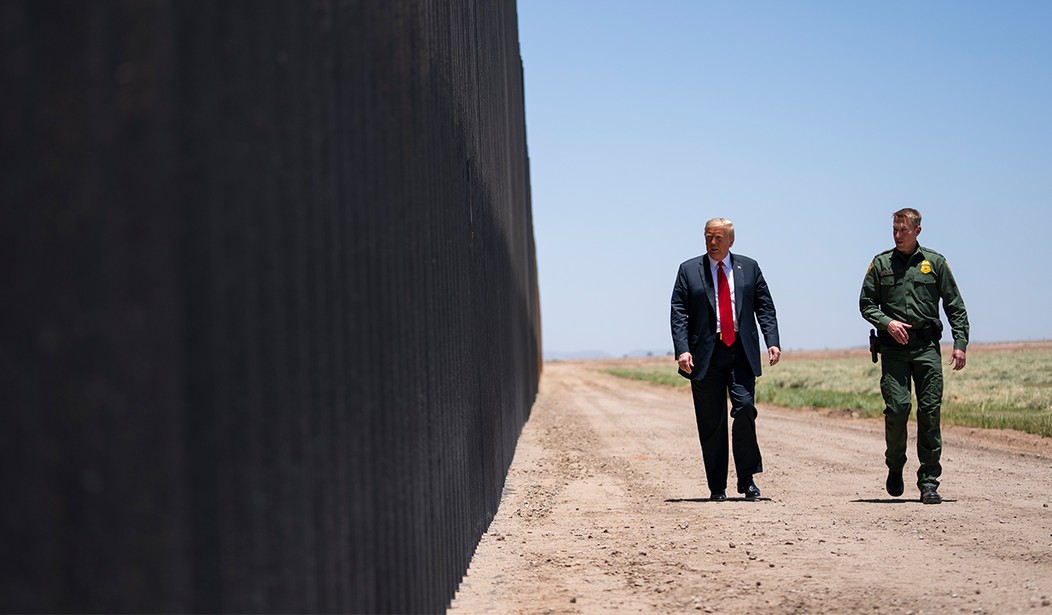
Donald Trump famously sought the presidency in 2016 on a platform that elevated the immigration issue to the singular political forefront. He was right to do so. There is a very strong case that immigration, both legal and illegal, represents the indispensable issue facing the United States. No other political issue so broadly affects virtually every other -- whether it is economics, national security, foreign policy, culture and religion, crime and law and order, or congressional apportionment -- as that most foundational issue of any legitimate self-governing politics: who we quite literally are, as a polity and a citizenry.
For the first three years of his presidency, Trump attempted intermittently to implement the broad contours of his immigration agenda. While he wasted precious political capital on other legislative pursuits, such as a milquetoast tax cut and a misbegotten jailbreak initiative, Trump galvanized executive branch authority to slowly build the border wall, reform visa abuses, rescind President Barack Obama's unconstitutional Deferred Action for Childhood Arrivals amnesty, end the destructive Obama-era illegal immigration magnet of interior "catch and release," and more generally seek a robust enforcement of extant immigration law.
Border hawks were certainly left wanting far more. And the left, with its dutiful "resistance" judges dispersed throughout the federal courts, did its best to condemn and stymie Trump's agenda. But overall, his agenda was fairly successful. Trump's innovative "Remain in Mexico" policy for prospective Central American asylum seekers helped quell the nightmarish 2019 border surge, and evidence suggests that working-class wages particularly increased in the U.S. metropolitan areas that saw the largest immigration declines (both legal and illegal). And of course, Trump's consistent scorched-earth rhetoric on the topic was itself enough to deter smugglers and families alike from attempting the journey north.
Then came COVID-19. Almost instantly, domestic quarantines sprang up, and cross-country travel bans proliferated. International travel became almost impossible. The infamous Mexican drug cartels and human trafficking rings were even affected, and U.S.-Mexico border crossings plummeted. According to U.S. Customs and Border Protection statistics, Border Patrol in April 2020 reported a mere 17,106 combined apprehensions/deemed inadmissibles -- compared with a record-breaking 109,415 one year prior, in April 2019.
The result was that the immigration issue, the hallmark of Trump's insurgent 2016 campaign, receded in importance as an electoral issue. Trump sometimes spoke on the stump about building a fuller border wall in a second term, but the contrast between his 2020 reelection campaign and his inaugural 2016 campaign was striking. With COVID-19 lockdowns, dire need for fiscal relief to struggling or laid-off workers, midsummer urban anarchy and a harrowing rise of violent crime, and the ever-ascendant rise of Communist China, there were simply too many other things on voters' minds to pay heed to an issue that COVID-19 had largely taken out of play.
But as the election neared, illegal border crossings rose again. Border Patrol combined apprehensions/inadmissibles in September, October and November 2020 were all higher than their corresponding months one year prior. The timing, as the widely assumed impending presidential ascension of immigration dove Joe Biden neared, was impossible to ignore. And as John Daniel Davidson recently noted in the New York Post, a brand-new mass of migrant "caravans" is now forming in Honduras, with its eyes set on the U.S. border.
With the Trump administration's days in office waning, we are set for the messy and divisive politics of immigration to return to national preeminence. Many of the old fights of the Obama era are due for a reprise, and the very nearly evenly divided House and Senate will both feature many immigration votes. It is incumbent upon Republicans, who have largely coalesced around a pro-worker, pro-borders platform, to do their best to peel off the few remaining like-minded Democrats who agree with the labor unions of old on labor inflows. Some still exist, though they are now overwhelmingly outnumbered by "intersectional" democratic socialists who peddle the calamitous lunacy of open borders. Senate Republicans will also have to use every constitutional tool at their disposal, including the power of the purse, to check Biden's imminent opening up of our border, indiscriminate flooding of the nation with cheap labor, and failure to enforce basic immigration laws.
The next four years will see many an immigration fight. In that sense, this term will be similar to the Trump presidency. Only this time, the roles are reversed. Here's hoping conservatives are ready for the fight.
Join the Conversation
VIP members get the ability to comment on articles.