





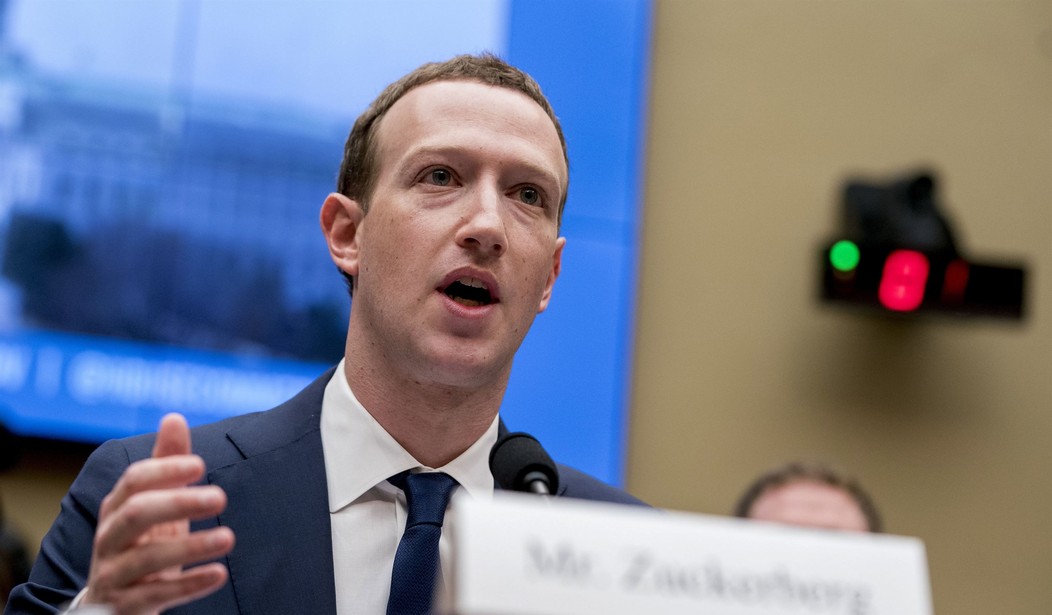
Here's a bet: Congress will end up "cracking down" on Facebook with "tough" regulations that Facebook will probably protest quite vigorously.
And then Facebook profits will go up.
Mark Zuckerberg, the founder and CEO of Facebook, withstood two days of questioning in Congress this week. You could tell Zuckerberg took it very seriously, not least because he shed his traditional T-shirt and hoodie in favor of a grown-up suit.
Again and again, he was asked whether he was opposed to regulation.
"You embrace regulation?" asked Sen. Lindsey Graham (R-SC).
"I think the real question, as the internet becomes more important in people's lives, is what is the right regulation, not whether there should be or not," Zuckerberg responded.
Many are focusing (understandably) on Zuckerberg's stance on the countless and complex free-speech issues raised by Facebook's dominance and reach. Zuckerberg kept suggesting that artificial intelligence could soon solve most of these problems by policing "hate speech" and perhaps "fake news" faster than human monitors ever could.
Sen. Ben Sasse (R-NE) had a brilliant line of questioning that exposed at least some of the problems with handing over these responsibilities to the real-world equivalent of HAL from "2001: A Space Odyssey" or Skynet from the "Terminator" movies.
"Can you define hate speech?" Sasse asked.
Zuckerberg admitted that beyond calls for violence, he couldn't come up with a definition of the sort of speech that should be banned by an algorithm.
Added Zuckerberg: "I do generally agree with the point that ... as we're able to technologically shift toward especially having AI proactively look at content, I think that that's going to create massive questions for society about what kinds of obligations we want to require companies to fulfill."
That is both an impressive understatement and a topic we'll all be returning to often in the years to come.
But let's assume Zuckerberg is correct. In the future, much of our speech will be policed by our robot overlords.
As Zuckerberg hinted more than a few times, political leaders will need to get involved in the regulation and administration of how these AI systems will work. We'll probably set up some new agency or a new division of the FCC to provide oversight.
And which company will have the loudest voice in the drafting of these new rules? If history is any guide, the obvious answer is ... Facebook.
The standard story of the Progressive Era, taught to high school kids and college students alike, is that the government has come to the rescue time and again to curtail the excesses of irresponsible, selfish or otherwise dastardly big businesses. Upton Sinclair, in his book "The Jungle," famously exposed the abuses of the meat-packing industry, prompting the government to impose new regulations on it.
Left out of this tale of enlightened regulation is that the meat-packing industry wanted to be regulated -- something even Sinclair admitted.
"The Federal inspection of meat was, historically, established at the packers' request," Sinclair wrote in 1906. "It is maintained and paid for by the people of the United States for the benefit of the packers."
The famous trusts were no different. In 1909, Andrew Carnegie wrote a letter to the New York Times suggesting "government control" of the steel industry. The chairman of U.S. Steel, Judge Elbert Gary, lobbied for the same thing.
The story repeated itself during the New Deal. The "malefactors of great wealth" that FDR demonized welcomed government regulation. Famed lawyer Clarence Darrow issued a report on the New Deal's industrial "codes" and found that in "virtually all the codes we have examined, one condition has been persistent. ... In Industry after Industry, the larger units ... have for their own advantage written the codes, and then, in effect and for their own advantage, assumed the administration of the code they have framed."
Why would the titans of capitalism welcome regulation? Because regulation is the best protection against competition. It stabilizes prices, eliminates uncertainty and writes profits into law -- which is why AT&T convinced Congress at the beginning of the 20th century to give it a monopoly over phone services.
I don't know what the regulation of Facebook will look like. But I suspect one reason Zuckerberg wants AI to be essential is that Facebook can afford to make AI essential while potential competitors can't.
Regardless, I have confidence that when all is said and done, Facebook will look more like the 21st century AT&T of social media.
Join the Conversation
VIP members get the ability to comment on articles.