





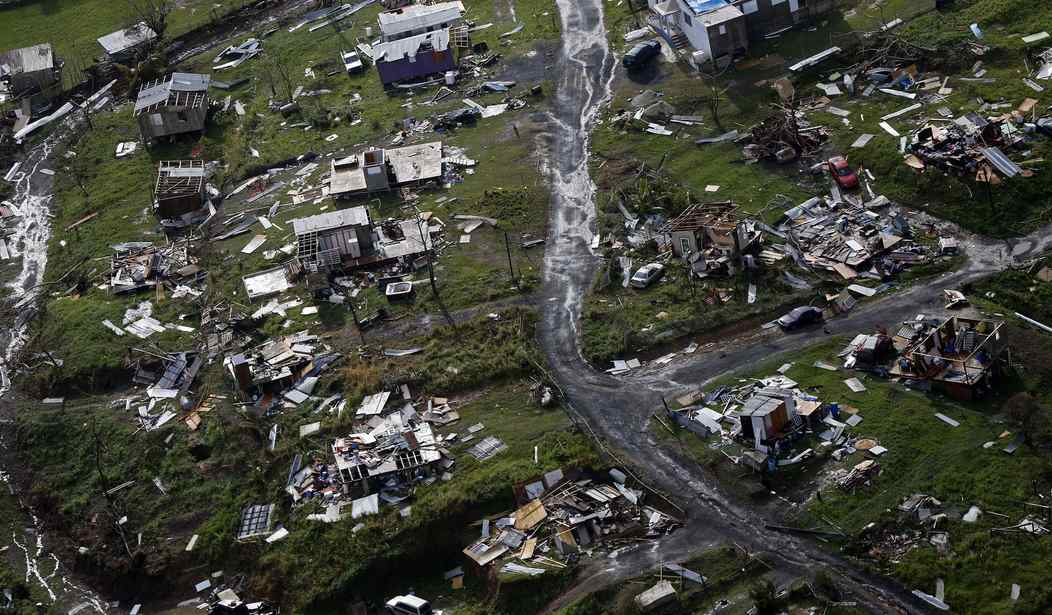
The hurricane devastation is severe. What should the federal government do?
Give us lots of money, say many.
Rep. Sheila Jackson Lee, D-Texas, demanded $150 billion -- just for Texas.
So far, Congress has agreed to $15 billion in hurricane relief. But more will come.
Few Americans will object. The House vote for the first $7.9 billion was 419-3.
But let's take a breath. Why is rebuilding the federal government's responsibility?
Clearly, only the feds can send in the military and some other first responders. After Hurricane Irma, 13,000 National Guard soldiers from 22 states helped rescue and evacuate people. That's the kind of emergency response we expect from the federal government.
But rebuilding after storms?
Washington, D.C., has no money of its own. Anything it spends comes from states. And states and local governments know better than Washington how relief money might best be used. (Though Puerto Rico may be an exception, since its government is, as one entrepreneur put it, "inept and riddled with corruption.")
The idea that the federal government must lead in rebuilding is only a recent phenomenon, says the Cato Institute's Chris Edwards.
"Prior to recent decades," he writes, "private charitable groups and businesses have been central to disaster response."
In 1906, the massive San Francisco earthquake and fire that followed destroyed 80 percent of the city. Yet that tragedy "is remembered not just for the terrible destruction it caused, but also for the remarkably rapid rebuilding ... (The) population recovered to pre-quake levels within just three years, and residents quickly rebuilt about 20,000 buildings."
The rebuilding was quick because it wasn't done by a cumbersome government bureaucracy. Rich people and companies donated labor and goods. "Johnson and Johnson quickly loaded rail cars full of donated medical supplies and sent them to San Francisco," writes Edwards.
Also, "90 percent of San Francisco residents had fire insurance."
Today in America, even people who live on the edges of oceans don't buy insurance. "Why pay?" many think. "There probably won't be a problem, and if there is, government will step in."
The more the federal government intervenes, the more people come to rely on handouts.
Just seven years after the San Francisco earthquake, the Midwest was hit with a huge disaster now called the Great Easter Flood. Eleven states flooded. Rising water and tornadoes killed 600 people.
Many storm victims "refused disaster relief, to the point of hiding from aid workers," writes historian Trudy Bell. Even mayors turned away outside aid, and would then "boast that they had refused it." Why? "Because cultural norms against being seen as accepting charity were more powerful than the physical imperatives of health, welfare and recovery."
Those norms have changed.
That's one reason why private charity is also better than government aid. Charities are less likely to fund freeloaders.
After Hurricane Katrina flooded New Orleans, Habitat for Humanity built 70 homes -- quickly. Even the mayor admitted that charities did what his government didn't.
"Private sector does it better and quicker," he told me. "Not a lot of rules and regulations."
Part of this year's post-hurricane effort from Congress is a $7 billion grant to the Department of Housing and Urban Development Community Development Fund.
"Community Development" sounds nice, but HUD has squandered millions of dollars. HUD bureaucrats often give money to sketchy developers who just vanish.
The Washington Post reports, "In at least 55 cases, developers drew HUD money but left behind only barren lots."
Federal bureaucrats are the last people who ought to fund rebuilding. It would be cruel to cut people off unexpectedly in the middle of a crisis, but when the crisis is past, let's debate better ways of doing things.
As Daniel Rothschild of the Mercatus Center puts it, "Unfortunately, the scale of major disasters leads many people to conclude that only governments have the resources to deal with the aftermath. This could not be further from the truth. What makes sustainable rebound possible is the rebuilding of communities and the organizations that support them: businesses, civic groups, religious communities and nonprofits."
Join the Conversation
VIP members get the ability to comment on articles.