







When Barack Obama became president in 2009, he moved quickly to overturn many of George W. Bush's policies. During his first 100 days, Obama issued executive orders revoking the Bush administration's limitations on stem cell research, easing marijuana prosecutions, and endorsing a United Nations declaration on gay rights that Bush had declined to sign. Other Obama directives restored support for organizations that provided abortions, loosened restrictions on Cuba, and stopped requiring contractors to notify employees of their right to limit payments to labor unions.
Eight years later, the worm turned.
When Donald Trump took office in 2016, he set about reversing Obama's legacy. He issued executive decrees doing away with his predecessor's requirement that companies report payroll data by race and gender; announced his intention to withdraw from the Paris climate agreement and the Iran nuclear deal; granted approval for construction of the Keystone XL pipeline; and rescinded Obama's guidelines on investigating campus sexual assault allegations.
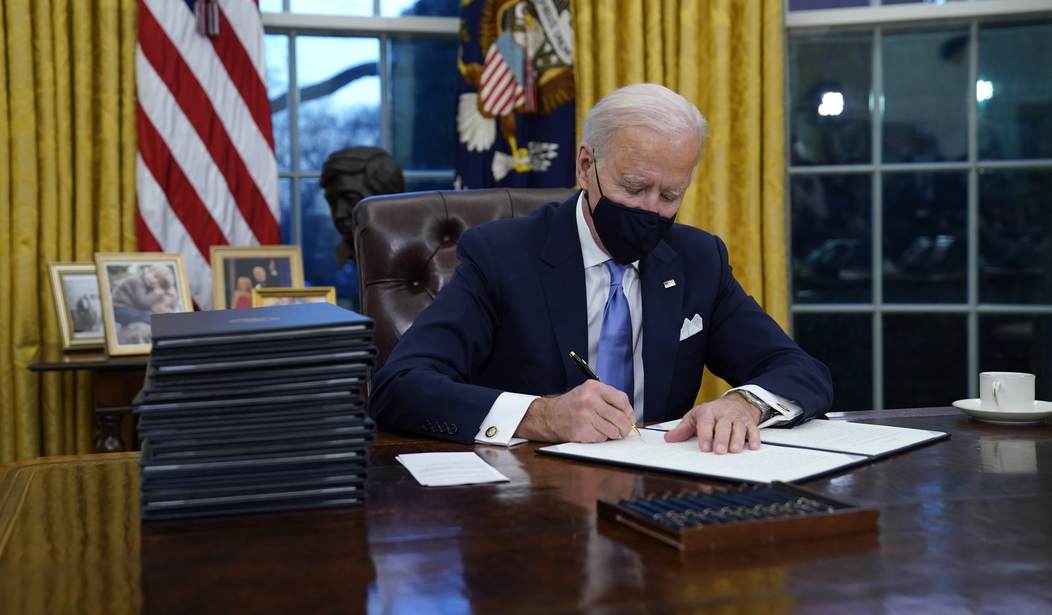
Now it's Joe Biden's turn to govern by decree. In his first two weeks as president, he signed 50 executive orders and memorandums, many directly overturning policies implemented under Trump. Among his changes: rejoining the Paris accord, ending construction of a border wall, canceling the Keystone pipeline permit, reversing the ban on travelers from several majority-Muslim countries, and again permitting support for organizations that promote abortion.
This has become the norm in American politics, and it should disturb anyone who values representative government and constitutional order — regardless of partisan loyalty. Americans who condemned Obama for bypassing Congress and unilaterally changing policy should have been just as unhappy when Trump later did the same thing. If a president's moves to govern by diktat were alarming under Trump, they should be no less worrisome under Biden. Yet too many pundits and politicos condemn executive imperiousness only when it comes from presidents they don't like. When they support the occupant of the White House, their response is more like that of Paul Begala, one of Bill Clinton's political advisers, who in 1998 summarized the appeal of presidential reliance on executive orders.
"Stroke of the pen, law of the land," Begala told the New York Times. "Kind of cool."
The Founding Fathers didn't think so. Article I of the Constitution begins: "All legislative powers shall be vested in a Congress of the United States." For most of American history, it was taken for granted that Congress would play a decisive role — often the decisive role — in crafting government policy. From settling the West to banning competition-killing monopolies, from the Pure Food and Drug Act to the passage of civil rights, many of the nation's most substantive and far-reaching changes were hammered out through the legislative process, with Congress indispensable to the process.
In recent decades, however, Congress has become almost an afterthought. On the presidential campaign trail, candidates now routinely promise to make sweeping changes in public policy through executive orders, often vowing to do so on their first day in the White House, or to act unilaterally if the legislative branch doesn't give them what they want.
But there are three serious problems with that approach.
First, it is antidemocratic by definition: It bypasses the deliberation, compromise, and consensus-building that are inherent to legislating.
Second, it is polarizing. Each new president now commences his term by signing orders to undo much of what his predecessor leaves behind. The fixation on executive orders contributes to a zero-sum mindset in American politics, with each party determined not merely to advance its political agenda but also to eradicate the agenda of the other party.
Third, it entrenches instability. Executive orders are canceled as easily as they were created. Shifts in policy prove ephemeral. What is America's policy on a border wall? On the Keystone pipeline? On Iran's nuclear development? When the answers to such questions are a matter of presidential caprice rather than an act of Congress, they aren't answers at all — merely holding patterns apt to change after the next election.
Biden, the first president since Lyndon Johnson to be elected following a long career in Congress, might reflect on LBJ's approach to achieving enduring change.
In a 1973 interview with Walter Cronkite, Johnson explained why he had insisted that civil rights reforms be grounded in legislation. Black leaders had "wanted me to issue an executive order and proclaim this by presidential edict," he recounted. "But I didn't think it would be very effective if the Congress had not legislated, and I didn't want to . . . start running the government by executive order." Legislation is harder, but it lasts.
Biden surely understands this. "We're a democracy. We need consensus," he said during his run for the White House. Make that your mantra, Mr. President. Put down the pen with which you've been signing executive orders, and focus on legislation instead. It will be more challenging to work through Congress. But the legacy you craft will have far more legitimacy. And your successor won't be able to undo it with the stroke of a pen.
Jeff Jacoby is a columnist for The Boston Globe.
Join the Conversation
VIP members get the ability to comment on articles.