







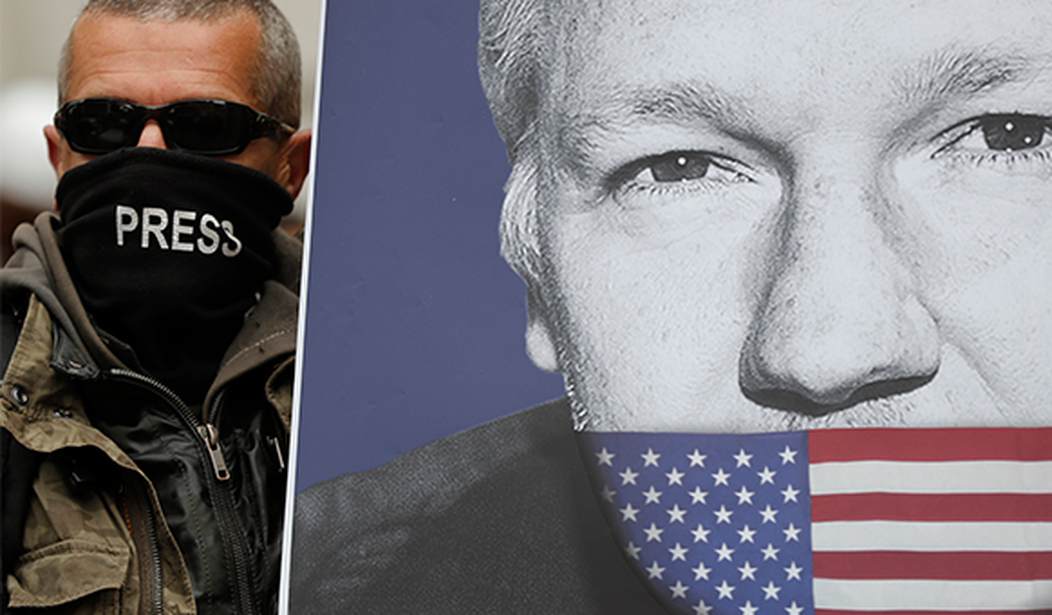
WikiLeaks founder Julian Assange has been imprisoned in London for five years, while Texas journalist Priscilla Villarreal was only briefly detained at the Webb County Jail. But both were arrested for publishing information that government officials wanted to conceal.
Assange and Villarreal argue that criminalizing such conduct violates the First Amendment. In both cases, the merits of that claim have been obscured by the constitutionally irrelevant question of who qualifies as a "real" journalist.
Assange, an Australian citizen, is fighting extradition to the United States based on a federal indictment that charges him with violating the Espionage Act by obtaining and publishing classified documents that former U.S. Army intelligence analyst Chelsea Manning leaked in 2010. He has already spent about as much time behind bars as federal prosecutors say he would be likely to serve if convicted.
President Joe Biden says he is "considering" the Australian government's request to drop the case against Assange. But mollifying a U.S. ally is not the only reason to reconsider this prosecution, which poses a grave threat to freedom of the press by treating common journalistic practices as crimes.
All but one of the 17 charges against Assange relate to obtaining or disclosing "national defense information," which is punishable by up to 10 years in prison. Yet all the news organizations that published stories based on the confidential State Department cables and military files that Manning leaked are guilty of the same crimes.
More generally, obtaining and publishing classified information is the bread and butter of reporters who cover national security. John Demers, then head of the Justice Department's National Security Division, implicitly acknowledged that reality in 2019, when he assured reporters they needn't worry about the precedent set by this case because Assange is "no journalist."
The U.S. Court of Appeals for the 5th Circuit took a similarly dim view of Villarreal in January, when it dismissed her lawsuit against the Laredo prosecutors and police officers who engineered her 2017 arrest. They claimed she had violated Section 39.06(c) of the Texas Penal Code, an obscure law that makes it a felony to solicit or obtain nonpublic information from a government official with "intent to obtain a benefit."
The cops said Villarreal committed that crime by asking Laredo police officer Barbara Goodman to confirm information about a public suicide and a fatal car crash. As interpreted by the Laredo Police Department, Section 39.06(c) sweeps even more broadly than the Espionage Act, making a felon out of any reporter who seeks information that is deemed exempt from disclosure under the Texas Public Information Act.
Gliding over the alarming implications of making it a crime for reporters to ask questions, the 5th Circuit dismissed the idea that Villarreal is "a martyr for the sake of journalism." The majority opinion by Judge Edith Jones dripped with contempt for Villarreal, an independent, uncredentialed journalist who posts her unfiltered reports on Facebook instead of publishing vetted and edited stories in a "mainstream, legitimate" news outlet.
Seemingly oblivious to what quotidian news reporting across the country entails, Jones faulted Villarreal for relying on a "backchannel source" and for "capitaliz[ing] on others' tragedies to propel her reputation and career." But like the judgment that Assange is "no journalist," such criticism fundamentally misconstrues freedom of the press, which applies to anyone who engages in mass communication.
The 5th Circuit's decision provoked four dissents authored or joined by seven judges, and it is not hard to see why. "If the First Amendment means anything," Judge James C. Ho wrote, "surely it means that citizens have the right to question or criticize public officials without fear of imprisonment."
In a petition it filed on Villarreal's behalf last week, the Foundation for Individual Rights and Expression urges the U.S. Supreme Court to vindicate that right. "Villarreal went to jail for basic journalism," it notes. "Whatever one may make of Villarreal's journalistic ethics, they are of no constitutional significance."


Join the Conversation
VIP members get the ability to comment on articles.