





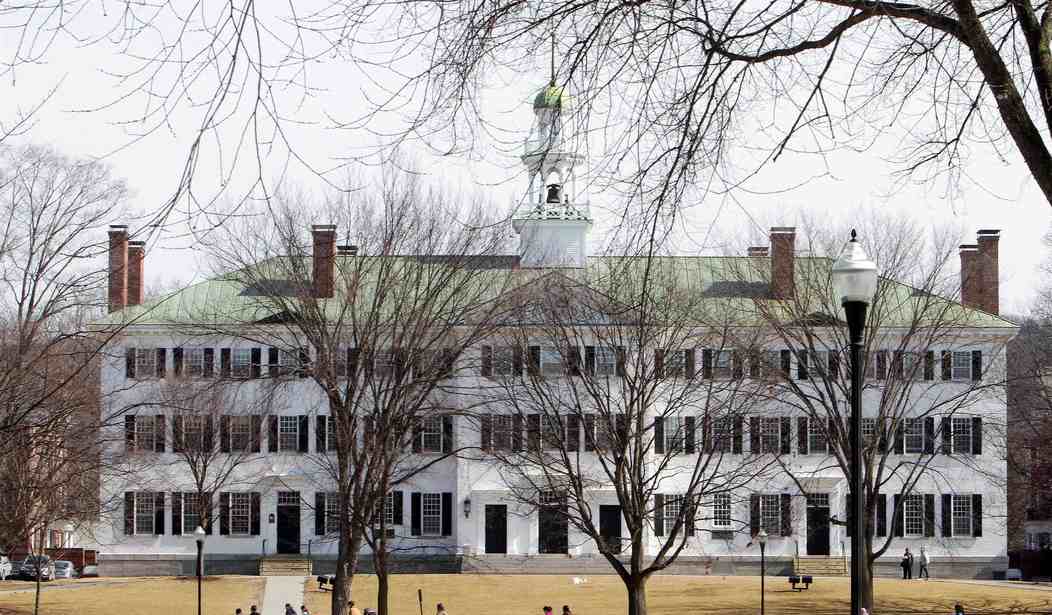
A recently conducted Dartmouth University survey supplies some invaluable insights.
According to The Dartmouth, “undergraduates were asked if learning that another student had political beliefs opposite from their own would affect a range of possible interactions with them.” Reportedly, 42 percent of respondents said that they would be less likely to befriend a person if that person’s politics were contrary to their own.Seventy percent remarked that they’d be less likely to get romantically involved with someone with differing political views. And 30 percent admitted to being less likely to trust a person with an opposite political perspective.
Yet the report is quick to note that these numbers in themselves conceal “sizable political differences [.]”
Democrats, it’s reported, are far more likely than Republicans or Independents to allow their politics to affect their relationships.
“While 82 percent of respondents who identified as Democrats say they would be less likely to date someone with opposing political beliefs, only 47 percent of Independents and 42 percent of Republicans said the same.”
When it comes to potential friendships, “55 percent of Democratic respondents said opposite political views would make them less likely to befriend another student, compared to 21 percent of Independents and 12 percent of Republicans.”
Judging from these results, students who are Democrats are the most intolerant of political differences while Republican students are vastly most tolerant than Democrats and even more tolerant than Independents—a situation that is the exact opposite of the picture that the left has been painting for decades.
The survey also found that while “majorities” of respondents claimed that knowledge of the political commitments of their professors would not dissuade them from taking classes with those professors, Democratic students were less likely than Independents and Republicans to enroll in courses taught by those with differing political views.
“Democratic students express less willingness to take classes from a Republican professor (38 percent) than Republican students do to take a class taught by a Democratic professor (23 percent).” Moreover, of the four political orientations offered in the survey—Republican, Democrat, Libertarian, and Socialist—the 25 percent or so of student respondents who expressed a disinclination to enroll in a course whose instructor subscribed to a political perspective at odds with their own, Republican professors were most unpopular.
“About a quarter of respondents said that knowing a professor is a Republican (26 percent) or a Socialist (23 percent) would make them more unlikely to take a class.”
To repeat, Republican professors are more unpopular than avowed socialists.
In stark contrast, only 16 percent of students suggest that they would be less likely to take a class with a known libertarian professor, and a mere 6 percent would be deterred from enrolling in a course taught by a Democrat.
The findings of the survey on the issue of free speech coheres neatly with the foregoing information.
The Foundation for Individual Rights in Education (FIRE) demoted Dartmouth this past year from a “yellow light” to a “red light.” According to Samantha Harris, Vice-President of policy research at FIRE, it was Dartmouth’s “Acceptable Use Policy” that accounts for the demotion. Under its restrictions, “broad categories of speech, a great deal of which would be entitled to First Amendment protection at a public university,” are banned. Despite this, the authors of the Dartmouth survey assure us that Dartmouth students do not think that free speech is under assault at their school.
However, this last verdict is revealing for what it conceals.
For starters, while 52 percent of students said that free speech is “very or somewhat secured,” 33 percent said that it is “very or somewhat threatened.” So, a third of the student body at Dartmouth, to judge from this survey, are of the latter opinion.
Secondly, “three times as many Republicans (69 percent) think free speech is threatened than do Democrats (21 percent).”
Thirdly, immediately after reporting that Dartmouth students judge that free speech is well and good at their institution, the survey finds that answers to “a related question about freedom of self-expression paints a somewhat different picture….”(emphasis added).
And what is this picture? “When asked about whether ‘the climate on Dartmouth’s campus prevents some people from saying things they believe because others might find them offensive,’ a large majority of respondents (81 percent) said they strongly or somewhat agree” (emphasis added).
The truth is in the details, and the details here confirm what anyone and everyone who hasn’t been living under a rock have long known.
“Republicans (94 percent), white students (86 percent), men (87 percent) and students affiliated with Greek life (86 percent) are most likely to agree that such a limit exists [on] campus speech.”
When students were asked whether it was more important for Dartmouth to foster an environment that prohibits “certain speech or expression of viewpoints that are offensive or biased against certain groups of people” or one in which “students are exposed to all types of speech and viewpoints, even if it means allowing speech that is offensive or biased against certain groups of people,” seven out of ten respondents opted for the latter.
Of these, though, students who are Republican (94 percent), white (71 percent), and male (84 percent) “were most likely to opt for” robust freedom of speech and expression.
It is not until the end of the report that readers are informed of one especially relevant, quite telling fact: “Dartmouth’s student body is about two-thirds Democrat (67 percent) with small minorities of Republican identifiers (19 percent) and Independents (14 percent) [.]”
In summary, the Dartmouth survey establishes the truth of three propositions:
(1)Republican students are overwhelmingly outnumbered by Democrats at Dartmouth.
(2)Republican students are far more tolerant of diverse viewpoints than Democrats at Dartmouth.
(3)Republican students value freedom of speech and expression far more than do Democrats at Dartmouth.
In a word, the Dartmouth survey confirms what many of us have long known while radically undercutting the left’s narrative concerning conservatives and Republicans as agents of intolerance.



Join the Conversation
VIP members get the ability to comment on articles.