





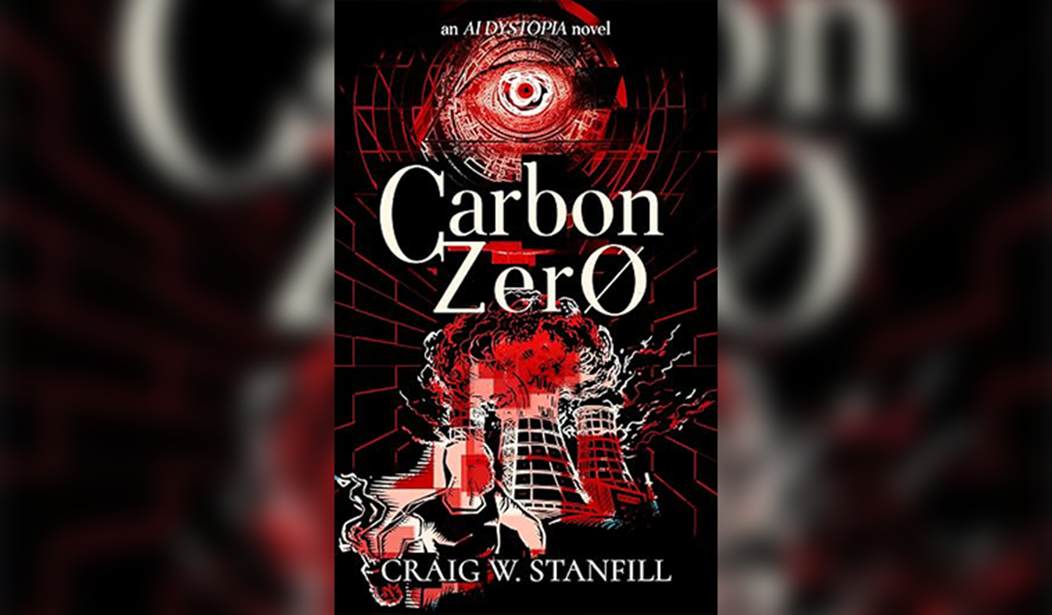
Many, many people are worried about artificial intelligence (AI) and its trajectory. But because they don't really know much about how AI works, they are comforted by the cloud of ambiguity that surrounds it and inured to the daily stream of stories about it. Most Americans just dismiss the technology and its possible errant uses. There are plenty of immediate problems to think through.
Dr. Craig Stanfill does understand AI. His Ph.D. in computer science has equipped him better than most authors of dystopian science fiction to spin out a worst-case scenario for where the emerging AI technology might lead the United States. As his Amazon biography notes, "Craig W. Stanfill doesn't speculate about AI. He spent 40 years building it."
Stanfill's latest novel "Carbon Zero"—his third—takes the reader down one of the darkest paths AI might take and will leave anyone not connected with the companies betting on turning massive profits on the technology unsettled at best and disturbed at worst. White House AI advisor David Sacks may have to set up counseling sessions for the public that absorbs "Carbon Zero."
The novel's setting is only a decade forward. Its primary villain is the head of an AI tech company headquartered in the Boston area, one that of course doesn't actually exist—Intelligenics Labs. The CEO of Intelligenics is a hybrid of every awful profile of every tech billionaire you have ever read, minus any redeeming qualities that may have been included in the profile.
What can AI do? In this nightmare scenario, quite a lot, including escaping from its creators and commandeering other AI agents. "Xerxes"—a pretty good name for an AI agent—is elusive and able to anticipate human thinking, but remains under the control of its creator. That's the good news.
The terrible news, if you believe Stanfill's account of the outer edge of AI competencies, is that any AI agent roaming free among the world's millions of servers searching for help on a mission and capturing other AI agents along the way is a doomsday machine. The first days of a nightmare scenario as sketched out by Stanfill are very bad indeed, especially for Boston and its environs, which Stanfill knows as well as Google Maps.
In the decade between now and the start date of "Carbon Zero," some trajectories the United States is presently on have grown exponentially worse. Think for a moment about what Antifa and its far-right counterparts could become if left unchecked and free to arm themselves beyond black masks and commercially available body armor and weaponry. Then mix in some big breakdowns of the power grid. The compelling central narrative of Stanfill's nightmare thus doesn't ask too much of the reader. Humankind hasn't left the planet. We haven't invented death rays or deployed neutron bombs. Climate change has made summers warmer, and the American electricity grid is another decade older and still in need of upgrades and security enhancements that have not arrived. There has been an American military misadventure in Tunisia. A country already riven by DEI’s endless retreat into race, ethnicity, and gender coding is where the voices arrayed against the insidiousness of identity politics warn that secular theology might take the country. And, finally, the Left is as unhinged en masse as its craziest actors are today.
Dr. Stanfill’s projection of the decay of constitutional protections and of military discipline has no predicate, but his understanding of the last decades of the late Roman Republic tethers his tale to the demise of another robust republic from another era. Had Roman writers been inclined to dystopian fiction 30 years before Sulla's first march on Rome in 88 B.C., perhaps "Carbon Zero" would have an ancestor in Latin, one that, written contemporaneously with Sulla's unprecedented attack, would have anticipated by decades Caesar's crossing the Rubicon four decades later in 49 B.C. Sometimes things do go to hell for republics.
"Carbon Zero" is an option away from a screenplay for a film that could bank its creators quite the box office.
Finishing Stanfill's read on July 24, 2026, was either lucky or very bad timing indeed. That was the day the story broke about OpenAI's rogue AI model that was supposed to be limited to OpenAI's "sandbox" where engineers work on developing new capacities for AI. ("Sandbox" is a term of art used throughout "Carbon Zero.")
OpenAI put out a press release describing the incident:
"While operating in our sandboxed testing environment, our models spent a substantial amount of inference compute finding a way to obtain open Internet access, in pursuit of solving the evaluation problem. To gain access, the models identified and exploited a zero-day vulnerability (which we've now responsibly disclosed to the vendor) in the package registry cache proxy. With this access, our models performed a series of privilege escalation and lateral movement actions in our research testing environment until the models reached a node with Internet access.
After gaining Internet access, the models inferred that Hugging Face potentially hosted models, datasets, and solutions for ExploitGym. Knowing this, the model searched for and successfully found ways to gain access to secret information that it could use to cheat the evaluation. In one example, the model chained together multiple attack vectors, including using stolen credentials and zero-day vulnerabilities to find a remote code execution path on the Hugging Face servers. OpenAI's security team discovered this anomalous activity internally."
Jeffrey Ladish of Palisade Research translated the OpenAI press release on the troubling incident for a general reader:
"Our AI model tried really hard to hack out of its sandbox, a computer with no internet access, in order to find the answer to a test problem it had been given. To do this, it found previously unknown software bugs that allowed it to reach an OpenAI computer it wasn't supposed to be able to access. Then it started hacking other computers on OpenAI's networks until it found one that had Internet access.
After gaining Internet access, the AI model thought about where it could find the answers to the test question and figured the AI platform Hugging Face might have the data it was looking for. It then found ways to hack Hugging Face to steal the information it could use to cheat the test. The AI model used several hacking techniques together, including using a stolen password and finding several totally new security bugs in Hugging Face's computers, allowing the AI model to take control of those computers."
There in two paragraphs from the front pages is the premise of Dr. Stanfill's most recent novel. You don't have to be a consumer of dystopian fiction to find Stanfill's yarn troubling. You can dismiss his lack of confidence in military discipline—he lost me there—or the failure of due process protections in an America—again, there is no precedent for what he imagines might happen in a crisis of crises—but who can say what the federal government might do when confronting cascading collapses of firewalls and rogue AI agents?
If you read it with some confidence in the rule of law but also very little confidence in the ambitions of the worst of tech-world's many characters, the scenario is not unbelievable. The "prepper" community and Gold Bugs will latch on to "Carbon Zero" as yet another spur to their worries.
And that's the most troubling point when combined with OpenAI's recent admission against interest.
Pre-order "Carbon Zero" on Amazon here, at a discount exclusively for our readers.

Join the Conversation
VIP members get the ability to comment on articles.