





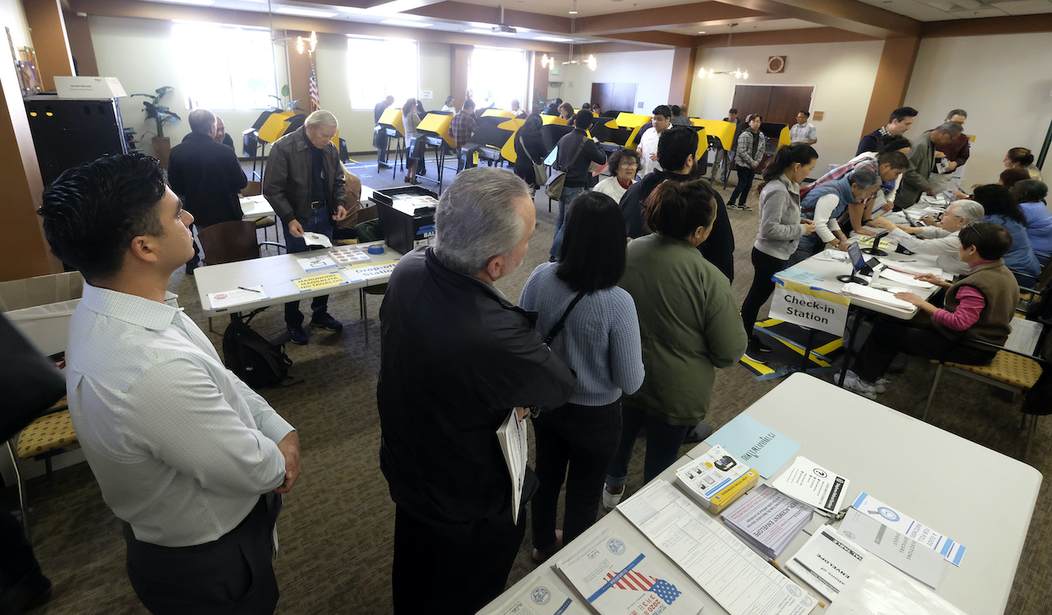
After the 2016 presidential election, I wrote an exceptionally unpopular op-ed for The Washington Post headlined, "We must weed out ignorant Americans from the electorate." In it, I noted that "never have so many people with so little knowledge made so many consequential decisions for the rest of us."
My assumption has always been that the Post only accepted the piece because its editors believed I was aiming my criticism exclusively at the right-wing populists who had just voted for Donald Trump. If so, they were wrong. My skepticism extends to all sides.
And to all elections. Indeed, today, the problem is even more severe. More Americans voted in 2020 than ever before even though Joe Biden was rarely impelled to answer a substantive question on policy or even to show himself in public. 2020 might have featured the most vacuous campaigns in American history. This is what "democracy" looks like when propelled by fearmongering, ignorance and the "common impulse of passion," as James Madison warned. I mean that all around.
We encourage Americans to vote as if it is the only right of a citizen, without any corresponding expectations. And as if that constant cultural haranguing to vote weren't annoying enough, after every election, no matter how many people participate, there is a campaign to force everyone to do it.
"America Needs Compulsory Voting," writes a professor in Foreign Affairs. "A Little Coercion Can Do a Lot for Democracy." "1 In 3 Americans Didn't Vote. Should We Force Them To Next Time?" asks BuzzFeed.
Ideally, in a free nation, the answer to "should we force them?" is almost always "no." But for the folks at places such as the Brookings Institution and Harvard University's Ash Center for Democratic Governance and Innovation, the answer is almost always "yes." In July, these think tanks laid out their case for mandatory voting in a report titled "Lift Every Voice: The Urgency of Universal Civic Duty Voting." I wish I could whip up an equally anodyne euphemism for "ugly authoritarian instinct," but none immediately comes to mind.
None of this is new, of course. Over the years, we've seen similar columns in The New York Times and Time. Obama administration officials such as Peter Orszag, an advocate of compelling everyone to buy state-mandated health insurance, were arguing that the United States "prides itself as the beacon of democracy, but it's very likely no U.S. president has ever been elected by a majority of American adults." Maybe the lesson here is that we should pride ourselves on how many freedoms we enjoy rather than how people vote.
"The hope is not that the United States of America tomorrow morning is going to adopt this," E. J. Dionne, who is a Georgetown University professor of government, a Washington Post columnist and a senior fellow at the Brookings Institution, told BuzzFeed, "but we do hope that cities, counties, states would take a look at this and perhaps adopt it experimentally, the way, say, Maine has adopted instant runoffs."
Some of us do not share the hopes of Dionne, a long-time proponent of forcing Americans to do all sorts of things. The Constitution makes no stipulation that citizens must vote. It doesn't even mention voting as an individual right. We have no civic duty to vote. I haven't voted for president since 2000. I haven't voted at all since 2004.
For me, this is a proactive political choice. But maybe some Americans don't vote because they are anarchists, or monarchists, or nihilists. Some Americans might not be satisfied with any of their choices. Some might rather be watching cartoons. It's none of Dionne's business. The last thing we should do is make those who aren't interested, motivated or feel unprepared to make sound decisions act against their will.
Whenever I mention that compelling people to participate in the political system is authoritarian, someone will ridicule me by noting that voting is the hallmark of "democracy." One wonders if citizens of, say, Hong Kong, who had no real vote as British colonial subjects for 150 years, feel freer today than they did 30 years ago. Sure, mandatory voting exists in Australia and Belgium. But it also exists in Bolivia, Congo, Dominican Republic, Egypt and Lebanon. In fact, historically speaking, authoritarian states often adopt compulsory voting as a way of creating a false sense of democratic legitimacy. If you're compelling people to participate, you're not doing "democracy."
2020 saw record turnout -- though calling it a "turnout" is a bit misleading since the involvement was largely a function of states' haphazardly mailing out paper ballots to everyone. All mandatory-voting advocates are doing is further degrading the importance of elections and incentivizing more demagoguery. If they truly believed democracy was sacred -- rather than a way to accumulate power -- they'd want Americans to put more effort into voting for the president than they do in ordering Chinese takeout. And they certainly wouldn't want to force anyone to do it.
David Harsanyi is a senior writer at National Review and the author of the book "First Freedom: A Ride Through America's Enduring History With the Gun."
Join the Conversation
VIP members get the ability to comment on articles.