







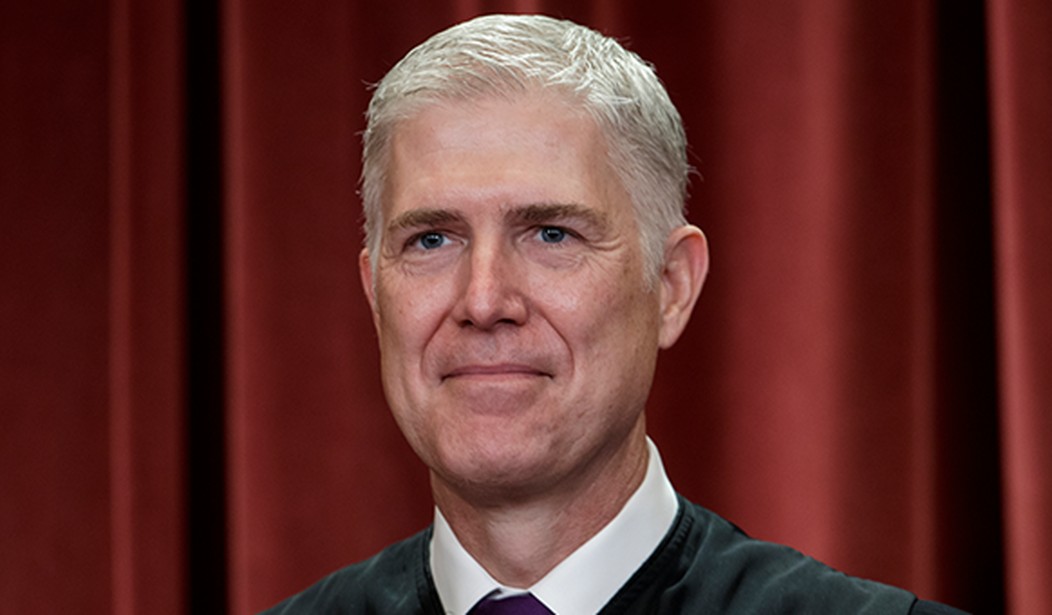
This week, the Supreme Court struck down a Montana constitutional provision barring religious schools from benefiting from the state's tax dollars. There are similar now-unconstitutional laws on the books across the nation -- many of them borne of anti-Catholic bigotry -- that subvert religious liberty and further empower government, rather than parents, to make educational choices for their kids. In most cases, those laws are now dead.
Some of us happen to believe that this development is more consequential than another tax cut or better trade policy. For us, school choice and the meaningful protection of religious liberty are non-negotiable. Would you know this from listening to the press?
Voters who took a completely rational view of the transactional nature of American politics, and who pulled the lever for Donald Trump as a result, are ridiculed with the derisive phrase, "But Gorsuch." Some liberals, such as Bill Scher, make the argument explicit, contending that "the GOP traded its principles for conservative judges. It was a bad deal." They misunderstand conservative priorities.
You'll notice, first off, that Democrats never betray "principles"; rather, they engage in pragmatism when supporting flawed candidates. I hate to break the news to them, but backing a corrupt and philosophically vacant charlatan like Hillary Clinton, who had no problem "wooing" Vladimir Putin and a slew of other authoritarians, was also an unprincipled choice. It's just one they're comfortable with. Still, whatever the choice, "But Gorsuch" is literally correct. Trump's judicial picks will transcend his tweets and his anarchic time in office. Moreover, considering the speed with which the mainstream Left has abandoned elementary republican governance, the courts may well be the only way to preserve our traditional constitutional order -- at least, in the short term.
One reason the courts exist is to temper the excesses and vagaries of crude majoritarianism. There is no reason whatsoever to shy away from demanding that courts uphold the law as written -- which is not the same as judicial activism, though liberals gleefully conflate the two. Scher argues that, historically speaking, Trump's record on judges been neither unique nor impressive, and that his loss might well pave the way for more liberal judges. That's certainly one way to look at it. Another way to look at it is that Trump's improbable win interrupted a potential 16-year string of anti-constitutional appointments, and, to some degree, balanced the ideological disposition of the courts moving forward. The idea that Democrats wouldn't have waged the same war on the judiciary if Clinton had won -- after they had blown up the judicial filibuster -- is, of course, baloney. They just thought they were going to win again.
"But Gorsuch" also had immediate implications. Without Gorsuch, there is no Janus v. AFSCME, and unions would still be forcing workers to pay dues to organizations that participate in political causes they do not support. Without Neil Gorsuch and Brett Kavanaugh -- who, say what you will about Trump, was unlikely to have sustained the support of any other Republican president through such a malicious confirmation battle -- states such as Colorado would still openly be destroying the lives of Americans over thought crimes.
A Supreme Court with two Hillary Clinton appointees would be whittling away the free speech protections of Citizens United. It would be hammering the Second Amendment protections that were reaffirmed by Heller and McDonald. Roberts may view himself as a Solomonic strategist and stickler for precedent, but his liberal colleagues have little problem dispensing with it whenever convenient.
It's true that Republican presidents often flub their picks. Gorsuch disappointed social conservatives when helping invent new protections for LGBT workers. Roberts, a George W. Bush appointee, will be a perpetual disappointment, I'm sure. Yet, both are worlds better than the alternative. You don't need to look any farther than the Montana school-choice decision to understand why.
The lesson gleaned from recent history isn't that Republicans have gotten a "bad deal," but rather that Republicans should fight harder to seat more jurists like Clarence Thomas and fewer like John Roberts. There is no "winning" in politics, after all, there is just constant struggle. Conservatives, as their name indicates, rack up unappreciated victories by hindering the progress of bad ideas and preventing them from coagulating into law.
Was Gorsuch worth it? Counter-histories are most often a waste of time. Perhaps Trump's election damaged the long-term prospects of conservative causes. Perhaps Democrats wouldn't have radicalized as quickly had Clinton been president. It doesn't really matter now. There are plenty of reasons a person may have not to vote for Donald Trump, yes. But the underlying arguments for "But Gorsuch" are stronger than ever.
David Harsanyi is a senior writer at National Review and the author of the book "First Freedom: A Ride Through America's Enduring History With the Gun."


Join the Conversation
VIP members get the ability to comment on articles.