






It’s difficult to promote good economic policy when some policy makers have a deeply flawed grasp of history.
This is why I’ve tried to educate people, for instance, that government intervention bears the blame for the 2008 financial crisis, not capitalism or deregulation.
Going back in time, I’ve also explained the truth about “sweatshops” and “robber barons.”
But one of the biggest challenges is correcting the mythology that capitalism caused the Great Depression and that government pulled the economy out of its tailspin.
To help correct the record, I’ve shared a superb video from the Center for Freedom and Prosperity that discusses the failed statist policies of both Hoover and Roosevelt.
Now, to augment that analysis, we have a video from Learn Liberty. Narrated by Professor Stephen Davies, it punctures several of the myths about government policy in the 1930s.
Professors Davies is right on the mark in every case.
And I’m happy to pile on with additional data and evidence.
Myth #1: Herbert Hoover was a laissez-faire President – Hoover was a protectionist. He was an interventionist. He raised tax rates dramatically. And, as I had to explain when correcting Andrew Sullivan, he was a big spender. Heck, FDR’s people privately admitted that their interventionist policies were simply more of the same since Hoover already got the ball rolling in the wrong direction. 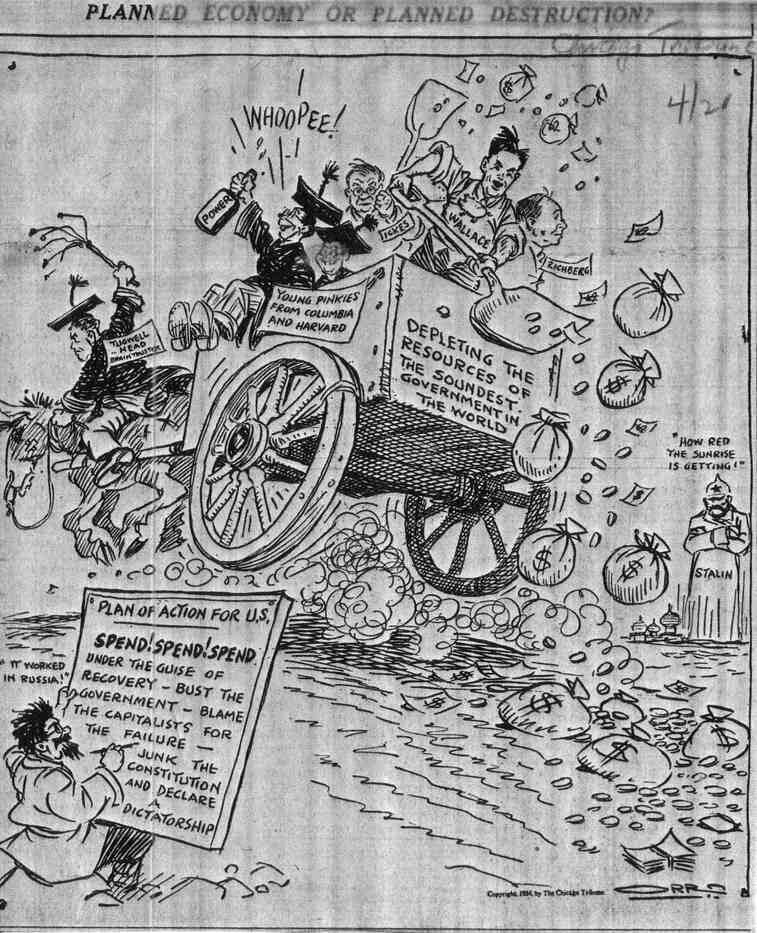 Indeed, here’s another video on the Great Depression and it specifically explains how Hoover was a big-government interventionist.
Myth #2: The New Deal ended the depression – This is a remarkable bit of mythology since the economy never recovered lost output during the 1930s and unemployment remained at double-digit levels. Simply stated, FDRkept hammering the economy with interventionist policies and more fiscal burdens, thwarting the natural efficiency of markets.
Myth #3: World War II ended the depression – I have a slightly different perspective than Professor Davies. He’s right that wars destroy wealth and that private output suffers as government vacuums up resources for the military. But most people define economic downturns by what happens to overall output and employment. By that standard, it’s reasonable to think that WWII ended the depression. That’s why I think the key lesson is that private growth rebounded after World War II ended and government shrank, when all the Keynesians were predicting doom.
By the way, Reagan understood this important bit of knowledge about post-WWII economic history. And if you want more evidence about how you can rejuvenate an economy by reducing the fiscal burden of government, check out what happened in the early 1920s.
P.S. If you want to see an economically illiterate President in action, watch this video and you’ll understand why I think Obama will never be as bad as FDR.
P.P.S. Since we’re looking at the economic history of the 1930s, I strongly urge you to watch the Hayek v Keynes rap videos, both Part I and Part II. This satirical commercial for Keynesian Christmas carols also is very well done.


Join the Conversation
VIP members get the ability to comment on articles.