






When I write about the importance of understanding the difference between a disease and its symptoms, I’m almost always seeking to help people understand why it’s important to focus on the problem of government spending rather than the side-effect of government borrowing.
But the same analogy is useful when looking at issues such as lobbying and campaign contributions.
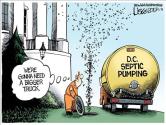 It’s very understandable for people to get nauseated when we see things such as lobbying for corporate welfare or campaign contributions being given in exchange for things such as ethanol subsidies.
So would it make sense to outlaw lobbying or to restrict campaign contributions? Setting aside constitutional issues (the First Amendment protects our rights to petition the government and to engage in political speech), the answer is no.
Why? Because lobbying and campaign contributions are a function of government being too big and being involved in too many areas.
If we shrink the size and scope of the state, we reduce incentives to manipulate the system. But if we leave big government in place, laws to restrict lobbying and campaign contributions will simply lead to different forms of “rent seeking.”
Not surprisingly, leftists want the wrong approach. Here are some excerpts from Dana Milbank’s Washington Post column, which argues that campaign spending is the problem.
…the Supreme Court…has created a campaign-finance system that is directly responsible for the rise of uncompromising leaders on both sides of the Capitol. …Political money was again before the Supreme Court on Tuesday morning, and, judging from their questions, the conservative justices are poised to make things even worse.Now they are prepared to expand on their 2010 decision that caused an explosion of independent spending by allowing the wealthy to give about $3.5?million apiece to candidates and parties in each election cycle. …The 1976 decision in Buckley v. Valeo made government for sale and created the arms race in campaign financing by equating unlimited spending with free speech. The John Roberts court in 2010 made the system dramatically worse in its Citizens United decision, loosening restrictions and spurring wealthy donors to make hundreds of millions of dollars in independent expenditures. …Justice Elena Kagan said those who give $3.5 million should expect “special treatment” from Congress — and Burchfield didn’t disagree. Under the Citizens United decision, he said, “gratitude and influence are not considered to be quid-pro-quo corruption.”

Milbank puts the cart before the horse. Big donors aren’t the problem. We should worry about big government.
If we had the type of limited central government envisioned by the Founding Fathers, there would be very little reason for billionaires (or the rest of us) to spend time or energy worrying about what happens in Washington.
I elaborate in this video on the real causes of political corruption in Washington.
P.S. In the title, I wrote that campaign contributions are a “possible” symptom. That’s because campaign contributions (like lobbying) don’t necessarily imply corruption. If John Doe gives money to someone like Rand Paul, he’s probably not looking for a government handout. But if the realtors cut a big check to someone like Chuck Schumer, it’s quite likely that they’re looking to obtain or preserve some undeserved goodie from Washington.


Join the Conversation
VIP members get the ability to comment on articles.