





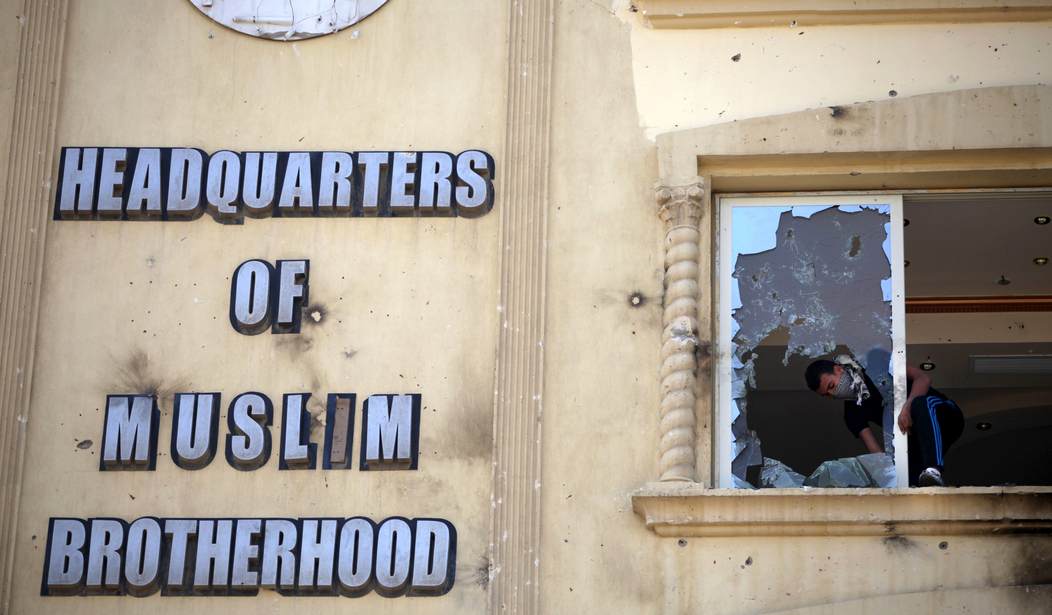
The United States' recent designation of three Muslim Brotherhood chapters (Egypt, Jordan, and Lebanon) as terrorist organizations signals the start of a predictable phase of organizational adaptation within the ranks of this highly deceptive Islamist group. The century-long history of the Muslim Brotherhood indicates that the group does not easily fall apart under pressure because it excels at retreating, adapting, and recalibrating. Understanding how the Brotherhood is likely to act in the next phase is essential for policymakers who need to stay focused and intensify efforts to dismantle the group effectively and prevent it from rebirth.
My own life was threatened and turned upside down after I fell on the wrong side of this evil organization when I was forced out of Egypt, my homeland. What was my crime? Publicly condemning Hamas' barbaric war crimes that raped and mutilated women and girls, murdered over 1,200 innocent people, and kidnapped 254 children and adults when it invaded Israel on October 7th, 2023. Lest we forget, Hamas itself is in fact the Palestinian branch of the Muslim Brotherhood.
The first and most expected response will be narrative manipulation and twisting facts, which is a game the Brotherhood PR machine has perfected over a decade. The Brotherhood has long relied on the language of victimhood to survive legal and political shocks, and designation offers fertile ground for this strategy. The organization and its affiliated voices are likely to frame U.S. action as political persecution rather than conduct-based enforcement. This is a stabilizing mechanism designed to reassure donors, preserve coalition partners, and discourage internal defections by recasting legal pressure as moral vindication.
In the U.S. and Europe, Brotherhood-aligned groups will focus on civil rights language, democratic principles, and constitutional protections, while deliberately omitting the actions that led to the designation. Their aim is to undermine the legitimacy of the designation process, delay enforcement, and damage the reputation of institutions and officials who acknowledge it. Over time, this approach seeks to turn designation from a legal fact into a disputed political opinion.
Organizationally, the Brotherhood is likely to fragment rather than disappear. Formal structures will become less visible, while informal networks gain greater importance. This pattern has been observed repeatedly since the Brotherhood's designation in Egypt in 2013. Assets are moved out of organizational names and into personal accounts. Leadership authority is dispersed to reduce legal risks while maintaining operational continuity.
Financial adaptation will be especially important. The Brotherhood has traditionally relied on a model that mixes centralized ideological direction with decentralized organizational management. Pressures to designate targets often speed up this process. Expect more reliance on trusted individuals, family networks, and small transactions that fall under regulatory thresholds. This fragmentation does not weaken the group's strategic goals. Instead, it makes detection and enforcement more difficult, increasing the burden on financial oversight instead of cutting off funding sources altogether.
Internally, the designation is likely to deepen existing ideological fractures. The Brotherhood has not been monolithic since losing power in Egypt. Pragmatists, who prioritize survival and gradual reintegration into political life, will argue for disengagement and rhetorical moderation. Hardliners, especially among younger cadres shaped by post-2013 repression, will interpret the designation as proof that confrontation is inevitable. This tension rarely finds a clear resolution. Historically, it has led to cycles of rebranding, splintering, and the rise of new factions that operate at varying distances from overt violence.
These internal divisions are important because they influence external risks. When pragmatic factions lose influence, the chance increases that younger or more radical groups will turn toward militancy, either by joining existing armed organizations or by creating new ones under different labels. A clear example is HASM, a designated violent militia formed by youth from the Egyptian Muslim Brotherhood after the Brotherhood was ousted from power in 2013. On the other hand, when pragmatists hold sway, the organization often focuses on long-term institutional engagement, such as universities, professional associations, and advocacy groups, rather than direct confrontation. Both scenarios present challenges, but they demand different policy strategies.
Perhaps the most concerning change will happen in the realm of identity politics. Brotherhood-affiliated actors are unlikely to openly defend the organization. Instead, they will focus on issue-based advocacy that supports Brotherhood goals without mentioning the movement directly. Palestinian solidarity activism, anti-colonial discourse, and civil rights framing will act as channels for spreading Brotherhood narratives. The focus will be on moral alignment rather than organizational loyalty.
Such a strategy lets the Brotherhood stay relevant while sidestepping direct legal risks. By framing its worldview within larger social movements, it gains coalition support and plausible deniability. The danger for policymakers isn't in direct coordination, which is easier to spot and prosecute, but in operational alignment in situations where U.S.-based platforms accidentally boost narratives that justify or excuse designated terrorist groups.
Designation also changes the Brotherhood's relationship with external state sponsors. Countries that have historically hosted or supported Brotherhood networks might reevaluate the risks of openly associating, especially where U.S. sanctions enforcement is strong. This could motivate Brotherhood members to look for new jurisdictions with less regulation or to further decentralize their global operations. The movement has shown a strong ability to adapt its ideology, even when physically limited.
None of these adaptations implies that the designation was wrong. On the contrary, they prove why the designation was necessary. The Brotherhood's strength has always come from its ability to operate across legal and political boundaries, adapting form without losing substance. Designation limits that flexibility by increasing the cost of participation, restricting access to official institutions, and forcing choices that reveal internal contradictions.
The policy challenge now is not about evidence but about an enforcement strategy that may only target organizational labels and miss the core of the problem. Success depends on ongoing focus on facilitation, financing, and coordination, especially when these happen through intermediaries or under the guise of lawful activism. It also requires institutional patience. The Brotherhood's adaptations are crafted to exhaust legal systems and survive political cycles.
What happens next will test whether U.S. counterterrorism policy can handle hybrid movements that mix ideology, politics, and sporadic violence. The Muslim Brotherhood is not unique in this, but it is instructive. If designation is seen as a symbolic endpoint, the organization will evolve around it. If it is viewed as the start of strict, conduct-based enforcement, the Brotherhood's operational space will shrink over time.
The real question is not how the Brotherhood will behave. Its patterns are well established. The question is whether U.S. institutions will recognize adaptation as continuity and respond accordingly.
Dalia Ziada is the Washington D.C. Coordinator and Research Fellow at the Institute for the Study of Global Antisemitism and Policy.



Join the Conversation
VIP members get the ability to comment on articles.