







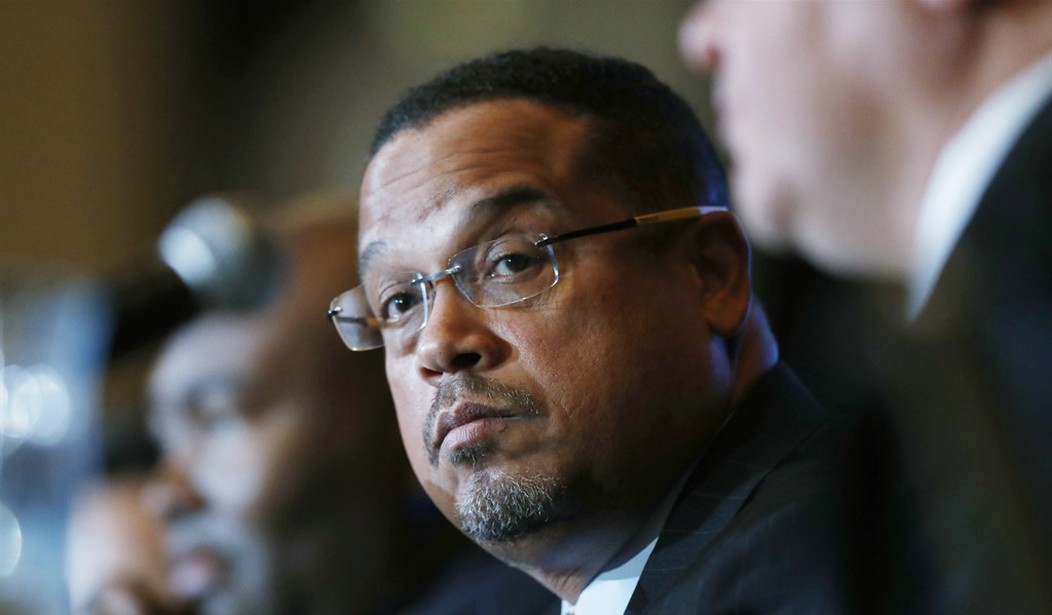
Despite the fact that Keith Ellison spent only a short time with the Nation of Islam, he seems to share with NOI’s leader, Louis Farrakhan, a disturbing conundrum: How, as a black man who is a Muslim, and a potential political leader of American liberalism, does he relate to today’s black slaves in bondage in Muslim lands -- in Sudan, Mauritania and Nigeria?
The answer, it seems with Ellison as with Farrakhan, is to ignore or deny the facts and abandon the slaves.
Indeed, Ellison’s model seems to be Louis Farrakhan, who was caught in a vicious fight over Sudanese slaves a little over two decades ago.
Short version: In 1994, an African Muslim from Mauritania –– Mohammed Athie –– and I broke the story of a modern-day slave trade in Mauritania and Sudan, in The New York Times. We reported that “perhaps 300,000” African Muslims were still serving Arab and Berber masters.
“Black Africans in Mauritania were converted to Islam more than 100 years ago,” we wrote, “but while the Koran forbids the enslavement of fellow Muslims, in this country race outranks religious doctrine. These people are chattel: used for labor, sex, and breeding. They may be exchanged for camels, trucks, guns or money. Their children are the property of the master.”
In Sudan, Africa’s largest country, we reported that slavery was “making a comeback, the result of a 12-year-old “holy war” waged by the Muslim north against the black Christian and animist south. Arab militias, armed by the Government, raid villages, mostly those of the Dinka tribe, shoot the men and enslave the women and children.
These are kept as personal property or marched north and sold.” We based our reports on government documents, human rights publications, and a stunning interview with a UN official.
Soon after the Times story broke, PBS’s Tony Brown Show, the most popular black news program at the time, invited Mohammed and I to speak about slavery. Immediately after our appearance, we were attacked by Farrakhan’s spokesman who denied that blacks served Arab masters in Sudan or –– worse from the NOI’s point of view –– that black Muslims served Arab Muslim masters in Mauritania.
A short time later, the Chicago Tribune’s Clarence Page reported that Farrakhan was being funded in part by Arab despot Muammar Gadhafi.
It was at a press conference in Washington, DC in 1996 that Farrakhan was asked most directly about reports of slavery in Sudan. According to the New York Times, he angrily challenged the reporter: “If slavery exists, go… to Sudan, and come back and tell the American people what you found.”
The Baltimore Sun sent two reporters to Sudan. They found and liberated slaves, and published a special four-page insert in the paper’s weekend edition. Farrakhan refused their request for an subsequent interview.
Farrakhan has always said that slavery in Sudan and Mauritania was a Zionist lie. But it turns out that he met with black South Sudanese leaders in the spring of 1994 who begged him for support –– and to help free the slaves. They wrote that he told them, “When it comes to a choice between religion or the dignity of the black man I will choose my skin.” He betrayed them.
But a small grass roots Christian organization (Christian Solidarity International) and (my own) secular American Anti-Slavery Group worked to redeem tens of thousands of slaves over these years. In March 7, 2012, South Sudan, the world’s newest nation, officially demanded the liberation of 30,000 slaves still held by Arabs in the North.
Still, it is estimated that tens of thousands remain in the North. Not to mention Mauritania’s black Muslim slaves and more recently Boko Haram’s slaves in Nigeria which from time to get receive fleeting attention.
As far as we know, no one has asked Keith Ellison about his silence concerning blacks who are today bought and sold by Arabs and Muslims in Sudan, Mauritania and Nigeria. If he is going to lead the party of American liberalism, he surely should commit to becoming the slaves’ most vociferous champion -- whether they are owned by Muslims or not.

Join the Conversation
VIP members get the ability to comment on articles.