







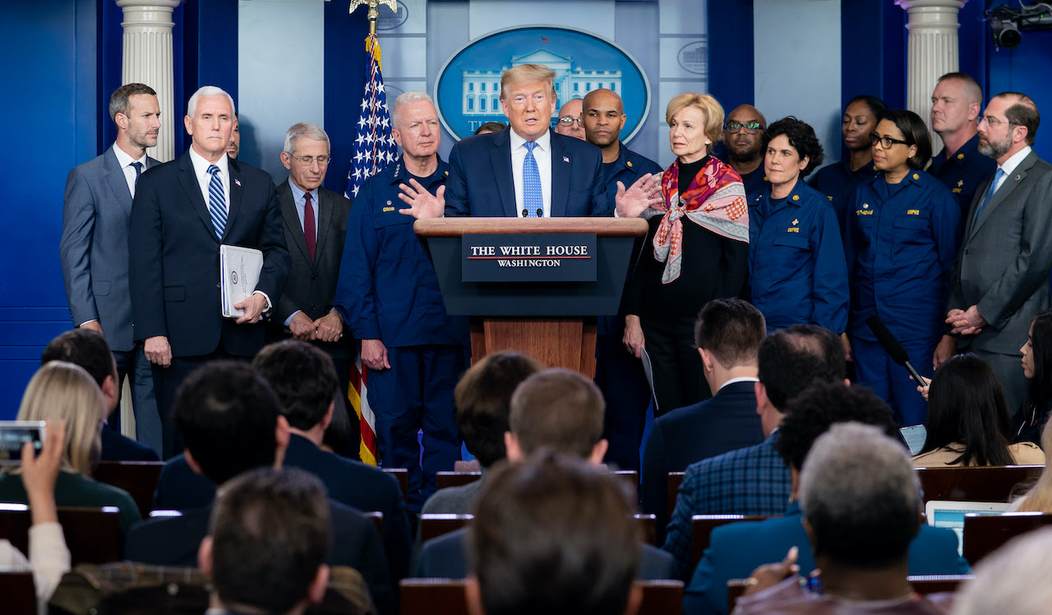
The drastic measures elected and unelected officials are taking to stem coronavirus (COVID-19) contagion reached new heights when President Trump invoked the Defense Production Act on March 18, 2020. The Korean War–era law grants the executive branch emergency powers to require American companies to increase production to combat shortages. Meanwhile, at the state level, governors have prohibited people from making purchases by closing bars, restaurants, spas, and salons.
Officials speculate the pandemic may overwhelm our limited medical resources. But as long as their data remains woefully incomplete, we must remember Newton’s Third Law of Physics: “For every action, there is an equal and opposite reaction.” The draconian restrictions officials are imposing could spark an economic catastrophe more disruptive to American life than the coronavirus itself. So, officials should restrain themselves from depriving people of their freedom to transact unless or until irrefutably necessary.
Imagine if I told you that, by taking a drastic action, we could prevent tens of thousands of deaths and hundreds of thousands of hospitalizations every single year. Would you deem that a worthy intervention? The reflexive reaction is, of course, “Yes.” However, if I told you that action was outlawing all motor vehicles so we could eliminate motor vehicle accidents, then you may rapidly change your mind. You may decide that the benefits of driving justify the risks, and you would be correct.
That is little consolation to someone who has lost a loved one to a motor vehicle accident. But even those who suffer that loss rarely respond by never driving again. They have instinctively made the internal calculation that the benefits far exceed the risks.
We are in an analogous situation with COVID-19. The government has taken extreme, desperate measures to slow the virus’s spread, but in doing so has functionally shut down large segments of our economy. That choice has ramifications. People live and die based on a functioning economy.
This is not merely a money argument; it’s a people argument. The movement and exchange of goods and services brings us food, educates our children, builds our homes, and keeps us safe. A healthy economy, in many regards, implies we are living our lives. But our lives have been brought to a screeching halt by interventions to slow COVID-19. Like the hypothetical elimination of motor vehicles proposed above, there is a tipping point where the disruption is so profound, and the consequences of the disruption so severe, that the treatment is worse than the disease.
Further confounding the situation is that governments are acting on models that replicate the spread of infection, but not the effects of their draconian measures on the economy. Even worse, statistics about COVID-19 currently available are unreliable. Based on these flawed numbers, the absolute number of deaths globally from COVID-19—in a world of nearly 8 billion people—are actually quite small. Anecdotal reports coming out of Italy and other places counter these numbers, though, suggesting far worse casualties are possible.
Because our data on COVID-19 is so incomplete, Dr. Anthony Fauci, director of the National Institute of Allergy and Infectious Diseases, is placed in a classic Cornelian dilemma. He is in a no-win situation. If his interventions succeed and the pandemic is nowhere near as severe as expected, people will scoff and complain that he overreacted. Alternatively, if the infection runs rampant, people will ask why he didn’t do more.
So, what is the right answer? That’s hard to know, but a wrong answer is easier to identify. If it is clearly right for officials to impose restrictions when the lack thereof would irrefutably encourage the spread of COVID-19, then it is clearly wrong for them to restrict freedom except when doing so would irrefutably discourage the spread of COVID-19.
I’m not declaring invalid every harsh measure the federal and state governments take against liberty to contain COVID-19. But we should not long confer god-like powers of life and death on officials who lack god-like knowledge. And facing any uncertainty, those officials should err on the side of liberty.
Chad Savage, M.D. (info@d4pcfoundation.org), is a D4PCF policy fellow and the founder of the DPC practice YourChoice Direct Care in Brighton, Michigan.

Join the Conversation
VIP members get the ability to comment on articles.