





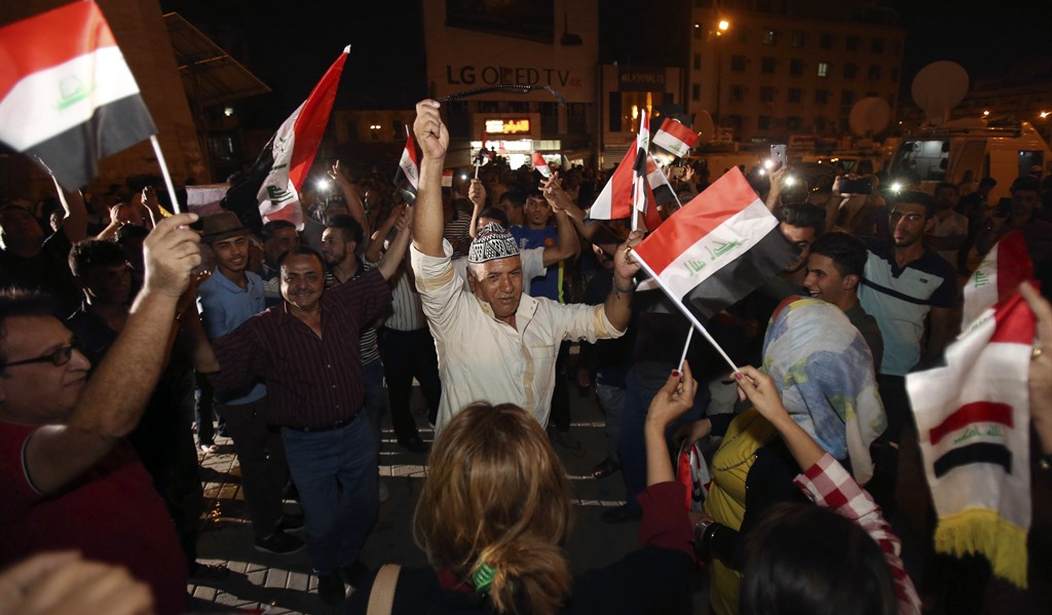
On July 10, Iraqi prime minister Haider al-Abadi declared coalition forces had won a "total victory" in their fight to free the city of Mosul. Since June 2014, the unfortunate city had been occupied by ISIS terrorists.
Abadi's claim of total victory was premature. In the following days, several small firefights erupted around the city. ISIS fighters reportedly entered a liberated village outside Mosul. Had they been hiding, planning to stage "stay behind" attacks on coalition forces? Or were they fleeing? Who knows. In city fights, flickering resistance may continue for weeks after the major battle is done.
Offensive operations to free Mosul officially began on October 16, 2016. "Shaping operations" to prepare for the decisive assault arguably began in 2015. Throughout the campaign the Iraqi government, fragile as it is, remained patient and persistent. To defeat the Islamic State, Iraqi Army and police units conducted operations with pro-Iranian Shia militias of suspect loyalty and Kurdish militias who disdain Baghdad. The government sought U.S. and NATO help, air support first and foremost, but also special operations personnel, the U.S. Marines and Army artillery units, and intelligence and logistics support.
The result: ISIS has lost Mosul, the once upon a time capital of the terrorist caliphate.
The city is severely damaged, with neighborhoods reduced to rubble. Its people have endured sustained terror.
Blame ISIS for the terror and ruin. ISIS commanders relied on beheadings and torture to control the population. They obliterated numerous shrines and historic sites in the region, with the biblical city of Nimrud a special target. Why? Erasing history ISIS leaders deemed "un-Islamic" was a key political policy.
A Muslim shrine could be marked for elimination. In late June 2017, coalition forces had surrounded the city. Iraqi forces, fighting street by street, neared the Al Nuri Grand Mosque, a magnificent building that had defined the city of eight centuries. In June 2014, ISIS senior commander Abu Bakr al-Baghdadi had proclaimed the ISIS caliphate from a balcony in the mosque.
But rather than let Iraqis retake the mosque, which would demonstrate the terrorists' impending loss, ISIS commanders blew it up.
Then they claimed an American airstrike destroyed the mosque.
So forgive prime minister Abadi his exuberance. His government conducted a complex political operation. It oversaw a complicated military operation, for which the forces it had available in 2015 were poorly suited.
One major operational goal stressed by Iraq officers was minimizing civilian casualties. ISIS fighters use civilians as "human shields" to deter coalition attacks on their positions. The thugs who commit this war crime always accuse their adversaries of targeting the civilians. ISIS also makes routine use of mosques as battle positions and supply depots. That complicates offensive operations where the attackers are trying to minimize the destruction.
Another key goal was protecting refugees. At one time, an estimated 1.5 million people were displaced in and around Mosul.
The coalition wanted to use air strikes and heavy artillery shelling very judiciously in order to minimize civilian deaths. However, in order to defeat ISIS the firepower edge, especially that provided by American airpower, had to be utilized. ISIS fanatics had fortified Mosul, particularly the Old City. They had mined the streets and placed improvised explosive devices in buildings. Firepower is an antidote for fanaticism.
Iraqi units also deployed tanks and armored infantry vehicles in Mosul. Armored vehicles are assets in urban warfare if they are protected by infantry on the ground. To successfully employ tanks and infantry in urban combat takes well-trained troops and experienced commanders.
"Mega-cities" -- think Tokyo, Seoul, Los Angeles, Berlin, Lagos, Cairo, Mumbai -- are 21st century political, economic and infrastructure realities. Urban combat in a mega-city will occur.
Mosul has some of the features found in mega-cities. The U.S. and its allies should conduct thorough and candid after action assessments of Iraqi and coalition operations in the liberation of Mosul.
Join the Conversation
VIP members get the ability to comment on articles.