





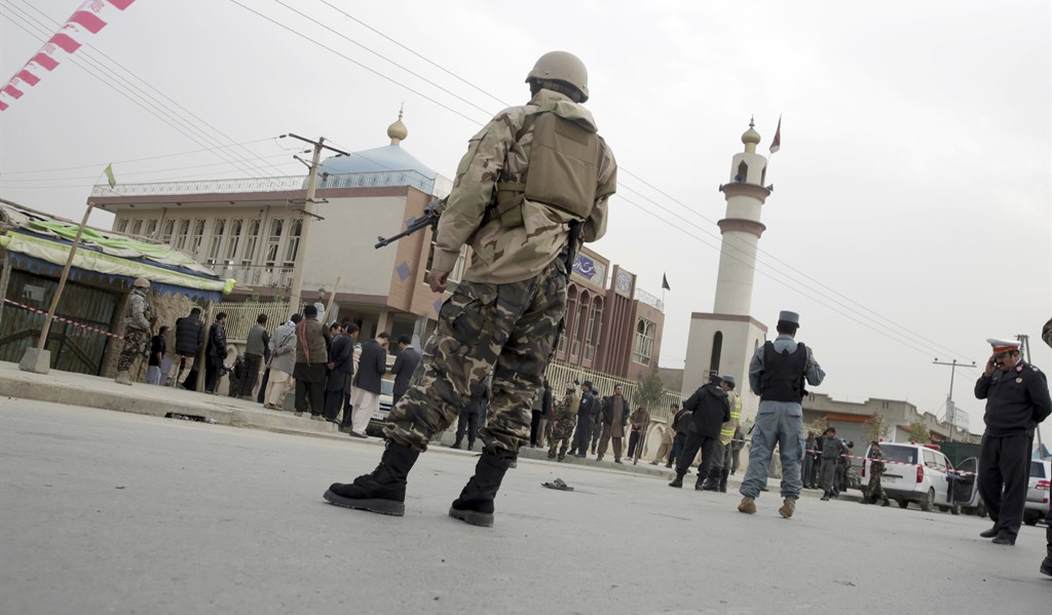
On November 21, an Islamist terrorist entered the Shia Muslim Baqir ul-Uloom mosque in Afghanistan's capital, Kabul. He detonated his explosive-laden suicide vest, killing 30 people and wounding over 70.
Afghanistan's Taliban militant organization denied responsibility for the attack. However, the Islamic State in Iraq and Syria claimed credit for the slaughter, touting it in a press release.
The terror attack incited anger and provoked fear throughout Afghanistan. Even headline writers for Western media outlets understood that dimension. The carnage and human suffering was evident and targeting worshippers in a mosque stirred curiosity. Voice of America published an article that said the mosque attack "is yet another indicator" of ISIS' "expanding terror activities" in Pakistan and Afghanistan.
It is that. It was also the second major attack by ISIS on an Afghan Shia shrine. In October, ISIS gunmen attacked Kabul's Karte Sakhi cemetery shrine and killed 19 Shiites.
The twin attacks on Shiites confirm a larger context illustrating in miniature the Obama Administration's ill-disciplined, shortsighted and always politically self-serving approach to fighting the global war on militant Islamist terrorists.
Recall the compact disc Iraqi Kurds snagged in early 2004. The disc contained a strategic assessment penned by infamous Jordanian al-Qaida operative Abu Musab al-Zarqawi. Part of the text asserted that al-Qaida radicals "are failing to enlist support" inside Iraq and "have been unable to scare the Americans into leaving." It lamented Iraq's "lack of mountains in which to take refuge" -- a major terrain difference with between Iraq and Afghanistan.
The document then offered a strategic solution to al-Qaeda's failure in Iraq: attack Iraqi Shias and start a "sectarian war" that will "rally the Sunni Arabs" to al-Qaida. This war against Shiites "must start soon at "zero hour,'" Zarqawi wrote, "before the Americans hand over sovereignty to the Iraqis."
After Iraqis run their own government, U.S. troops will remain, the document says, "but the sons of this land will be the authority ... This is the democracy. We will have no pretexts." Iraq's new army and police will link with the people "by lineage, blood and appearance." Al-Qaida fears an American and Iraqi strategic victory -- a democracy defending itself against terrorists.
ISIS is attempting to exploit in Afghanistan the same Sunni-Shia Muslim division Zarqawi attacked in Iraq. ISIS seeks to ignite a Sunni-Shia sectarian war. That war, once ignited, will produce further anarchy within Afghanistan and create the perception of hopelessness in in the U.S. and western European states invested in stabilizing Afghanistan.
It appears the Taliban want to avoid a sectarian war with Afghan Shias. The Taliban are a radical Sunni militant movement but are also an ethnic Pashtun movement, which means they understand accommodating other tribes and ethnic groups. But upsides have downsides. ISIS is targeting the Taliban's dual identities. Murdering Shias positions ISIS as the "pure" Sunni militant movement.
It's the "we're more militant than thou" game played by radicals everywhere.
ISIS is probably responsible for other recent suicide bomb attacks in Afghanistan, including one on the U.S. airbase at Bagram. Meanwhile, at least some Taliban openly advocate negotiations with the Afghan government and the U.S. This Taliban faction wants to become an independent Afghani political movement and demonstrate that it isn't a creature of allegiance to Pakistani intelligence.
ISIS perceives a political opportunity. It would become the leading militant Islamic movement in Afghanistan.
Now return to Zarqawi's letter. Zarqawi assumed U.S. forces would remain in Iraq and nurture Iraq's democracy. American forces, unfortunately, did not. In the face of common sense, President Barack Obama withdrew them. He was wedded to the narrative that he would bring peace to Iraq.
With U.S. forces gone, ISIS exploited Iraqi weaknesses, murdering hundreds of thousands of people in the process.
The U.S. has not left Afghanistan -- not quite. However, President Obama is perceived as weak. He failed to demonstrate spine. Obama's weakness has damaged the entire U.S. effort. The U.S. commitment to Afghanistan is perceived as frail.
Afghanistan has lots of mountains. If ISIS flees from Iraq, will Afghanistan become its haven?


Join the Conversation
VIP members get the ability to comment on articles.