





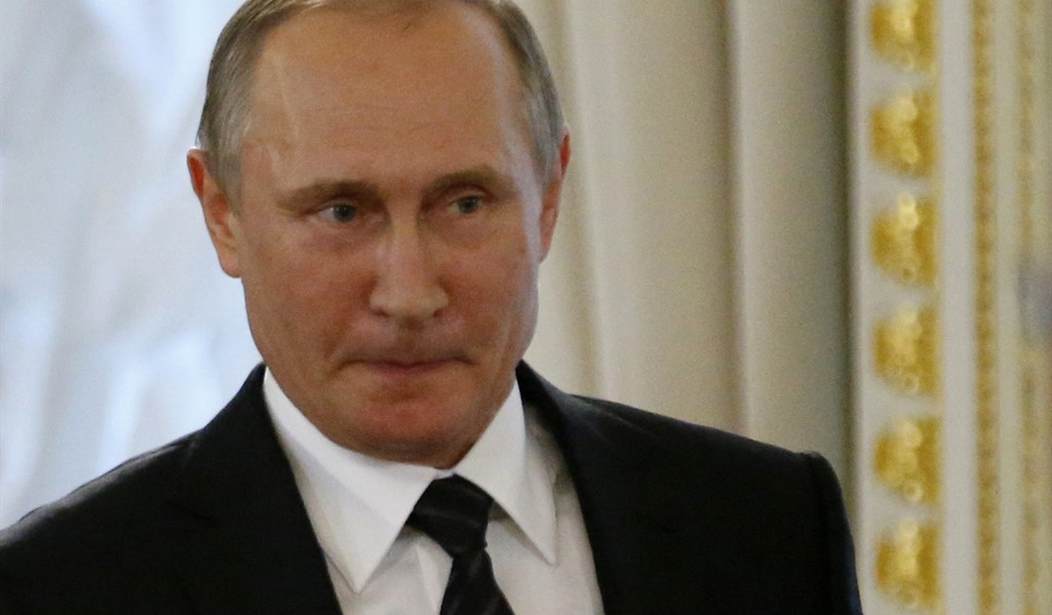
Russian leader Vladimir Putin's high-octane vitriol -- directed at George W. Bush, of course -- provided evidence of the effectiveness of the Bush Administration's response to Putin's "creeping war of aggression" in 2008.
The Bush Administration met the Russian invasion with aggressive diplomatic action, seeking support from NATO allies and threatening Moscow with sanctions. It also backed diplomacy with military action. As Russian Army regular units approached the Georgian capital, Tbilisi, the Georgian government asked the U.S. to fly the Georgian Army brigade serving in Iraq home to Georgia. The U.S. complied. 2,500 well-trained and reasonably well-equipped Georgian reinforcements were on the battlefield.
The Bush Administration demonstrated that it was prepared to act on behalf of an ally, not just talk.
At the time, Putin was Russia's prime minister. He's now the president. Under either name, he's the Kremlin's authoritarian boss. In an interview with CNN (August 28, 2008) Putin accused the U.S. of "orchestrating" the war in order to benefit a presidential candidate, implicitly suggesting Bush had started a war in Georgia in order to promote John McCain's candidacy. Outrageous propaganda, of course, but Putin is a master propagandist. He also claimed his forces had to intervene because Russian peacekeepers in the secessionist enclave of South Ossetia had been killed. Why, the U.S. had failed to stop Georgian aggression!
False. Moscow orchestrated the entire war. The so-called terrible U.S.-Russia relationship that the Obama Administration's "re-set" claimed to correct was the result of aggressive Russian misbehavior and principled U.S. reaction.
Russia's 2008 invasion of Georgia eerily echoed the "creeping war of aggression" Serbian dictator Slobodan Milosevic launched in 1991 when Serbia attacked Croatia. Serbia would launch an attack, take a small piece of territory, and then hunker down to absorb the political blowback from the UN and Western Europe. Then Serbia would attack again. Serbian Special Forces would cooperate with Serb agitators in ethnic Serbian area of Croatia. When firefights broke out regular Serbian military units would join the battle. Serbia used similar military-political tactics when it invaded Bosnia in 1992.
The Kremlin's February 2014 invasion of Crimea added two new wrinkles. The first was rapid follow-on action by conventional military forces to support "threatened ethnic Russians." The second was outright annexation of territory. In March 2014 Putin shredded the Budapest Accord (signed by the Clinton Administration) which guaranteed Ukrainian territorial integrity.
What did the Obama Administration do? It complained -- talk. It imposed economic sanctions. What did Russia do? The "creeping war of aggression" entered eastern Ukraine, as Moscow accused Ukrainians, Poles and Americans of killing ethnic Russians.
Ukraine's slow war continues. Last month (July 2016), Ukrainian and other European media reported an increase in Russian military activity in eastern Ukraine.
That was a bad indicator. August is Europe's traditional month for launching a military campaign, with August 1914 being a particularly hideous example. The ground is usually dry enough for maneuvering large forces. If the invaded country fails to surrender, winter will stall the counter-offensive.
In 2008, the Bush Administration was heavily engaged in Iraq. Putin wondered if Bush would respond to a probe. He did. In 2016, Putin rattles sabers in Ukraine as the Obama Administration seeks Russia's help in Syria.
In the next few weeks, Russian forces could seize another chunk of Ukrainian territory, and do so with very little political risk. The Kremlin may also be conducting a political probe. Will Russian war making in Eastern Europe become a presidential election issue? If it doesn't, in 2017 Eastern Europe can expect more war from Moscow.


Join the Conversation
VIP members get the ability to comment on articles.