





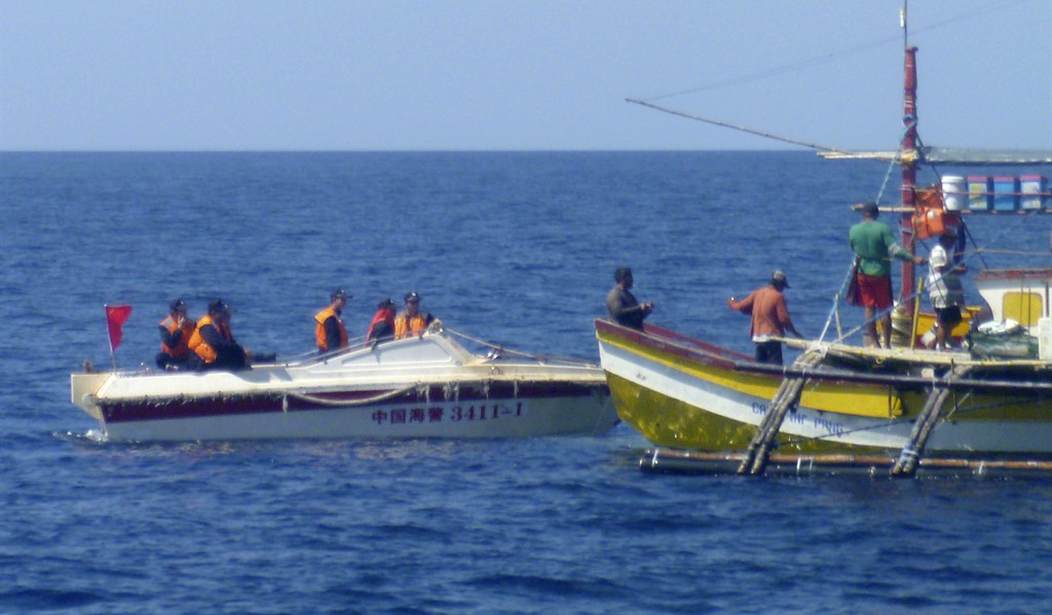
Arbitrators in The Hague have given the Philippines a unanimous legal victory over China, one that definitely frustrates China's "divide and conquer" strategy for gaining sovereign control of the South China Sea.
The ruling, however, does not answer the question that could ignite a deadly regional war. Given China's immense military and economic power, how will the Philippines enforce the decision?
In 2013, the Philippines asked The Hague's Permanent Court of Arbitration to rule on the territorial disputes between Manila and Beijing. The Court would convene under terms prescribed by the UN Convention on the Law of the Sea. 167 nations have signed the treaty, including the Philippines and China. China ratified it in 1996.
The panel addressed "the role of historic rights and the source of maritime entitlements in the South China Sea, the status of certain maritime features and the maritime entitlements they are capable of generating, and the lawfulness of certain actions by China."
The panel concluded China has indeed violated the Philippines' Exclusive Economic Zone in the South China Sea. EEZs extend 200 nautical miles from sovereign territory. All natural resources found in those waters belong to sovereign nation.
The decision got into the seaweeds. It had to, for EEZ violations involve money and jobs. China interfered with Filipino oil exploration operations. China tried to prevent Filipino fisherman from fishing in their own EEZ while encouraging Chinese fishermen to violate it. In other words, China was committing large-scale robbery.
The ruling savaged China's so-called "nine-dash line," and in so doing dealt Beijing a heavy diplomatic and political blow. The nine-dash line maritime claim has become something of a Chinese ultra-nationalist symbol for restoring Chinese hegemony in Asia and the world.
The boundary defined by its dashes dips south for hundreds of kilometers from China's southern coast and curves as it nears the island of Borneo. Singapore, Malaysia and Indonesia think the bottom of its rough parabola is suggestively close to the Strait of Malacca. That waterway is the primary shipping passage between the Pacific and Indian Oceans.
The panel concluded there "was no legal basis for China to claim historic rights to resources within the sea areas" within the line and China's attempt to game the system by pouring concrete in the sea was illegitimate. The panel ruled that the "Convention classifies (sea) features on their natural condition" and China's "land reclamation and construction" program didn't change that.
The island construction program has been Beijing's most outrageous activity in the region. However, Chinese ultra-nationalists back this maritime imperialism. For some two decades China has been building artificial islands in the South China Sea. China's neighbors contend the program amounts to conquest with concrete braced by steel. The concrete transforms sea features into fake islets big enough to support airfields for combat aircraft. Think of them as immobile aircraft carriers.
Beijing's diplomats and international lawyers then say the islets are sovereign Chinese land surrounded by 12 miles of territorial water. The Chinese military then says no one can sail through those waters without permission.
Except international arbitrators concluded the claim is rubbish.
So here we are. The Chinese government refused to participate in the arbitration. It now refuses to accept the decision. Beijing insists that it will only recognize bilateral agreements with its neighbors -- which means it will bully them one on one.
No nation in Southeast Asia can match Chinese power and it is very doubtful a coalition of nations could, either ... unless that coalition had the backing of the U.S.
Which leads to the next unanswered question: What will Washington do? Washington says it supports its traditional ally, the Philippines, and also supports the panel's decision. But does "support" include a willingness to wage war with China if China and the Philippines come to blows?
No one really knows.



Join the Conversation
VIP members get the ability to comment on articles.