





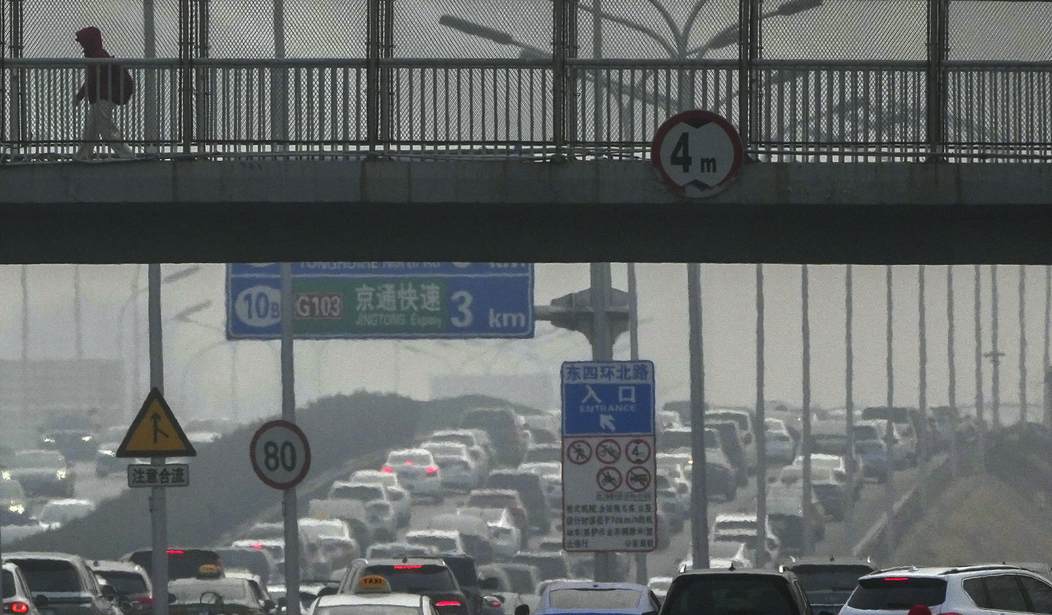
Everyone knows that China pollutes. The reality of Chinese smog, waste, and pollution is beyond dispute. But how much is an entirely open question.
Defining “pollution” itself is a difficult task. The concept involves a wide variety of topics, from plastics in the ocean to carbon in the atmosphere to even light in the night sky. Defining who is responsible is even tougher: if a river runs through India and China – two countries notorious for lots of pollution and little reporting of it – which country gets the blame?
This uncertainty has not stopped governments from creating sketchy statistics, which they then use to protect their own industries or target America’s. China’s government claims to have the numbers and, unsurprisingly, has been pleased to report that its pollution has been decreasing. The Global Times, a Chinese Communist Party mouthpiece, blasted those who doubted China’s numbers, pointing to random X users and the United Nations Environment Program’s declaration of the “Beijing Miracle” as examples of expert refutations. But the United Nations cannot be trusted here. China is the second-largest funder of the organization, and as such, obviously is expecting to get something for its money.
Then there’s the European Union, which just instilled its Carbon Border Adjustment Mechanism (CBAM) to charge a fee on imports to the EU depending on how much pollution was emitted during production. But this relies entirely upon Europeans putting a value on the emissions derived from the products they import and requires the creators of the products – such as Chinese companies – to honestly report on how many emissions their products are responsible for, a dubious prospect at best.
Frustratingly, the United States has had no mechanism through which to protect our responsible manufacturers or figure out how much China actually pollutes; independent scientists provide estimates, and our own government could make educated guesses from time to time, but it is still an open question. This is a serious problem. And it’s not as if it’s just crept up: the United States government has long known that it was an issue, with Chinese pollution having spent decades finding its way into the air and water breathed and drank by Americans. The problem is that we just don’t know how much there is. By having accurate numbers of pollution rates, which are sure to be high, American firms and workers win in the international marketplace against their dirtier foreign competition.
Fortunately, the United States is one step closer to finding out. That’s due to the recently passed Prove It Act. The original legislation, sponsored by Sen. Kevin Cramer (R-ND) with a version now signed by President Donald Trump, mandates the Department of Energy undertake a study to find out exactly how much pollution is being emitted by members of the Group of Seven, plus countries of concern – including China and other adversaries – and anyone else the secretary believes should be included.
Even though the bill has become law, it has attracted resistance from organizations like the American Energy Alliance, a lobbying group that falsely claims the Prove It Act seeks to pave the way for a new energy tax. Such an argument runs contrary to the Trump administration’s agenda; after all, their concern seems to stem from potential tariffs, a beloved tool of the president’s. There is nothing in the bill that requires or even contemplates the imposition of a tariff or tax. As a matter of fact, the Prove It Act is only a study – and nothing more – to show how much more responsible American production is than China’s and other adversaries. This should be universally welcomed: more information on adversaries gathered by an America First administration is an unabashed good.
These wild claims are fearmongering at best and China-coddling at worst. Let’s be clear here: these arguments ultimately just have the effect of protecting Communist China from a U.S. government study that will help level the playing field for more efficient American manufacturers and workers.
The Trump administration should reject them. We must make sure American businesses, and workers, are treated fairly.
Editor’s Note: New York City is now facing the consequences of Mayor Zohran Mamdani’s socialist takeover.
Help us continue to report on his radical policies and expose the Democrats who support him. Join Townhall VIP and use promo code FIGHT to receive 60% off your membership.

Join the Conversation
VIP members get the ability to comment on articles.