


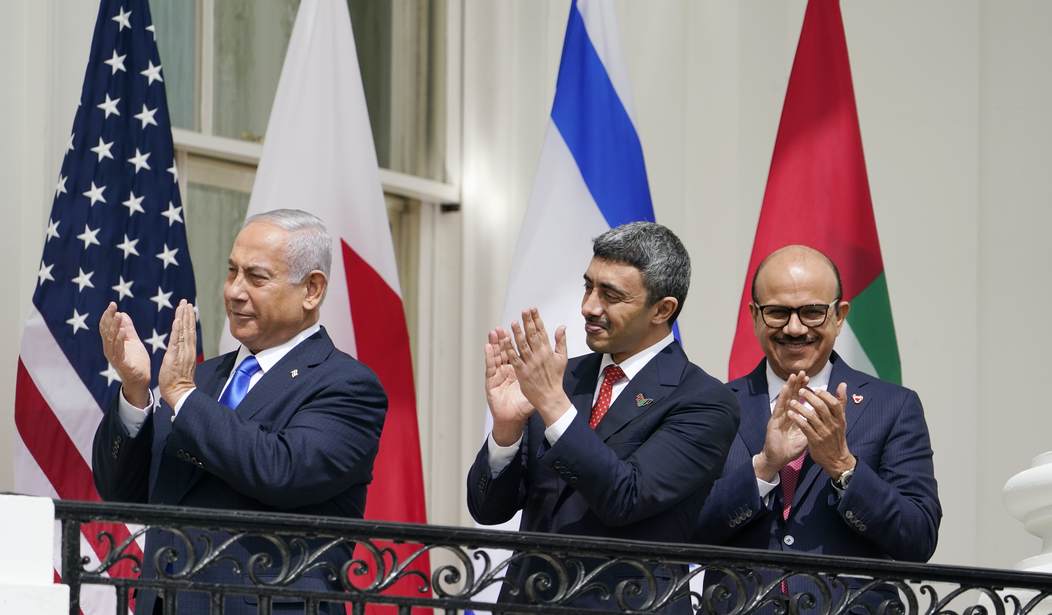
While the Biden administration seeks to leverage easing of diplomatic tensions between Saudi Arabia and Israel to broker a new version of the Iran deal, there are others eyeing the region’s newfound move toward peace who aim for less nakedly political goals.
Instead, the Philos Project will continue its work protecting the fractured Christian community in the region while also taking advantage of the dramatic shift toward unity after decades of war. Robert Nicholson, president of the Philos Project, hopes his organization’s efforts will lead the entire region into accepting the historic role each of the three Abrahamic religions has played in that part of the world – and hopefully toward a more unified and stable region.
But politics, he says, is never completely out of mind.
“What’s unique about the near east is three of the biggest world religions are based there,” Nicholson tells Townhall. And he says it’s not an easy thing to accept that the place where these religions are rooted “is also where so many of these problems come from.”
Politics in the rest of the world is often downstream from what happens in the Near East, Nicholson admits. “When something happens in Israel, suddenly there are killings in Africa or East Asia,” he says. “The downstream affect [of our work] into politics can be huge.”
His organization has watched with concern as Christians have been persecuted in the region, particularly in Iran, where 2021 reports of heavy growth in Christian churches led to stories of persecution and imprisonment by 2022. But the Abraham Accords opened a new pathway that Nicholson decided to set alight on and travel, knowing the journey would be uncharted and dangerous.
Recommended
As such, he’s done a bit of leveraging himself, announcing the Philos Project’s “Abraham’s Missing Child initiative,” a year-long series of summits for Near Eastern Christian leaders that will seek to “capitalize on this moment to develop practical recommendations to protect and strengthen indigenous Christian communities,” Nicholson said at the Washington, DC event announcing the initiative.
“This is the perfect time for a pragmatic approach,” Nicholson says.
The late-May event announcing the initiative featured Philos scholars and respected DC religious freedom and Near East experts such as Jonathan Schanzer of the Foundation for Defense of Democracies, (FDD), Elizabeth H. Prodromou with Atlantic Council, and Sam Tadros of the Hudson Institute.
Nicholson is used to living in a cynical world and is unbothered by the new secularism, at least in Western nations, that waters down religious concerns in governance.
“The secularism thesis has been a heartache for humans over the last century,” Nicholson says. “Humans are perennially, eternally religious. They believe in things that motivate their practical actions.”
He’s banking on religion being the glue that binds the region in peace so long as the approach is calculated to build alliances rather than sow divisions.
“The obvious first step is to build a stronger connection through people who are already on your side,” he says, a concept he calls “starting with your friends.”
Wagging one’s finger at those outside the fold has failed, he says. “It’s one of the biggest mistakes of advocacy,” Nicholson says.
And he believes – with help from friends of other religions, both domestically and in the Near East itself, who share an interest in seeing peace in the region – a new, never-seen-before coalition could be building.
Nicholson is protective of Iranian Christians who are particularly endangered at the moment and is dedicated to making sure the new initiative doesn’t make things harder for them, especially as discussions of a new Iran deal heat up and persecutions continue.
But if the Abraham’s Missing Child talks go well, he hopes it will give them faith to carry on.
“Hopefully those Christians in the Iranian side of the region will be drawn to that success,” he says.



Join the conversation as a VIP Member