


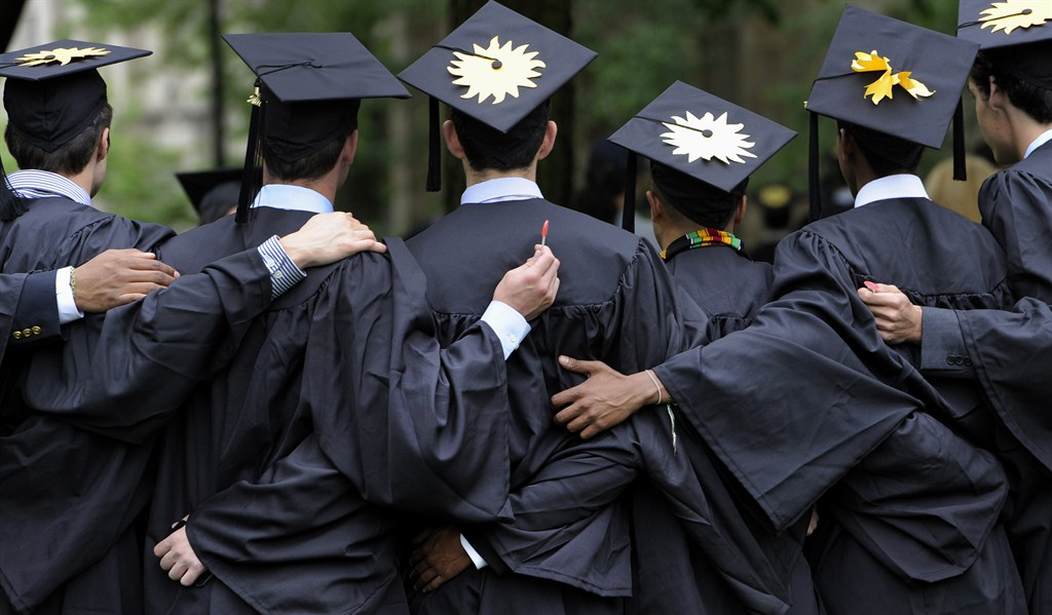
Despite five years of economic recovery, college graduates continue to face a tough job market. Certainly, young people should take responsibility for their lives, but parents, educators and politicians all share some blame for their troubles.
College graduates earn much higher wages and are less likely to be unemployed than high school graduates—and those gaps are increasing. Still many recent graduates cannot earn enough to live independently, and often end up in jobs that don’t require a college education.
Those with training in specialized fields generally find a good paying position quickly. For example, 75 percent of engineering and education majors find employment requiring a degree, but among those in liberal arts or communications, the figure is only 40 percent.
Essentially, many students paid and borrowed upwards of $100,000 or more to major in French or anthropology and end up working at Starbucks or a Verizon outlet.
The most fundamental problem is that high school students too often see four years at college as “an experience” and not “an investment.” And they get a lot of bad advice from adults who should know better.
Since first entering the classroom in 1970, hundreds of neighbors and friends have asked me about colleges and told me of their children’s plans.
So often mothers tell me they want their son or daughter to study what they love, pursue their passion, and everything will work out. The world may be glutted with international relations majors who also minored in history, but “Jimmy is bright and will find a good job.”
Recommended
Fathers are worse. “Lacrosse is a big success factor for Sally, and her college really supports female athletes.”
High school teachers, coaches and counselors too often echo those sentiments.
As for politicians, I can’t remember a president or governor telling ordinary high school students “the country needs engineers and entrepreneurs.” Instead, they wax eloquently about public service, when government agencies are overwhelmed with applicants.
Legally, 18 year olds may be adults, but they are hardly qualified to borrow and invest 50 or 100 thousand dollars wisely, but that is exactly what we require them to do—burdened with too much bad advice.
President Obama courted the youth vote by making inexpensive loans for college more accessible and that makes matters worse.
Easy access credit has pushed up college tuition far faster than inflation generally and even health care costs. University presidents are happy to pad bureaucracies, and indulge faculty who would rather undertake research than teach, if students can borrow money to pay for it all.
Teenagers need to be told a college education is mostly about preparing to earn a living. You don’t need to read Socrates or solve differential equations to be a good citizen. Until the mid-20th Century, the vast majority of Americans led responsible and satisfying lives without a sheep skin.
In a technologically advanced economy, where even sophisticated white collar workers are replaced by machines and software—look at what computers did to travel agents—college is about acquiring skills that have value in the marketplace. That means picking a course of study that makes tuition and all that time in the library a good investment.
Before that can happen, parents, educators and politicians have to stop indulging adolescent inclinations, and start talking sense to youngsters—when they start looking for colleges at ages 15 or 16, and not when they leave at 22.
Until that happens, we will continue to have too many frustrated and overly indebted young adults.
Peter Morici is an economist and business professor at the University of Maryland, national columnist and five-time winner of the MarketWatch best forecaster award. He tweets @pmorici1





Join the conversation as a VIP Member