





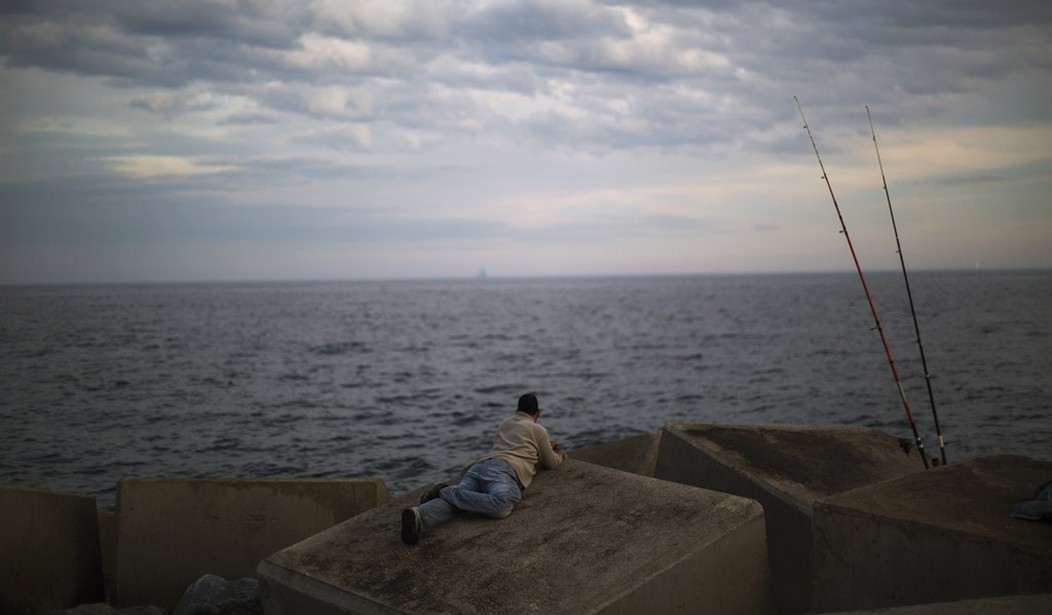
From the heights of Gibraltar you can see Africa about nine miles to the south and gaze eastward on the seemingly endless Mediterranean that stretches 1,500 miles to Asia beyond. The Romans called it Mare Nostrum, "our sea," and these deep blue waters allowed Rome to unite Asia, Africa, and Europe for half a millennium under a single prosperous, globalized civilization.
But the Mediterranean has not always proved to be history's incubator of great civilizations -- Greek, Roman, Byzantine, Ottoman, Florentine, and Venetian. Sometimes the ancient "Pillars of Hercules" at Gibraltar's narrow mouth of the Mediterranean marked not so much a gateway to progress and prosperity as a cultural and commercial cul-de-sac.
Between the rise of the Ottoman Empire and the construction of the Suez Canal, the classical city-state powerhouses in Italy and Greece faded from history, and the Mediterranean became more a museum than a catalyst of global change. In contrast, the Reformation and Enlightenment energized Northern European culture, safely distant from the exhausting Mediterranean wars with Islam.
By the early 17th century, Northern Europeans could more easily and safely reach the rich eastern markets of China and India by maritime routes around Africa. The discovery of the New World further shifted wealth and cultural dynamism out of the Mediterranean.
After World War II, the Mediterranean seemed to roar back. Huge deposits of petroleum and natural gas were found in North Africa. The Suez Canal was a shortcut to the newly opulent and strategically vital Persian Gulf. With the unification of Europe and the ongoing decolonization of Africa and the Middle East, there was the promise of a resource-rich, democratic, and commercially interconnected Mediterranean.
Not now. The Arab Spring has brought chaos to almost all of North Africa. The bloodbath in Syria threatens to escalate into something like the Spanish Civil War -- sucking in Lebanese militias, Iranian mercenaries, Turkey, the Sunni sheikdoms, Israel, and the Palestinians, along with surrogate arms suppliers like China, Europe, Russia, and the United States.
The economies of the Islamic rim of the Mediterranean are in shambles, but so is the southern flank of the European Union, as Greece, Italy, Portugal, and Spain haggle for subsidies and loans from an increasingly fed-up Northern Europe. New oil and gas finds in North America, China, and Africa may soon make both Mediterranean supplies and Suez passage to the Persian Gulf irrelevant for a billion energy consumers.
A shrinking and aging Europe keeps drawing in young Muslim immigrants from the Middle East and North Africa. They want out of their impoverished Islamic homelands but are being consumed by, rather than enriching, the wealthier European societies to which they are drawn like moths to a flame. The recent rioting in Sweden, the gruesome near-beheading of a soldier in London, and periodic unrest in the French suburbs all remind us that the Mediterranean is not a shared postmodern vacation getaway. Instead it is increasingly a stagnant premodern pond of religious, political, and economic tensions.
Unrest in the West Bank, Gaza, Cyprus, Syria, Libya, and Egypt could at any moment spark violence that cuts across religious, racial, and political fault lines. Otherwise, these tired hotspots are immaterial to a world that from Shanghai, Mumbai, and Seoul to Palo Alto, Houston, London, and Frankfurt is creating vast new wealth, technologies, and consumer goods without much of a nod to Mediterranean science or innovation.
The old strategic fortresses at Cyprus, Crete, Sicily, Malta, and Gibraltar are becoming inconsequential as the United States pivots to Asia. The Cold War is long over. Europe has all but disarmed. Meanwhile, societies on the southern and eastern shores of the Mediterranean are coming apart at the seams.
It is hard to find a robust free-market economy anywhere in the Mediterranean these days. Instead European socialism, Arab statism, and Islamic terrorism are in various ways retarding commerce and growth. Mediterranean tourism -- with visitors gazing at ancient rather than modern wonders -- is more profitable than manufacturing.
Will the Mediterranean world rebound again? History is usually more cyclical than linear, and the region's favorable climate and opportune geography suggest that it could.
Before we see another Mediterranean renaissance, constitutional government must sweep the Muslim world. The fossilized bureaucracy of the European Union must radically reform or disappear. A new generation of Michelangelos and da Vincis must believe that they can think, say, and write whatever they wish in a climate of economic confidence, prosperity, and security.
Unfortunately, Mediterranean culture is reverting to its stagnant 18th-century past rather than leading the 21st century.


Join the Conversation
VIP members get the ability to comment on articles.