


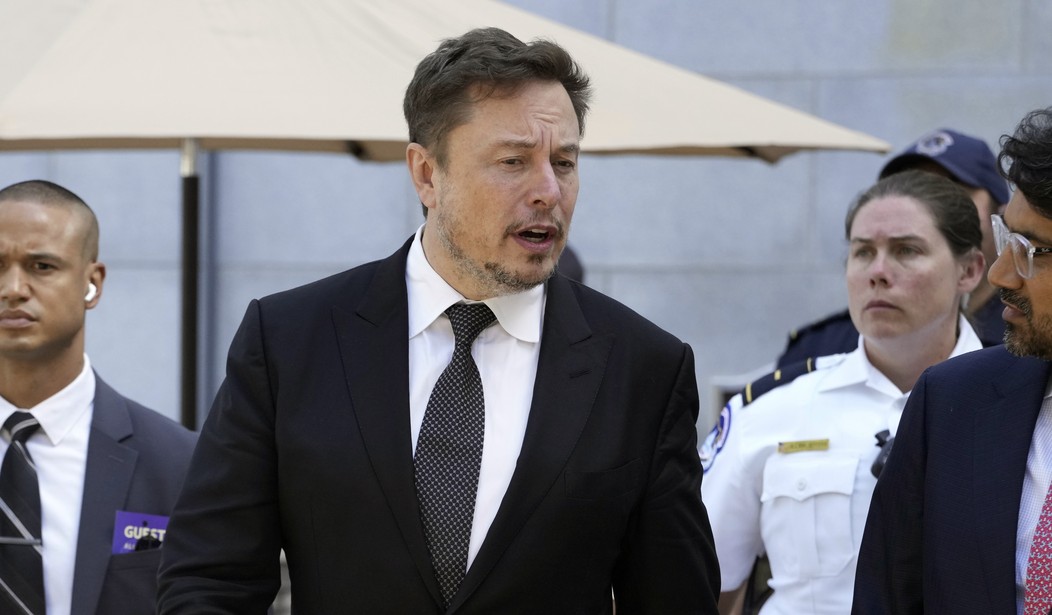
Elon Musk is not only the wealthiest man in the world, but he might also be the most powerful. The tech entrepreneur has climbed to the top of the economic ladder with a combination of innovative ideas and government contracts. Our government has, in large part, enriched the billionaire with taxpayer dollars in the form of Tesla tax credits and NASA contracts with SpaceX. In fact, Musk’s reach into the government is so deep, as Ronan Farrow’s recent profile of the billionaire notes, that numerous government agencies are — to quote Farrow — “now reliant” on Musk.
The question now is whether our national security is becoming too dependent on Musk’s enterprises, especially the ongoing Starlink project with its objective to cover the earth with an internet satellite network.
When Russian forces invaded Ukraine, they quickly shut down Ukraine’s Internet communications. Since modern military intelligence and communications technology relies on satellites for any viable war effort, today’s satellites are essential to military operations. Musk rode in on a white horse when Ukraine's Internet went dark. His donated SpaceX Starlink internet terminals proved crucial in keeping Ukraine’s military operating as it defended its nation against the Russian invaders.
After a few months, Musk asked the Pentagon to pay for the service, which they did. Then, although Ukraine’s access to commercial satellites had proven critical to its defensive efforts against Russia, Musk began limiting its access to this technology in February after he independently concluded that satellite operations for military purposes risked “escalating” the situation. The SpaceX CEO later justified the decision, arguing that Starlink was not intended to be “weaponized.” Making matters worse, he — according to Pentagon officials — had direct talks with Russian leader Vladimir Putin, leading to his pondering pulling the plug on Starlink in the war-torn nation altogether.
Several countries have since characterized Musk’s erratic behavior in Ukraine as a cautionary tale of relying on Starlink’s internet infrastructure in particular, and on one man in general, for their national security needs.
Recommended
That’s why, when Chinese ships cut two of Taiwan’s critical internet cables in February, downing internet access for more than 14,000 Taiwanese, Taiwanese officials decided not to adopt Starlink satellites. The country felt Elon Musk’s financial ties to China might influence SpaceX to stop providing the island with critical internet services during a conflict.
Other governments, including the European Union and Turkey, have also expressed concerns that Starlink satellites could present security threats since they’re at the discretion of a private company.
American generals, defense strategists, and policymakers must ensure that the United States’ defensive capabilities are not exclusively at the discretion of individuals outside the Pentagon. This means ensuring that the U.S. Department of Defense has access to independent, non-commercial satellite services it can depend upon during conflict. Military officials, not civilians, should decide when the U.S. uses satellites for military intelligence and communications.
There is mutual efficiency in the U.S. military partnering with SpaceX and other civil space companies to create redundant capabilities. But commercial satellites were never intended to be the primary source for military needs. Depending on them for such can create security vulnerabilities. Russia now considers commercial space systems used in military operations “legitimate targets for retaliation,” leading Ukrainian forces to experience security issues when using these technologies. These technologies include Russia’s ability to locate, jam, and degrade these satellites, exposing Ukrainian soldiers to attack and slowing critical communications efforts.
With the government investing $1 billion to create new intelligence satellites in 2021, the U.S. already has the tools to develop independently-operated satellites. In fact, it already depends on several NASA satellites to conduct intelligence efforts.
Given the U.S. government’s existing satellite capabilities, it’s time we ceased using commercial satellites as a sole source for any military requirement. We need dedicated military satellites for defense and related communications efforts.
Col. Terry Thompson, U.S. Air Force (ret.), was a war planner at the Pentagon and a wing commander at Dyess Air Force Base, Texas.







Join the conversation as a VIP Member