


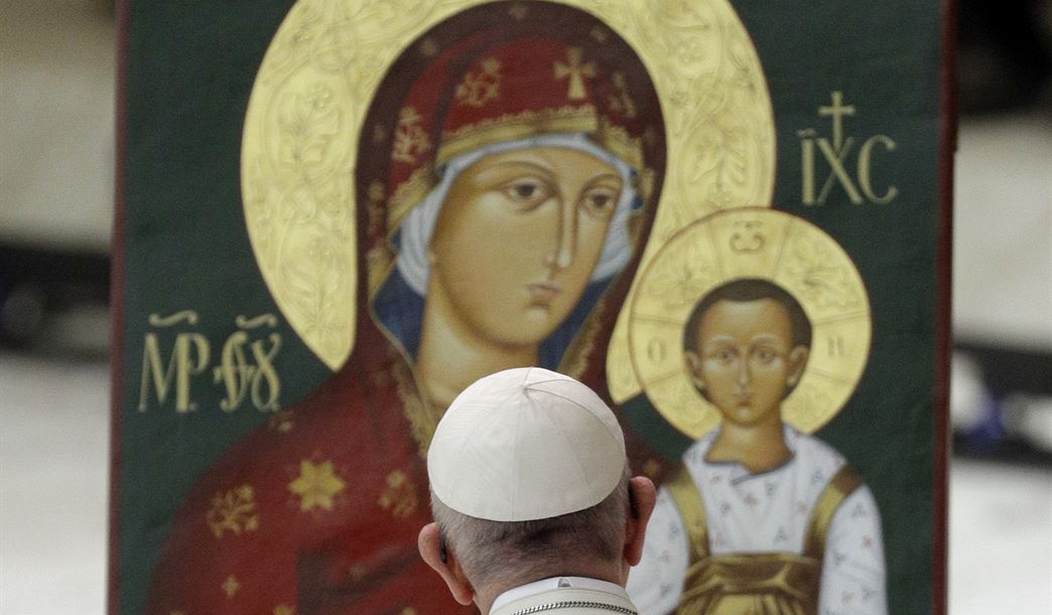
You would think this would be pretty easy to get right: according to the Gospels, Yeshua (Jesus) was born a Jew in an ancient Jewish city in the historic land of Israel. But no, all this must be disputed, after all, how can Jesus be the liberator of the oppressed if He Himself was born to an oppressor people in an oppressor city? The narrative must be changed.
That’s why, for many years, we have heard that “Jesus was a Palestinian,” or, more fully, “Jesus was a Palestinian freedom fighter,” suggesting that He led an armed revolt against – guess who? – the Israeli Jews!
In the words of Hamid Dabashi, in an op-ed published on December 25, 2018 on Aljazeera News, “Remember: Christ was a Palestinian refugee.”
Dabashi, the Hagop Kevorkian Professor of Iranian Studies and Comparative Literature at Columbia University, does acknowledge that Jesus was Jewish, but only in the context of being “a Jewish Palestinian refugee child who grew up to become a towering revolutionary figure.”
And in the midst of an article meant to be conciliatory for Muslims and Christians, he opines, “The dark days of Zionism laying a false claim on Judaism and Palestine alike are happily over. The lies of a gang of European settler colonialists trying to rob Jews of their ancestral faith and Palestinians of their historical homeland have finally come to a crushing defeat when Jews and Palestinians, and Jews as Palestinians, have come together to lay a post-Zionist claim on their ancestral faith and homeland alike.”
Can you feel the Christmas spirit? (And yes, when you parse every word of that paragraph, Prof. Dabashi’s claims are beyond shocking.)
This very Christmas, a Catholic priest from New York, Father Edward Beck, said this on CNN: “What I'm so struck by is that the story of Christmas is about a Palestinian Jew. How often do you find those words put together? A Palestinian Jew born into a time when his country was occupied, right? They can't find a place for [Jesus’s mother, Mary] to even give birth. They're homeless. They eventually have to flee as refugees into Egypt, no less. I mean, you can't make up the parallels to our current world situation right now.”
Recommended

This is not just a matter of historical inaccuracy, since the land in which Yeshua was born was not called Palestine until more than one century after His death and resurrection.
This is a matter of separating Yeshua the Jew from the Jewish people as a whole and from His ancient Jewish homeland. It is also making a political statement, comparing the first-century Roman occupiers of Judea with the people of Israel today, occupiers of the West Bank and Gaza. The Romans were and the Israelis are evil oppressors with no right to the land.
That’s the magic of using words like “Palestinian” and “occupied.”
As for language that is even more extreme, how about these comments from Palestinian Authority Prime Minister Muhammad Shtayyeh on December 28, 2020?
“The birthday of our lord Jesus, peace be upon him - the first Palestinian self-sacrificing fighter from whom we learned Martyrdom-death, and who paid for his mission with his life - takes place at the same time as the anniversary of the outbreak of the Palestinian revolution [i.e., the anniversary of “the Launch” of Fatah, counted from its first terror attack against Israel], for which thousands of Martyrs have paid with their lives so that we will live and remain, and so that our children will dream of a better future.” (For a sampling of other, similar quotes, see here.)
Did you think I was exaggerating?
How threatening it is to say that Yeshua was a Judean Jew, born in Bethlehem, the ancient city of David, called “rabbi” (not “reverend” or “imam”) by His followers.
This does not mean that Jesus would agree with every policy of Israel today or of every tenet of Judaism. He certainly would not. (The same can be said about Him agreeing with every American policy today or of every tenet of Christianity.) And this does not imply that He does not hurt for the downtrodden and the oppressed of all peoples. He certainly does.
But the references to Him as a Palestinian refugee born in occupied territory, not to mention Him being compared to an Islamic jihadist “martyr,” are meant to mislead in the most insidious way.
In comparison, the recent article by Victoria Emily Jones in Christianity Today, while not insidious, is certainly misleading, stating, “Jesus was born in Asia. He was Asian. Yet the preponderance of Christian art that shows him at home in Europe has meant that he is embedded deeply in the popular imagination as Western.”
What, exactly, does Jones mean? Pointing to Asian nativity scenes dating back 1240, she explains, “Some may object to depicting Jesus as anything other than a brown male born into a Jewish family in Bethlehem of Judea in the first century, believing that doing so undermines his historicity. But Christian artists who tackle the subject of the Incarnation are often aiming not at historical realism but at theological meaning.
“By representing Jesus as Japanese, Indonesian, or Indian, they convey a sense of God’s immanence, his ‘with-us–ness,’ for their own communities—and for everyone else, the universality of Christ’s birth.”
On the one hand, all this is quite understandable, since people from every nation embrace Jesus as “one of us.” That means that we depict Him (or imagine Him) to look like us. That’s why there are White European Jesus images and Black African Jesus images, along with other racial and ethnic Jesus images.
But Jesus was not born in Asia, nor was He Asian (based on what “Asian” would mean in the first-century Roman empire, and based on what “Asian” means today).
More importantly, given the historic attack on the Jewishness of Jesus, beginning with early Church leaders severing the Jewish roots of the faith, continuing with classic Christian art that demonized the ancient Jewish leaders and transformed Jesus into a White European, moving to the Nazi effort to make Jesus into a non-Jewish Aryan, and to the current “Jesus was a Palestinian refugee” rhetoric, now would be a good time to emphasize historic truth.
Jesus, whose Hebrew name was Yeshua, was born in Bethlehem of Judea. His mother’s name was Miriam, and His followers were named Yaakov and Shimon and Yehudah, among others. And He was the Messiah (Christ in Greek) because He was hailed as the long-awaited Savior of the Jewish people (and thereby, the Savior of the whole world).
He was born King of the Jews and died King of the Jews.
And when He comes again, He is returning to Jerusalem.
Does this offend you?








Join the conversation as a VIP Member