





It actually has happened. Barack Obama's November 2007 speech at a Jefferson-Jackson Day dinner in Des Moines is generally credited with giving him a lift toward winning the caucuses there two months later and putting him on the path to the presidency.
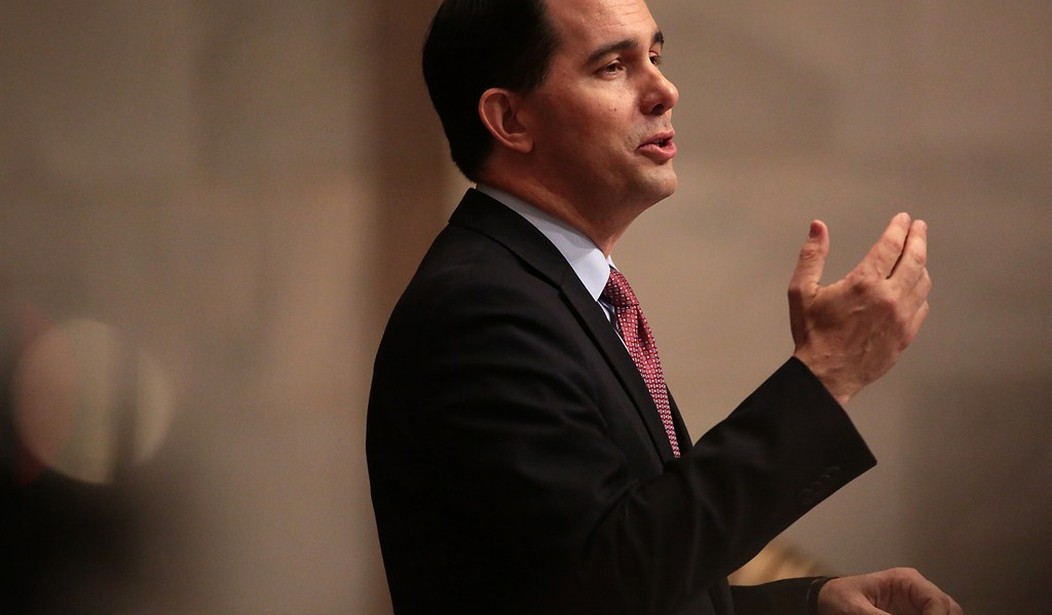
Perhaps it happened again, ten months earlier in the 2016 cycle, when Wisconsin Governor Scott Walker spoke January 24 at the Freedom Summit sponsored by Citizens United and Congressman Steve King in Des Moines.
Walker's speech -- one of more than a dozen -- got rave reviews from the crowd and reporters present. More prominently and notably, it seems to have gotten rave reviews from a much wider swath of Iowa Republican voters.
A Des Moines Register/Bloomberg poll, conducted by Ann Selzer's firm January 26-29, showed Walker leading the field of potential Republican candidates with 15 percent of the vote.
But that's not the important takeaway. As in just about every poll of potential Republican candidates, multiple candidates are bunched in what is, statistically, a tie. What's important is that Walker's ratings among Republican voters have improved substantially.
In an October Selzer poll, Walker had just 4 percent. Now it's 15 percent (16 percent when you allocate second choices of Mitt Romney supporters). In October he was in the bottom half of Republicans in favorable ratings. Now 60 percent are favorable to him and only 12 percent unfavorable.
Reporters in Des Moines were expecting a boring Midwestern guy. Walker proved to be an exciting Midwestern guy -- raised in Iowa for seven years, he pointed out, until his pastor father moved to next-door Wisconsin.
Many activists in the crowd, but by no means all Iowa Republicans, knew that he had battled the public employee unions in Wisconsin -- and that the left, which prides itself on compassion and civility -- responded with riots and death threats and a June 2012 recall election. Walker won that contest as he had in 2010 and did again in 2014: three elections in four years in a state that has voted Democratic for president since 1988.
Recommended

Walker had his applause lines down pat: We celebrate the Fourth of July, not the 15th of April; the safety net should be not a hammock but a trampoline. His emphasis was almost entirely on economic issues, but laced through his text were references that sounded offhand and authentic to family and faith.
All that suggests a candidate with potential appeal to economic and cultural conservatives, one who can bridge the divide -- the critical divide in the 2012 Republican primaries -- between the suburbs and the countryside. Mitt Romney won the nomination by winning big margins from affluent suburbs in large (1 million plus) metro areas. He ran behind, until he clinched the nomination among the less affluent and culturally more conservative non-major-metro Republicans.
Walker's base is in the Milwaukee suburbs. He was elected County Executive three times in Milwaukee County (67 percent Obama 2012). In the 2010 primary for governor, against a candidate who had won a statewide nomination before, Walker won an amazing 76 percent in the four-county Milwaukee metro area, and he carried that metro area against Democrats in 2010, 2012 and 2014.
He continues to live in the close-in suburb of Wauwatosa, which voted 50 percent Obama, 49 percent Romney: much like America. His neighbors are neither rich nor poor, nor lopsidedly mononpartisan.
He impressed Iowans by telling how he stuffs his pockets with coupons to buy a shirt at low-price (and Wisconsin-based) Kohl's. He speaks fluently, without oratorical flourish, in language I would describe as demotic (dictionary definition: denoting or relating to the kind of language used by ordinary people). He seems able to connect with people in both suburb and countryside.
His stands on public employee unions result from application of demotic common sense. Teacher layoffs should be determined not by seniority, but by merit. Public employee unions shouldn't be allowed to insist that school districts buy expensive health from a union-crony-controlled firm.
Walker promised to return to Iowa many times and has said, "I wouldn't be betting against me." His Des Moines speech and his jump in the Iowa poll certainly do not make him the favorite for the nomination. But they likely guarantee him serious attention in what is currently a crowd of candidates.



Join the conversation as a VIP Member