



In 2004 Congress passed a law requiring that all publicly funded educational institutions and federal agencies provide educational programming about the U.S. Constitution on September 17, the date of signing in 1787.
It was “ignorance among young Americans at colleges and high schools across the country” that prompted Senator Robert Byrd, a West Virginia Democrat, to introduce the bill according to the Chronicle of Higher Education.
The rule, which went into effect in 2005, did not specify how the Constitution should be taught. But Byrd and others voting for the bill might have been shocked by what eighth-graders in Portland, Oregon, (and in other districts) are learning from the book assigned to them, a young people’s version of A People’s History of the United States by Howard Zinn, the late communist history professor. Zinn’s book, in publication since 1980, has sold over a record-breaking 2.6 million, with popularity increasing. A flourishing Zinn industry spins off titles (A People’s History of Sports, A People’s History of Art History, etc.), produces curricular materials, documentaries, and fodder for other far-left textbooks.
Eighth-graders reading the adapted A Young People’s History will first get an introduction from Zinn himself addressing them as “mature enough to look at their nation’s policies honestly” before getting the Charles Beard 1935 version of the history of the Constitution. They will not, however, be told that Beard has been debunked by several historians—only that he “angered some people” because he presented the writers of the Constitution as fearing that “the poor would demand a share of the rich people’s property,” including that of the 55 writers of the Constitution, all white men, most wealthy, according to Zinn. They denied the vote to women, Indians, slaves, and many property-less men. Yet, the “problem of democracy went deeper than the Constitution’s limits on voting. It lay in the division of society into rich and poor.” What with those with “great wealth and power” owning and controlling “the land, the money, the newspapers, the churches, and the educational system”—“How could voting cut into such power?”
Recommended

Alexander Hamilton through selective quotation is cast as an elitist. James Madison in a Federalist Paper argues for a federal government because it is better able than a state government to keep down “riots, revolts, and civil disorder” and “People’s desire for such ‘wicked’ things as ‘an equal division of property.’” The Bill of Rights also is a cynical attempt to stop the rebellion of the oppressed, evidenced in the Sedition Act seven years later.
Eighth-graders might as well be reading the 1951 Outline Political History of the Americas by William Z. Foster, the General Secretary of the CPUSA from 1945 to 1956, who, pointing to the denial of franchise to Indians, “Negroes,” and women, wrote, “The aim of the capitalistic constitution writers . . . was to keep the franchise from the broad masses of toilers and to restrict it to the propertied classes, those who had a distinct interest in the exploitation of the workers.” (In 1951, Zinn, according to his FBI file, was teaching Marxism at the Communist Party headquarters in Brooklyn.)
Zinn, in the adult version of his book, called the idea that “there really is such a thing as ‘the United States’” or “a ‘national interest’ represented by the Constitution, in territorial expansion, in the laws passed by Congress, the decisions of the courts. . .” a “pretense.” The point is also made quite clear in the young people’s version.
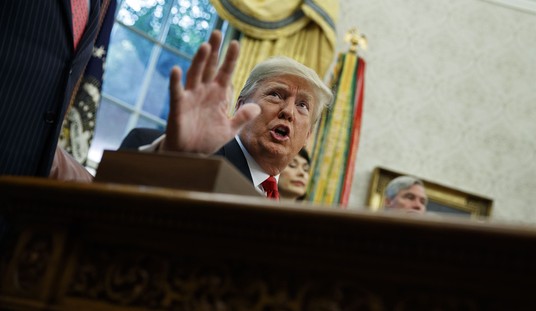
In his first Constitution Day proclamation, President Trump referred to “the enduring brilliance of our Founding Charter,” a constitution “older than any other written constitution in use today” and “founded on a fundamental trust in America’s citizens.” He vowed to return government to the people, restore the three branches to their rightful functions, and reduce the size and impact of federal agencies.
But it is no wonder that the message does not resonate with young people. Their ears have been filled with Zinn’s siren song of communism.






Join the conversation as a VIP Member