







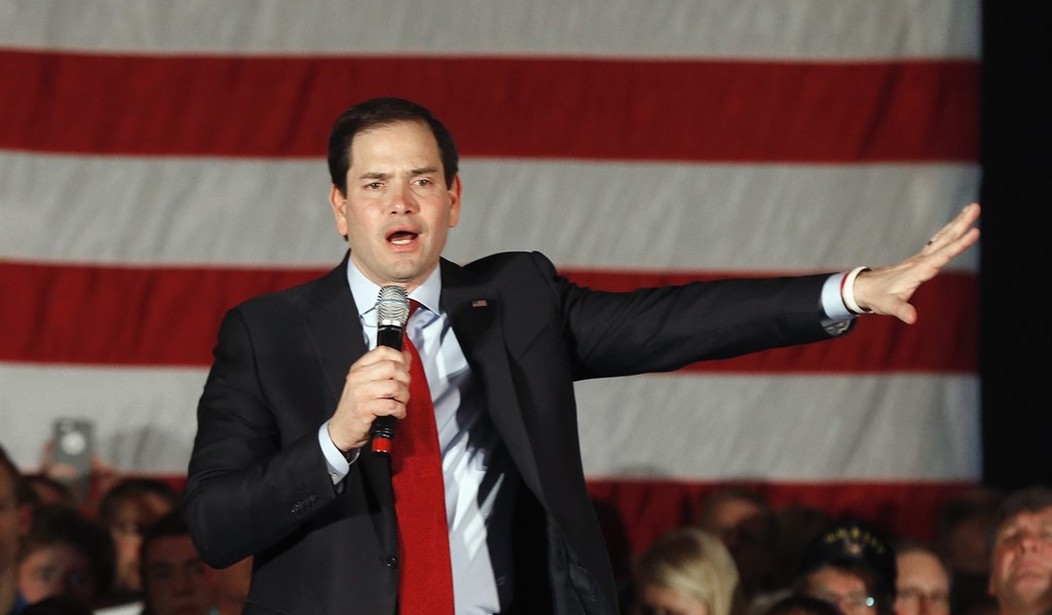
When losing to the star of a reality TV show, is it really so crazy to resort to reality-show tactics to defeat him?
I'm not referring to Marco Rubio's decision to fight fire with fire with Donald Trump and return insult for insult. I, for one, thought it was wholly appropriate for Rubio to give the schoolyard bully a taste of his own medicine. The evidence shows that Rubio's attacks, while tardy, paid off. Voters not already enraptured with Trump are open to persuasion, and late deciders broke disproportionately for Rubio on Super Tuesday in most races.
Indeed, once again, most voters voted against Trump, not for him, and that's where reality-show tactics come in.
Not counting "Top Chef" and "Naked and Afraid," I'm not a big fan of reality shows, but I've watched my share of "Survivor," "The Bachelor" and even Trump's own personal propaganda series, "The Apprentice." It seems to me that in many of these shows, the game is played the same way: Groups form alliances. Sometimes these alliances are formal, often they are tacit and voluntary -- but they are all temporary.
At the end of the season, the winner is the guy or gal who was in the right alliance until the alliance no longer served his or her needs. Fans may be happy or disappointed based on who emerges, but it's silly to say that Tiffany stole the Bachelor from Rhonda. That's simply how the game is played.
Well, welcome to the big leagues. Trump has been playing the game all along, and now that he's ahead, he doesn't think anyone should be allowed to change their tactics to beat him.
If this had been a two-person race from the beginning -- as the Democratic race has been since Iowa -- Trump would probably be as far behind as Bernie Sanders is. But Trump took advantage of the fact that the Republican field was so divided for so long. Nothing wrong with that.
But there's also nothing wrong with trying to stop Trump. Alliances are part of the game. The delegate system allows for it. And that's why Mitt Romney's advice in his powerful anti-Trump speech Thursday was entirely valid. If you're against Trump and you live in Ohio, vote for John Kasich. If you're against Trump in Florida, vote for Rubio. If you're against Trump in a state where Ted Cruz is ahead, vote for Cruz.
Starting March 15, primary winners get all of a state's delegates. Losers don't even get steak knives. In proportional Virginia, Rubio lost to Trump, but Trump got only one more delegate than Rubio. If no one gets to the convention with a majority of the delegates, the convention chooses a nominee. It might be Trump. Then again, it might not.
This may feel like cheating, but it isn't. It's just that conventions have been infomercials for so long, we're not used to the idea that one might actually matter. Also, for the last 50 years, any candidate who could make it past Super Tuesday as a front-runner was acceptable to a majority of the party, and the pressure to coalesce was strong. Things are different this time because Trump is different. His supporters -- many of whom are not Republicans, Trump is fond of noting -- may not like it, but the man is simply unacceptable to many conservatives.
When you say this to Trump supporters, they reply by hurling a word-salad about a shadowy organization called "The Establishment" that's working to thwart the will of the majority. Talk radio hosts rant about this cabal's effort to "steal" the nomination from Trump.
For instance, Romney's speech was denounced by many as an outrageous effort to sway voters. Similar criticisms were made when the magazine I work for, National Review, dedicated a special issue to opposing Trump.
"How dare you try to tell voters how to vote!" cried countless pro-Trump cable news commentators, pundits and radio hosts. It's a fascinating complaint coming from people who make a living by offering their opinions on how voters should vote.
It's also nonsense. If opposing Trump is now the definition of the establishment, then roughly 66 percent of GOP primary voters are members of the establishment. The "silent majority" isn't a majority and most certainly isn't silent. Alas, "The Loud Plurality For Trump!" doesn't look as good on homemade signs at rallies.
Trump is stoppable, according to the rules. And if he is stopped and that makes you sad, don't hate the players, hate the game.
Join the Conversation
VIP members get the ability to comment on articles.