





Future historians will likely be flummoxed by the moment we're living in. In what amounts to less than a blink of an eye in the history of Western civilization, homosexuality has gone from a diagnosed mental disorder to something to be celebrated -- or else.
Indeed, the rush to mandatory celebration is so intense, refusal is now considered tantamount to a crime. And, in some rare instances, an actual crime if the right constable or bureaucrat concludes that you have uttered "hate speech."
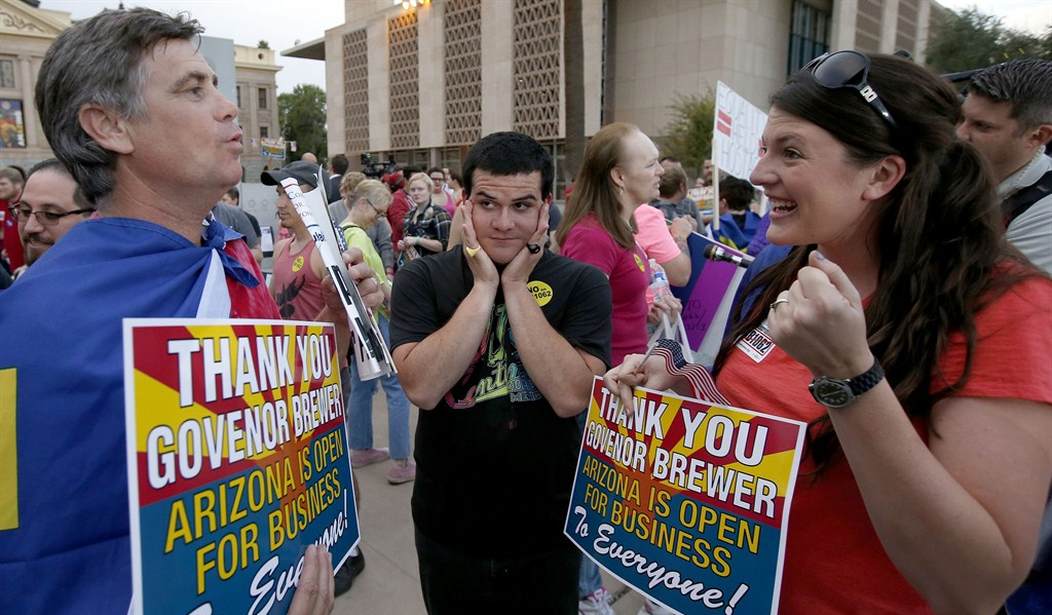
Or, if you refuse to bake a gay couple a cake for their wedding. That was the horror story that sparked much of this foofaraw.
Arizona's proposed SB 1062 would have amended the state's 15-year-old Religious Freedom Restoration Act in a few minor ways so as to cover businesses the way it already covers government. Arizona's religious freedom statute was modeled on a similar federal law signed by Bill Clinton with large bipartisan majorities in both houses. It would have allowed small businesses to decline work that violated their consciences, unless the government could show a compelling reason why such refusal was unreasonable or unjust.
Speaking of unreasonableness, according to ESPN's Tony Kornheiser, if Arizona allows bakers to refuse to bake cakes for gay couples, gays may have to wear "yellow stars" like the Jews of Nazi Germany. It would be Jim Crow for gays according to, well, too many people to list.
Recommended

Now lest you get the wrong impression, I am no opponent of gay marriage. I would have preferred a compromise on civil unions, but that ship sailed. The country, never mind the institution of marriage, has far bigger problems than gays settling down, filing joint tax returns and arguing about whose turn it is to do the dishes. By my lights it's progress that gay activists and left-wingers are celebrating the institution of marriage as essential. Though I do wish they'd say that more often about heterosexual marriage, too.
But I find the idea that government can force people to violate their conscience without a compelling reason repugnant. I agree with my (openly gay and black) friend, columnist Deroy Murdock. He thinks private businesses should be allowed to serve whomever they want. Must a gay baker make a cake for the hateful idiots of the Westboro Baptist Church? Must he write "God hates fags!" in the icing?
The ridiculous invocations of Jim Crow are utterly ahistorical, by the way. Jim Crow was state-enforced, and businesses that wanted to serve blacks could be prosecuted. Let the market work and the same social forces that have made homosexuality mainstream will make refusing service to gays a horrible business decision -- particularly in the wedding industry!
When August "Gussie" Busch, the CEO of Budweiser, bought the St. Louis Cardinals in 1953, he was vexed by the Brooklyn Dodgers' success, which was due in large part thanks to Jackie Robinson. He asked Cardinals executives how many blacks they were cultivating, and when they said "None," he was appalled. "How can it be the great American game if blacks can't play? Hell, we sell beer to everyone!" he exclaimed. The next year the Cardinals had a black first baseman, Tom Alston.
In 2000, Jonathan Rauch, a (gay) brilliant intellectual and champion of gay marriage, wrote a wonderful essay on "hidden law," which he defined as "the norms, conventions, implicit bargains, and folk wisdoms that organize social expectations, regulate everyday behavior, and manage interpersonal conflicts." Basically, hidden law is the unwritten legal and ethic code of civil society. Abortion, assisted suicide and numerous other hot-button issues were once settled by people doing right as they saw it without seeking permission from the government.
"Hidden law is exceptionally resilient," Rauch observed, "until it is dragged into politics and pummeled by legalistic reformers." That crowd believes all good things must be protected by law and all bad things must be outlawed.
As society has grown more diverse (a good thing) and social trust has eroded (a bad thing), the authority of hidden law has atrophied. Once it was understood that a kid's unlicensed lemonade stand, while technically "illegal," was just fine. Now kids are increasingly asked, "Do you have a permit for this?"
Gay activists won the battle for hidden law a long time ago. If they recognized that, the sane response would be, "You don't want my business because I'm gay? Go to hell," followed by a vicious review on Yelp. The baker would pay a steep price for a dumb decision, and we'd all be spared a lot of stupid talk about yellow stars.







Join the conversation as a VIP Member