


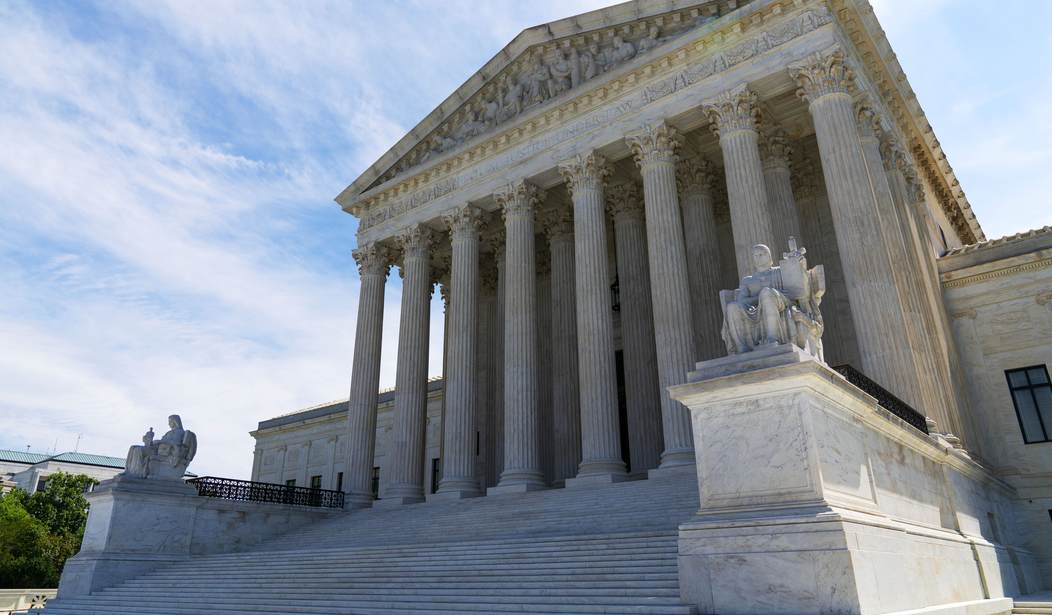
A social media platform is like a telegraph, Texas Solicitor General Aaron Nielson told the Supreme Court on Monday, defending his state's restrictions on content moderation by Facebook, X (formerly Twitter) and YouTube. Paul Clement, speaking on behalf of the tech trade group NetChoice, rejected that comparison, saying a social media platform is more like a newspaper.
Neither of those analogies is entirely satisfying. But Clement's has the advantage of recognizing that Facebook et al., unlike "dumb pipes" that simply transmit messages, unavoidably curate a vast amount of content, exercising the sort of editorial discretion that the Supreme Court has said is protected by the First Amendment.
Most of the justices seemed to recognize that point. In response to concerns that content moderation favors certain viewpoints over others, Chief Justice John Roberts noted that Florida, like Texas, decided the solution is "exercising the power of the state" over those decisions.
Florida Solicitor General Henry Whitaker, who was defending his state's social media law, had argued that it served "an important First Amendment interest" by "ensuring the free dissemination of ideas." But "since we're talking about the First Amendment," Roberts wondered "whether our first concern should be with the state regulating what we have called 'the modern public square.'"
The Florida law at issue in Moody v. NetChoice requires social media platforms to host speech by any "candidate for office," even when it flagrantly violates their content rules. The law also says Facebook et al. may not limit the visibility of material "by or about" a political candidate and may not "censor, deplatform, or shadow ban a journalistic enterprise based on the content of its publication or broadcast."
Recommended
The Texas law challenged in NetChoice v. Paxton is similar but in some ways broader, saying social media platforms may not "censor" speech based on "viewpoint." It defines censorship to include not just deletion of posts and banishment of users but also any steps that make user-generated content less visible, accessible or lucrative.
Public statements by Florida Gov. Ron DeSantis and Texas Gov. Greg Abbott made it clear that both laws were aimed at correcting a perceived bias against conservative speech. As they see it, Facebook et al. are using their influence to promote a progressive agenda.
Whitaker nevertheless insisted that content moderation decisions do not communicate any particular message. When platforms enforce their terms of service, he said, they are engaging in "conduct, not speech."
Yet that conduct, like the constitutionally protected decisions of newspapers and parade sponsors, reflects value judgments about which sorts of speech are beyond the pale, which is precisely why DeSantis and Abbott object to it. If platforms are legally barred from discriminating based on "content" or "viewpoint," they cannot exercise those judgments.
Even DeSantis and Abbott might not like the results. If the Texas law takes effect, Clement warned, his clients would be forced either to decree that users must avoid certain subjects altogether or to treat all viewpoints the same, no matter how abhorrent they might be to users and advertisers.
If platforms allowed pro-Jewish speech, for instance, they would have to give anti-Semitism equal prominence. They would be required to take a neutral stance regarding suicide prevention vs. suicide promotion, speech condemning terrorism vs. speech glorifying it, and posts encouraging vs. discouraging dangerous conduct such as bulimia and the "Tide Pod Challenge."
That is probably not a situation most users would welcome, which is why platforms established content rules to begin with. While people may reasonably object to the specifics of those rules or the way they are enforced, those complaints do not justify using state power to impose different policies.
Given the choices available to people who do not like a particular platform's rules, equating those rules with government censorship is "a category mistake," as Clement observed. Based on that mistake, politicians are perversely arguing that the First Amendment must be sacrificed in order to save it.




Join the conversation as a VIP Member