


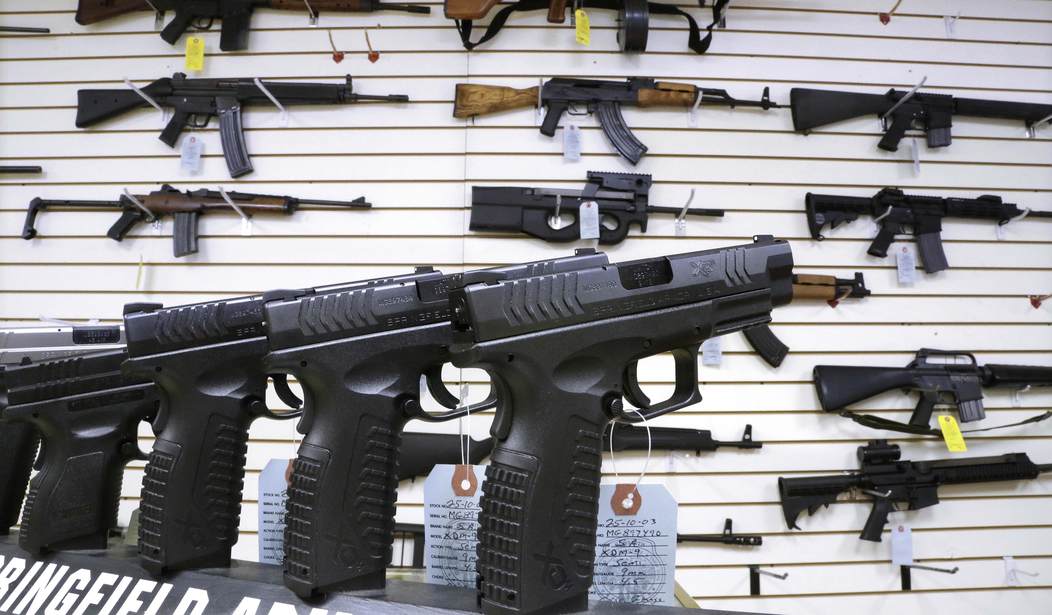
According to a landmark 2022 Supreme Court decision, the Second Amendment constrains the requirements that states may impose on residents who want to carry guns in public for self-defense. It stands to reason that the same is true of the steps that people must take to acquire guns in the first place.
That is essentially what the U.S. Court of Appeals for the 4th Circuit concluded last week, when it ruled that Maryland's handgun licensing system is inconsistent with the right to keep and bear arms. The case exemplifies a new front in constitutional challenges to gun control laws under the Second Amendment test that the Supreme Court established last year.
To pass that test, a law must be "consistent with this Nation's historical tradition of firearm regulation." But Maryland's law, which requires would-be handgun owners to complete a process that can take up to 30 days, bears little resemblance to regulations enacted in the 18th or 19th century.
Maryland is one of 14 states that require background checks for all firearm purchases, whether or not the seller is a federally licensed dealer. Since 2013, Maryland has imposed an additional requirement on handgun buyers: They must first obtain a "handgun qualification license," which entails completing at least four hours of firearm training and undergoing a seemingly redundant "investigation" aimed at screening out people who are legally disqualified from owning guns.
Maryland argued that its law fits a tradition of disarming "dangerous" individuals, such as people with felony records, illegal drug users and people convicted of domestic violence misdemeanors. But even assuming those categories of "prohibited persons" are validated by long-standing practice, 4th Circuit Judge Julius Richardson said, Maryland's statute goes further by "preemptively disarming every person until they can each prove that they are not dangerous," which "burdens a far broader swath of people."
Recommended
Writing in dissent, Judge Barbara Milano Keenan highlighted the Supreme Court's distinction between "may issue" laws like New York's, which required carry-permit applicants to demonstrate "proper cause," and "shall issue" laws, which make permits available to all applicants who meet "objective criteria." Maryland's licensing system for handgun buyers falls into the latter category, Keenan said, which suggests the Court would be inclined to uphold it.
While the Supreme Court did indicate that "shall issue" laws could be consistent with the Second Amendment, it also noted that "any permitting scheme can be put toward abusive ends." It therefore did not rule out "constitutional challenges to shall-issue regimes where, for example, lengthy wait times in processing license applications or exorbitant fees deny ordinary citizens their right to public carry."
Although it's not clear what counts as an unacceptably "lengthy" time to wait for permission to obtain a firearm, the 4th Circuit majority thought a month was too long. If so, the laws of other states that license gun buyers could be vulnerable.
To buy or possess a gun in Illinois, for example, you need a "firearm owner's identification card." Although the maximum processing time is supposed to be 30 days, the average was more than four months in late 2020, and it still exceeded the statutory limit in the first three quarters of this year.
In New York, where licenses are required to possess handguns or semi-automatic rifles, the minimum wait time is four months. The New York Police Department says processing takes "approximately six months," while Ontario County advises applicants that they should expect to wait "eight months to one year."
Notably, people have to jump through these hoops merely to legally possess guns on their own property. Getting permission to carry guns in public is a separate process that typically requires more time, effort and expense.
The Supreme Court has rejected outright bans on handguns and laws that give licensing officials discretion to decide who may publicly possess firearms. It eventually will have to deal with the question of how far states may go in requiring permission simply to own a gun.






Join the conversation as a VIP Member