



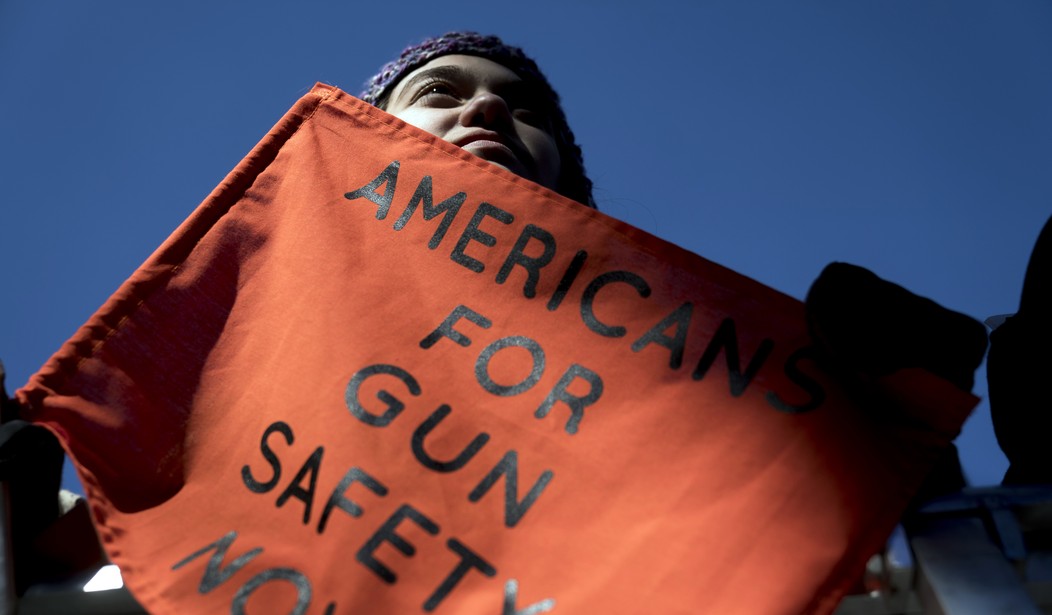
It is easy to understand the bipartisan appeal of a policy that promises to reduce gun violence by targeting dangerous individuals instead of imposing broad limits that affect millions of law-abiding Americans. So it's not surprising that the Senate gun control deal announced on Sunday includes federal grants aimed at encouraging states to pass and enforce "red flag" laws, which authorize courts to prohibit people from possessing firearms when they are deemed a threat to themselves or others.
However sensible that policy may seem, it suffers from two basic limitations that cannot be wished away by consensus-building rhetoric: Predicting violence is much harder than advocates of this approach are usually willing to admit, and trying to overcome that challenge by erring on the side of issuing red flag orders inevitably means that many innocent people will lose their Second Amendment rights, typically for a year and sometimes longer, even though they never would have used a gun to harm anyone.
The very concept of red flags assumes that experts can reliably distinguish between harmless oddballs and future murderers. But there is little basis for that assumption.
"The notion that we can identify mass killers before they act is, as yet, an epidemiologic fiction," psychiatrist Richard Friedman noted in a 2019 New York Times essay. "Experienced psychiatrists fare no better than a roll of the dice at predicting violence."
Even if certain "red flags" are common among mass shooters, almost none of the people who display those signs are bent on murderous violence. While "there may be pre-existing behavior markers that are specifiable," a 2012 Defense Department study noted, those markers "are of low specificity and thus carry the baggage of an unavoidable false alarm rate."
RAND Corporation researchers Rosanna Smart and Terry Schell made the same point in a 2021 essay. "Policies targeting individuals based on risk factors would result in an extremely high rate of false positives," they wrote. "Even the best available risk factors can identify only a subpopulation in which the risk of committing a mass shooting is on the order of one in a million."
Recommended

In the face of all this uncertainty, it is vitally important that red flag laws include robust safeguards to minimize "false positives." But the 19 states that have already passed such laws typically have weak due process protections, which means people can be stripped of their constitutional rights based on little more than unvalidated allegations.
Temporary red flag orders, which are issued without a hearing and sometimes without evidence that a threat is imminent, can last for weeks. For final orders, which usually last a year and can be renewed, some states require nothing more than showing that the respondent is more likely than not to pose an unspecified level of risk -- meaning that orders are issued even when the target is highly (SET ITAL)un(END ITAL)likely to hurt someone.
The red flag legislation that emerges from negotiations between Democrats and Republicans in the Senate could help rectify this situation by setting minimum standards for grant eligibility. The criteria should include prompt hearings, demanding standards of proof, a right to court-appointed counsel and time limits on orders.
Senators should not copy the approach that House Judiciary Committee Chairman Jerrold Nadler (D-N.Y.) took in 2019, when he sponsored a bill that seemed to have been crafted so that every jurisdiction with a red flag law could qualify for grants. That would have lowered the bar to the level of the jurisdictions with the weakest due process protections.
The senators who are working on a red flag bill say they want states to "create and administer laws that help ensure deadly weapons are kept out of the hands of individuals whom a court has determined to be a significant danger to themselves or others, consistent with state and federal due process and constitutional protections." The details of their legislation will tell us whether they are serious about that last part.







Join the conversation as a VIP Member