


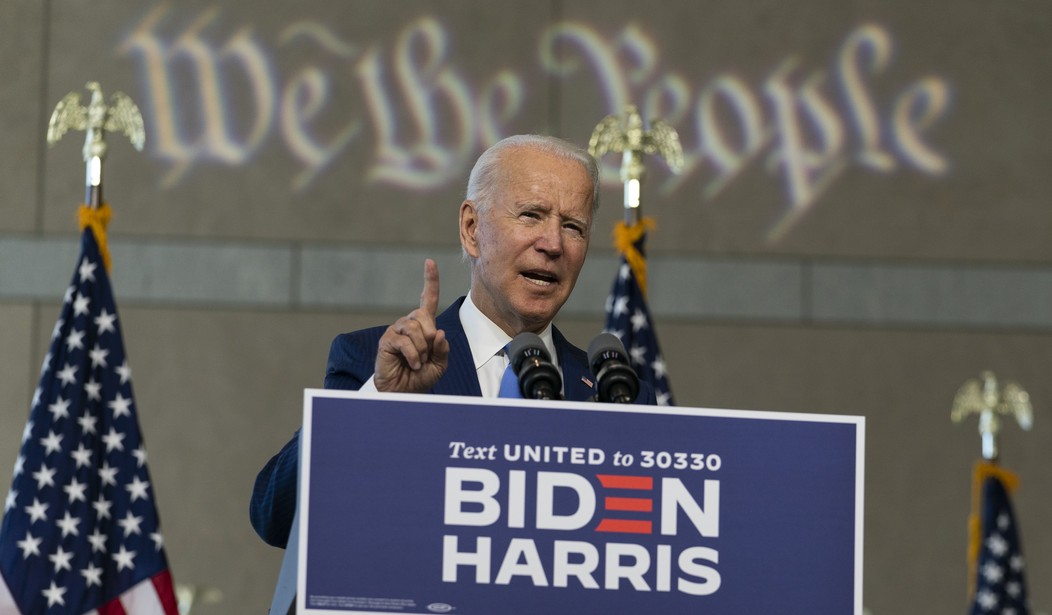
Judging from their grandstanding during Amy Coney Barrett's confirmation hearing, Democrats think the composition of the Supreme Court is a big issue in next month's presidential election. Yet, evidently, it is not big enough for their candidate to tell voters whether he favors expanding the Court to accommodate his policy preferences.
"You'll know my opinion of court packing when the election is over," Joe Biden told reporters last week. His unwillingness to discuss the issue should alarm anyone who values judicial independence as a bulwark against the abuse of power, regardless of which party happens to be wielding it.
Biden himself explained the threat posed by court packing as a senator in 1983. "It was a bonehead idea," he said, referring to Franklin D. Roosevelt's 1937 plan to make the Supreme Court more receptive to his New Deal agenda through legislation that would have authorized him to appoint up to six additional justices.
That plan "violated no law," Biden noted. Still, "it was a terrible, terrible mistake to make, and it put in question for an entire decade the independence of...the Supreme Court."
Last year, Biden was still opposed to FDR-style bullying. "I'm not prepared to go on and try to pack the Court, because we'll live to rue the day," he told Iowa Starting Line in July 2019.
Biden was equally firm during a Democratic presidential debate three months later. "I would not get into court packing," he said. "We begin to lose any credibility the Court has at all." As recently as January, Biden told The New York Times he had no judicial reform plans.
But as court packing gained favor among Democrats outraged by Senate Republicans' decision to keep Antonin Scalia's seat open for Neil Gorsuch and their swift action to replace Ruth Bader Ginsburg, Biden was suddenly silent. He conspicuously refused to rule out court packing during his debate with President Donald Trump last month, and so did his running mate, Kamala Harris, during her debate with Vice President Mike Pence last week.
Recommended
It's not as if Democratic anger at Republicans' hardball tactics makes the lessons of FDR's failed bid to expand the Court less salient. Roosevelt's plan was never popular with voters, and it provoked intense opposition from Democrats, who controlled the House and Senate, as well as Republicans.
House Judiciary Committee Chairman Hatton Sumners refused to back the president's bill. Roosevelt's own vice president, John Nance Garner, was against it.
The Senate Judiciary Committee issued an adverse report on FDR's plan that said it "does not accomplish any one of the objectives for which it was originally offered" and "violates all precedents in the history of our government." The committee called the bill "a dangerous precedent" that "would undermine the independence of the courts," violate "the spirit of the American Constitution," subvert "the rights of individuals," and weaken "the protection our constitutional system gives to minorities."
FDR eventually reshaped the Supreme Court in the usual way, filling eight vacant seats. But he paid a huge political cost by trying to jump the gun.
"When the dust settled, FDR had suffered a humiliating political defeat," notes historian Michael Parrish. "The protracted legislative battle over the Court-packing bill blunted the momentum for additional reforms, divided the New Deal coalition, squandered the political advantage Roosevelt had gained in the 1936 elections, and gave fresh ammunition to those who accused him of dictatorship, tyranny, and fascism."
Biden is candid about the reason for his reticence about emulating FDR. "It's a great question," he conceded last week, "and I don't blame you for asking it. But you know, the moment I answer that question, the headline in every one of your papers will be about that (instead of) focusing on what's happening now."
What's happening now, of course, is a decision about whether to replace Trump with Biden. Voters deserve to know whether Biden now thinks FDR's "bonehead idea" was pretty smart after all.
Jacob Sullum is a senior editor at Reason magazine. Follow him on Twitter: @JacobSullum. To find out more about Jacob Sullum and read features by other Creators Syndicate writers and cartoonists, visit the Creators Syndicate webpage at www.creators.com.






Join the conversation as a VIP Member