


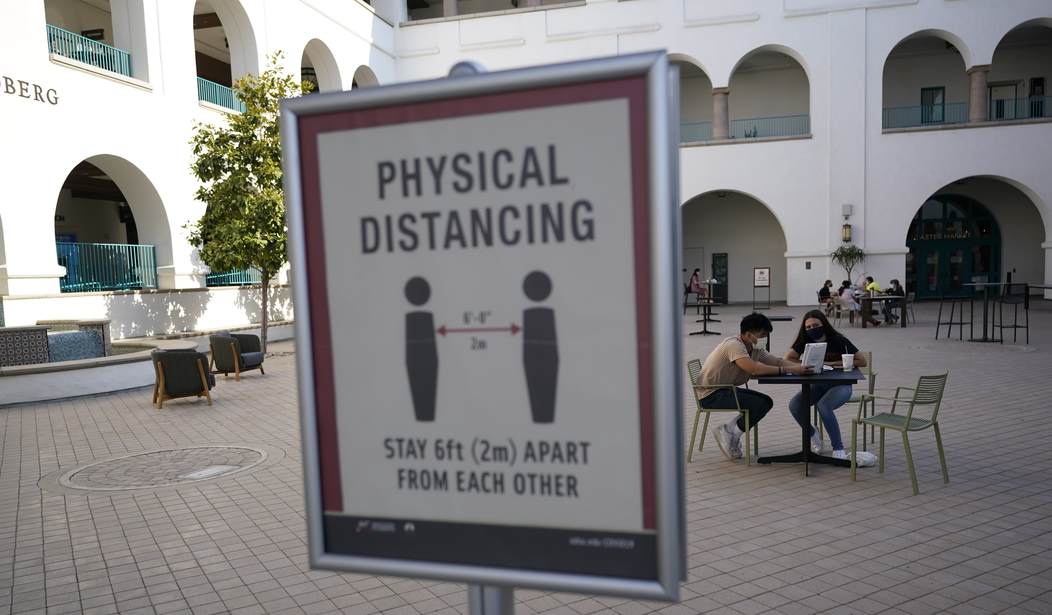
As recently as early March, I was saying it "seems unlikely" that the United States would respond to the COVID-19 pandemic with lockdowns similar to Italy's. While we all know what has happened since then, two recent court decisions underline the unprecedented and legally untested nature of the sweeping social and economic restrictions that all but a few states imposed this year.
Last Friday, the Michigan Supreme Court ruled that a law Gov. Gretchen Whitmer used to shutter businesses and confine people to their homes except for Whitmer-approved purposes improperly delegated legislative functions to the executive branch. And last month, a federal judge in Pennsylvania said that state's lockdown violated the right of assembly guaranteed by the First Amendment, along with the 14th Amendment's guarantees of due process and equal protection.
Both decisions uphold a principle that politicians across the country seemed to forget while they rushed to curtail the epidemic last spring. As U.S. District Judge William Stickman put it in the Pennsylvania case, "the Constitution sets certain lines that may not be crossed, even in an emergency."
In the Michigan case, the relevant line was the distinction between writing the law and enforcing it. During a "public emergency," a state law enacted in 1945 says, "the governor may promulgate reasonable orders, rules, and regulations as he or she considers necessary to protect life and property or to bring the emergency situation within the affected area under control."
As illustrated by Whitmer's orders, which dictated when 10 million people could leave their homes, where they could go, what they could do, and whether they could earn a living, the power purportedly granted by that law is vast. It lasts indefinitely, and it is constrained only by the requirement that the governor's edicts be "reasonable" and seem "necessary" -- to her.
Recommended
In the Michigan Supreme Court's view, those two words are tiny fig leaves that cannot disguise the naked transfer of the legislature's plenary police powers to a single executive-branch official. "The sheer magnitude of the authority in dispute, as well as its concentration in a single individual, simply cannot be sustained within our constitutional system of separated powers," the justices concluded.
The powers claimed by Pennsylvania Gov. Tom Wolf were similarly broad, and Judge Stickman found that he had exercised them in a "shockingly arbitrary" way. While Wolf's reopening plan allowed people to congregate for commercial purposes, for instance, it banned political gatherings, including campaign events as well as protests in which the governor himself has nevertheless participated.
Even if those restrictions are treated as content-neutral "time, place, and manner" rules, Stickman concluded, they cannot be reconciled with the First Amendment, which requires that such policies be "narrowly tailored to serve a significant government interest." Wolf's orders perversely treated gatherings protected by the First Amendment as less important than quotidian activities such as shopping and dining.
When Wolf decided which businesses could operate during his lockdown, he likewise drew puzzling distinctions with no obvious relationship to the risk of virus transmission. Small businesses were forbidden to sell hair products, furniture and appliances, for example, while big-box retailers, because they were deemed "life-sustaining," continued to offer the very same items -- a decree that shifted transactions from one place to another without stopping people from visiting stores to buy stuff.
Such capricious dictates, Stickman concluded, cannot pass muster even under the highly deferential "rational basis" test, which applies to economic regulations and to equal protection claims that do not involve "suspect" categories such as race and religion. "Distinctions cannot be arbitrary or irrational and pass scrutiny," he noted.
While the country has faced "many epidemics and pandemics," Stickman emphasized, "there have never previously been lockdowns of entire populations," which he called "such a dramatic inversion of the concept of liberty in a free society as to be nearly presumptively unconstitutional." His decision, like the Michigan Supreme Court's, is an overdue rebuke to politicians who think such emergencies make constitutional constraints irrelevant.
Jacob Sullum is a senior editor at Reason magazine. Follow him on Twitter: @JacobSullum.





Join the conversation as a VIP Member